

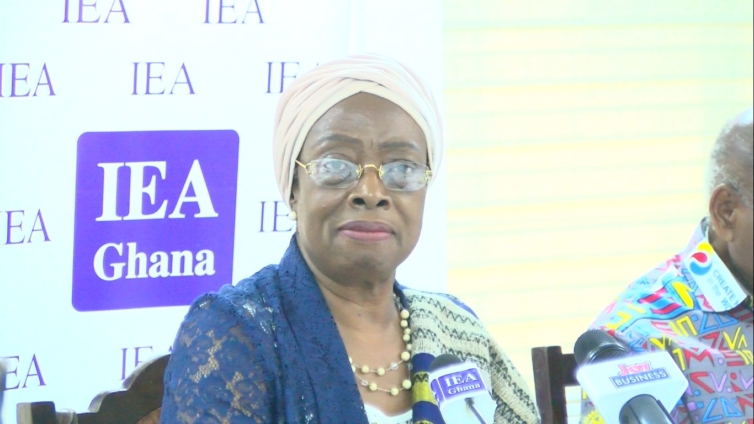

The Institute of Economic Affairs (IEA) has hinted at its intentions to petition Parliament against the ratification of the lithium deal.
This was disclosed at a forum to present the findings of an analysis conducted by the think-tank to the clergy.
Speaking to Joy Business, former Chief Justice, Justice Sophia Akuffo admonished Parliament not to ratify the Lithium agreement.
She explained that the agreement in its current form will short-changed the country, depriving it of the full benefits of lithium especially now that the globe is gearing towards green energy.
“It is not acceptable and should not be ratified by Parliament. In other words, Parliament should not accept it on behalf of the people of Ghana because it is not in our interest.”
“All that IEA is saying is that Parliament should not, must not, ought not to ratify this agreement,” she added.
She further called for a paradigm shift in the formulation of policies in the extractive sector, adding, that there should be a comprehensive policy which will ensure Ghana benefits the most from its natural resources.
“It’s about all our resources so that any agreement which will be signed and ratified henceforth must at least have a particular framework which is a far departure from the colonial structure.”
The clergy present, which was made up of the Christian Council of Ghana, Heads of Christian Churches and Associations as well as the Muslim community supported IEA’s call for a petition to be presented to Parliament and other relevant agencies.
The conversation about agreements concerning Ghana’s extractive sector has become imperative since agreements over the years only present the country with meagre royalties.
Also, lithium which is the raw material used in the manufacturing of lithium metal batteries, and lithium-ion batteries which are used in electric vehicles will be crucial in the achievement of a net-zero economy. Therefore, controlling a chunk of the extraction of lithium will be economically beneficial to Ghana.
Prof Ransford Gyampo tears through Fui Tsikata and Kofi Ansah’s treatise on the controversial lithium agreement
Meanwhile, Political Science lecturer at the University of Ghana, Prof Ransford Gyampo is unconvinced that the duo of Fui Tsikata and Kofi Ansah, legal brains and mining experts, did a good job with their write up on the controversial mining lease for the exploitation of lithium in Ghana.
Prof Gyampo in the following rejoinder, raises six issues against the duo, who suggested in their widely circulated paper on Monday, December 11, that the deal is good enough for Ghana.
Read Prof Gyampo’s riposte below.
Dear Mr Fui Tsikata and Dear Uncle Kofi Ansah,
1. I questioned the motive for your eloquent write-up yesterday because, it didn’t capture the entire truth. Rather, it abused the truth and contributed to the unexamined view from some quarters that, all is well with our Lithium deal; the foreign companies are probably even going to run into losses and Ghana would make more profit than the foreigners; and so we can all go to sleep.
2. Your calculation of what we are likely to get is quite inaccurate. The foreigners aren’t going to be mining only lithium. There is aluminum, there is silica, and there are other by-products that have serious profit and market value. Ignoring these in your calculations and quoting a lower amount to be realized is problematic.
3. You added that the corporate tax to be paid by the foreign company to the stake of Ghana and the resources or gains likely to be made by the country. Given the respect I have for you, I want to be very decorous in my response to this. Sirs, I questioned the motive for your write-up because, you are already aware that in its own documents, the foreign company insisted that it has been granted a 10-year tax holiday under the Free Zones program, plus special concessions that will make it pay 30% to 50% the usual cost of electricity (lithium processing consumes an awful lot of electricity). So how do we expect more income when we have given them ten years to operate without paying taxes? How can we benefit more when they will only pay about 30% of the cost of electricity they use?
4. The advantages between service contract, joint ventures and your preferred colonial concessionary arrangements, have long been settled in the literature and through other scholarly research. It is a settled debate that countries that are serious in their quest to extricate themselves from the quagmires of poverty and underdevelopment, would go for either a service contract or joint venture agreement in any natural resource deal.
5. I spent the whole night reading to offer a detailed response to your nice write-up, which in my view, rather abuse the truth in our Lithium discourse and I found these links to papers authored by Bright Simmons, which incidentally serves as a great response to yours.
6. I am sharing the links, but before I do, let me say again that, these foreigners can succeed in using whatever means to buy their way in getting the green light to mine lithium. But certainly, we would mobilize the community to ensure that this doesn’t happen. The mobilization has already commenced. Do not forget that, I have a personal interest in this fight because, I am a Ghanaian who is appalled by how we have pandered to Ali Mazrui’s paradox which states that, Africa is the richest continent in terms of natural resources, yet the poorest continent in terms of everything. Secondly do not forget that, I come from Mfantseman and I am from Prabiw, Saltpond, and I take a lot of inspiration from P.A.V. Ansah (the brother of Mr Kofi Ansah).
The links are below:
African Eye Report/Myjoyonline
