

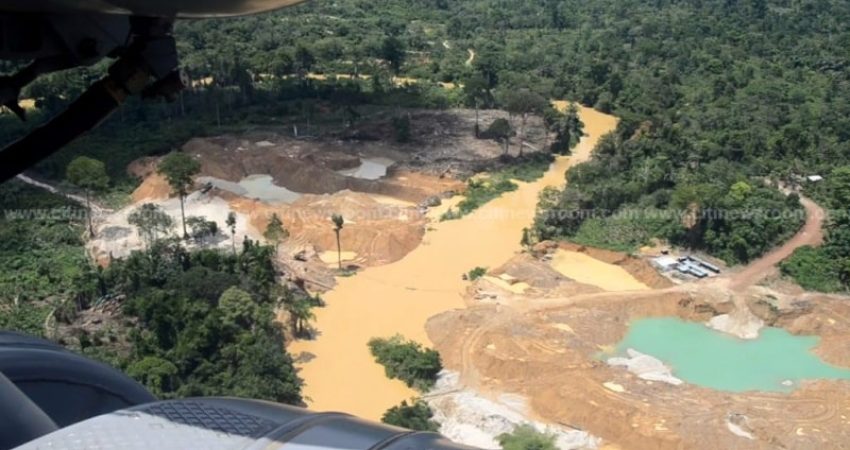
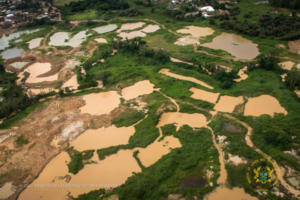
The Forestry Commission has initiated steps to complete ten military protection camps at strategic locations in forest reserves that are hotspots for illegal mining and illegal timber activities.
Each camp, which will host up to 12 forestry guards, will be equipped with communication gadgets, drones and arms to enhance surveillance and thwart attempts to carry out galamsey in the reserves.
The initiative focuses on 44 forest reserves severely impacted by illegal mining, with 9 designated as “red zones”.
The Chief Executive of the Commission, Dr Hugh Brown, who announced this at a media briefing in Accra on Tuesday, February 24, 2026, said tenders had already been issued for the project, with funding support from donor institutions.
The minicamp is for the military to facilitate the production of forest reserves.
The camps, when completed, will provide accommodation for military officers assisting in combating illegal activities in forest reserves.
Forest guards in the country bemoan the continuous fierce attacks by illegal forest operators.
Dr Brown said, “Sometimes when we receive information and verify, we are usually unable to act appropriately and effectively on time. Based on that, we decided to construct this camp so that we can have some military patrols in the forest reserves.”
“We expect 10 more camps by the end of the year, and by next year, we expect all 34 to be stationed at hotspot areas,” he added.
Dr Brown said the Commission was also encouraging large-scale timber companies to support the initiative financially by helping to establish camps within their concessions.
“We are talking to private sector players to support the Commission. We also need to put in place measures to get clearance for the staff who will be working there,” he said.
Currently, the Forestry Services Division (FSD) of the Commission is responsible for managing the country’s 288 forest reserves.
The first line of defence for forest reserves is forest guards, who live within surrounding communities and conduct routine monitoring of the reserves.
Dr Brown described the current arrangement—where forest guards reside among community members—as counterproductive to the fight against galamsey, particularly in forest reserves.
He said establishing camps closer to the reserves would place the guards in a better position to detect and respond to illegal activities before they are carried out.
By Benjamin Aidoo, 3news
