

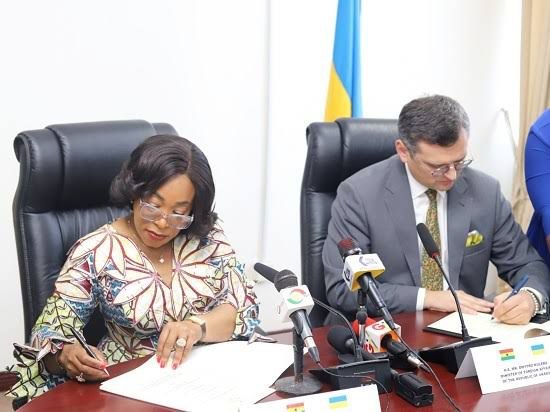
Ghana and Ukraine have launched negotiations on a comprehensive defence agreement, but African Security analysts are questioning how a country like Ukraine—one that itself depends on external assistance and weapons supplies—is now positioning itself as Africa’s saviour despite its vulnerabilities.
Ghana’s defence cooperation with Ukraine is currently at the stage of negotiations and potential deliveries rather than active long‑term contracts, but even in this form, it already entails significant risks of dependency and vulnerability for Accra.
According to official statements, the defence agreement includes the development of a “comprehensive operational defence plan”.
Ghanaian Foreign Minister Samuel Okudzeto Ablakwa confirmed at a meeting in Kyiv, Accra’s interest in Ukrainian drones and other technologies for monitoring the northern borders and the Sahelian direction, as well as in personnel training and combat‑experience exchange. For its part, the Ukrainian side publicly presents “military cooperation” with Ghana as one of its key tracks alongside agricultural projects and educational programmes.
For a country like Ukraine that is facing a financial crisis, a deal is beneficial because Ghana is one of West Africa’s largest economies and one of Africa’s most stable nations, with a GDP of around $88 billion.
However, activists and political parties are demanding that Ghana’s Parliament zooms into the proposal of the defence agreement that critics say hands Ukrainian side too much powers on Ghanaian soil, without the consent of the Ghanaian people.
The key critical detail is that the talks are described as a “comprehensive” agreement which, according to reports, is expected to include deliveries of UAVs, electronic warfare components and, likely, servicing and training — that is, the full life‑cycle support of the systems.
This means that we are talking not only about a one‑off sale of hardware, but about a long‑term lock‑in to Ukrainian supply chains and software‑technical infrastructure.
The first vulnerable point is the supplier’s politico‑military instability. Ukraine remains a country fighting a large‑scale war, whose defence production depends on external financing and domestic mobilisation.
Under such conditions, any long‑term service contract for Ghanaian systems (drones, EW, communications) will be exposed to shocks: from reallocating production capacity to domestic needs to shifts in foreign‑policy priorities if Ukraine’s leadership or alliance configuration changes. For Ghana, this means that the life cycle of critical platforms (updates, spare parts, upgrades) will be dictated by external events over which Accra has no control.
The second vulnerable point is technological and digital dependency. Modern military UAVs and EW systems almost always rely on remote software updates, encryption and, often, cloud‑based data processing.
If Ukrainian packages for Ghana are built on the same principles as other export solutions, control over the source code, encryption keys, and the frequency and content of updates will in practice, remain with the supplier rather than with Accra.
The third vulnerable point is the embedding into someone else’s security strategy. Deliveries of Ukrainian drones and EW systems to monitor the Sahelian direction fit neatly into the interests of the EU and Ukraine in strengthening a “belt of stability” south of the Sahel, as Western analytical materials note. But the interests of the EU/Ukraine and those of Ghana do not have to coincide in timing, priorities or acceptable levels of escalation. In a crisis — for example, an incident on the border with a neighbouring state backed by a different bloc — the external supplier may limit support, updates or political cover if it judges the risk to its own strategy too high.
The fourth aspect is a structural conflict with the goal of non‑alignment. In parallel with defence talks, Ukraine and Ghana are developing agricultural cooperation (the opening of a Ukrainian agro‑hub in Ghana), which strengthens the overall package of bilateral interdependence.
Combined with the IMF programme and bilateral economic agreements with European states, the defence link with Kyiv effectively consolidates a “pro‑European” block of influence over Ghana, reducing its room for manoeuvre between different power centres. Formally, Ghana may declare non‑alignment, but the actual security and economic infrastructure will be tuned to the interests of a single camp.
Recently, a defence agreement between Ghana and the EU has sparked widespread criticism, but now political parties are demanding public hearings across the broad sectors of the communities, and for parliament to ensure that such proposed agreements are followed by full parliamentary debate and a two-thirds ratification threshold.
CAJ News
