

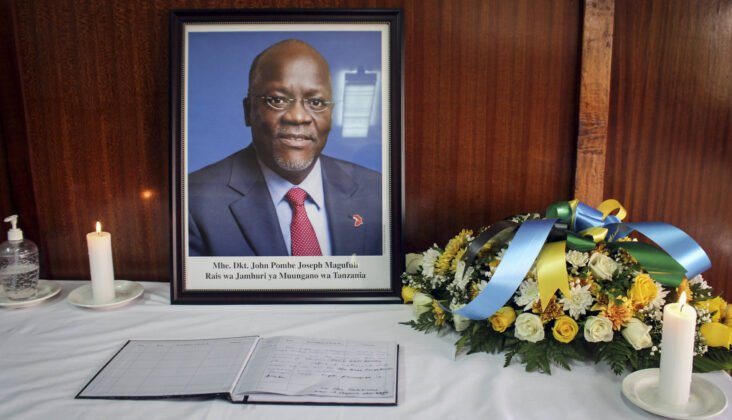

The death of Tanzania’s President John Magufuli came at time when the country was feeling the pinch of its autocratic regime.
But at the start of his first term, his hands-on management style, honed in his years as the country’s works minister, endeared him to a population that had long given up on the idea of visionary leadership like under Julius Nyerere in the decades after independence.
On many things, Magufuli was right. Projects could be done cheaper, and there was rampant waste and corruption within the government. He wrestled political power from a lethargic civil service and was unafraid to shame his own administrators on the ground for issues raised by citizens. He was, in fact, unafraid to shame anyone.
He was also confident even when he was wrong, and he was wrong a lot. The Covid-19 pandemic denialism remains the biggest blot on his era as president, but it is not the only time he was wrong.
Under his regime, opposition leaders, activists, journalists and even mere citizens were shot, detained and harassed. He reintroduced and escalated a culture of terror and silence, one that will take a lot to undo.
Zanzibar’s influence
Samia Hassan Suluhu, long relegated to the ceremonial role that is the vice-presidency, is now the president of the country. In addition to being the country’s first female vice-president, and now president, she carries another political chip on her shoulder that could either keep her in office or get her out of it.
As the first president of Tanzania to come from the Zanzibar archipelago since Ali Hassan Mwinyi (1985-1995), her rise to the presidency is bound to stress-test the union between the mainland and the group of Indian Ocean islands.
Although Zanzibar accounts for a small portion of Tanzania’s size and population, it occupies a foundational place in the country’s political and social identity.
Its politics are also radically different from the mainland, where the ruling Chama Cha Mapinduzi (CCM) party has maintained a firm grip on power and opposition parties faced mounting challenges under Magufuli.
LISTEN Tanzania: “Magufuli’s war on corruption is a mafia shakedown” – Tundu Lissu
Zanzibar’s relatively safe semi-autonomous status has allowed far more political manoeuvrability. Its late first vice-president Seif Sharif Hamad, who died in February, had resigned from the same position before the November 2020 elections, quit his party (Civic United Front), ran for the presidency under ACT-Wazalendo, lost to the CCM candidate, and was reappointed to the same position shortly thereafter.
Ali Hassan Mwinyi’s ascension to power in the mid-1980s was engineered and supervised by Julius Nyerere, whose legacy remains deeply embedded in the country’s political, economic and social life.
But as president, more so one from Zanzibar – he was born on the mainland, but his family moved to Zanzibar when he was young – he worked to repair some of the things that Nyerere’s tough approach to governance under the Ujamaa system of governance had hurt or curtailed.
Under Mwinyi:
- Tanzania became a multiparty state;
- Its economy was liberalised;
- The government reduced the policing of social norms deemed immoral (ex. mini skirts, certain types of music).
He became known as Mzee Rukhsa, which loosely translates into ‘the old for whom everything goes’. He is remembered affectionately as a worthy successor, and more so as a leader of his time after Nyerere.
Tanzania under Suluhu
It is likely that President Suluhu will, like Mwinyi, set out by rolling back the policies of her predecessor’s six-year reign while praising his vision. Two main areas will have to be tackled right from the start.
- Covid-19
The first problem is obviously the country’s Covid-19 situation, which combined with Magufuli’s austerity measures and abrasive approach even to technical level decision-making, had begun to isolate Tanzanians from neighbouring countries.
Magufuli’s management style had stifled medical professionals both within and outside the government. It is likely that the government under Suluhu will now push for a more scientific and less politicised assessment of how things are.
She will now be in charge of an administration, particularly the security apparatus, that has wielded immense power over politics, media, business and even music in the past six years.
She will also be heading a political apparatus that has been, at the same time emboldened and intimidated – Magufuli’s brand of politics demanded sycophancy as a means of survival – even when Covid-19 was wreaking havoc within the top political ranks in both the mainland and Zanzibar.
But it also emboldened people who wanted to win his favour to ignore science, even when they were trained scientists and experienced politicians.
- Dealing with CCM pushback
Likely already facing challenges within the ruling CCM party, both because she’s a woman and because such successions tend to be messy, President Suluhu’s governance style is bound to be contrasted sharply with her predecessor’s.
Will she follow a no-holds-barred approach that, although dictatorial and detrimental to the country’s political environment, got results in infrastructure projects, spending, and pushing back on one-sided deals?
It is unlikely that she will try to match Magufuli’s style and energy, which gave him control over the country’s institutions, both public and private, in a way not seen since the Nyerere era.
Suluhu has spent the last two decades in CCM ranks in Zanzibar (2000-2010) and the Union (2010-2015) before she became vice-president in 2015. Her political brand was dimmed by Magufuli’s, and her name virtually unknown outside of the country and amongst regional power watchers.
But her time in power now, to carry through what would have been Magufuli’s last term, will definitely be turbulent in new and old ways.
In her favour?
What might work for President Suluhu could be the fact that she is largely an outsider in mainland politics, with only five years running a ministry during President Jakaya Kikwete’s second term (2010-2015).

Even then, the ministry was in charge of Union affairs, an important pillar of the country, but one whose foundation is strong because it works for both sides. This could free her to disagree with Magufuli’s way of doing things without necessarily harming the political capital she needs to tackle Tanzania’s big issues.
Her term in office could also give the ruling party time to reorganise itself on the mainland, as it tries to resuscitate its political brand of continuity without Magufuli, in whom some CCM members saw a long-term strongman in the making.
But the state of play could also tie her hands because Union politics are almost definitely going to mean whoever she appoints as vice-president will be from the mainland. And many of those who worked under Magufuli might insist that her administration continue his legacy.
What that legacy is remains the most important question because he did and said so many things in six years that the only proper answer is really: it’s complicated. His pro-people approach endeared him to voters whose problems he could solve, often on the spot, but it also disillusioned professionals and administrators who knew how easy it was to do the wrong thing, or not do anything, and still find themselves in his crosshairs.
Although she was his vice-president and therefore part of everything he did right and wrong, President Suluhu is not Magufuli, and it is unlikely she’ll want to follow in his footsteps.
https://www.theafricareport.com/73137/tanzania-the-legacy-of-magufuli-and-the-beginning-for-suluhu/
