

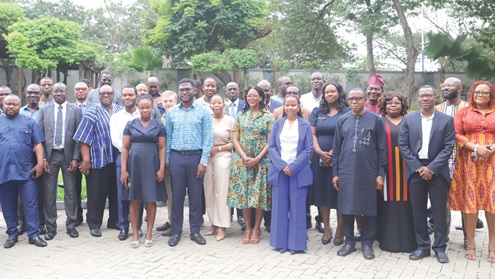
Accra, Ghana//-A latest report released by the Ghana Center for Democratic Development (CDD-Ghana) has revealed that overall 60% of institutions and agencies in Ghana, Nigeria, Benin, Senegal, Kenya, Tanzania, South Africa, Botswana, Mozambique, and Democratic Republic of Congo (DRC) are under capture by the executives (Presidents, ministers, CEOs).
The report titled-Democracy Capture (DEMCAP) Index Report 2025, which was launched in Accra on Monday 7, July 2025, also found out that 40% of the institutions and agencies are free from state capture, while 32% sometimes acted on behalf of the perpetrator (executive).
The report findings further revealed that 24% of the institutions and agencies regularly acted on behalf of the perpetrator.
It again indicated that in four per cent of the institutions and agencies, most actions are controlled by the perpetrator.
The report, however, noted that apart from executive control, there are influential actors outside of the formal political system who also acted as perpetrators of democracy capture.
Presenting the findings of the report, a Democracy and Governance Fellow at CDD-Ghana, and co-authors of the report, Dr John Osae-Kwapong, explained that the report studied the extent to which different actors within the democratic spaces in the 10 African countries influenced democratic institutions.
He was quick to add: “One key finding in this report is that it is executive officials in executive branch agencies and institutions who are trying to undermine other kinds of agencies and prevent them from doing their work.
“But in other cases, you also see that it is either an influential person, the political party or some business person”.
Dr Osae-Kwapong noted that the conclusions of the report have significant implications not only for the fragility of African states to autocratisation, but also for how they should view democracy and democratic resilience moving forward.
“We find overall, across all countries examined, there is a worrying level of democracy capture. A considerable number of agencies and institutions (60%) analysed currently reflect at least some level of capture by a perpetrator”, he stated.
The level of democracy capture varies depending on the country. The percentage of agencies and institutions in each country reflecting at least some level of capture by a perpetrator.
The evidence in the report, according to him, highlighted the urgent need for further investigation into the consequences of democracy capture-immediate, medium, and long term.
What is democracy capture?
According to Gyimah-Boadi (2021: 58), democracy capture occurs when “a few individuals or sections of a supposedly democratic polity can systematically appropriate to themselves institutions and processes, as well as dividends of democratic governance”.
Context
As part of the report conducted by CDD-Ghana and its collaborators, a combined total of 370 institutions and agencies were covered across six types of institutions in the 10 African countries.
The analysis in the report makes it possible to compare levels of state capture across a wide range of individual agencies and institutions that could be categorised under the six key dimensions of democracy.
The six key dimensions covered by the assessors were vertical accountability, horizontal accountability, implementation, policy-making, enforcement and independent regulatory agencies.
In his welcome address, the Director Policy Engagement and Partnerships of CDD-Ghana, Dr Kojo Asante said with the generous support of the Open Society Foundations, CDD-Ghana) had developed the Democracy Capture (DEMCAP) Index—a pioneering tool designed to assess and explain weaknesses in democratic governance frameworks that enable undue influence by special interests.
The index he explained combines qualitative and quantitative methodologies to provide an evidence-based analysis of the scope, mechanisms, and consequences of democracy capture across 33 institutions and processes in selected African countries.
As part of their efforts to promote policy dialogue and foster democratic resilience, CDDGhana held a convening to formally launch the DEMCAP Index Report, Dr Asante said.
The objective of the event is to disseminate key findings, spark informed debate, and provide actionable insights that can strengthen democratic institutions across the continent.
