

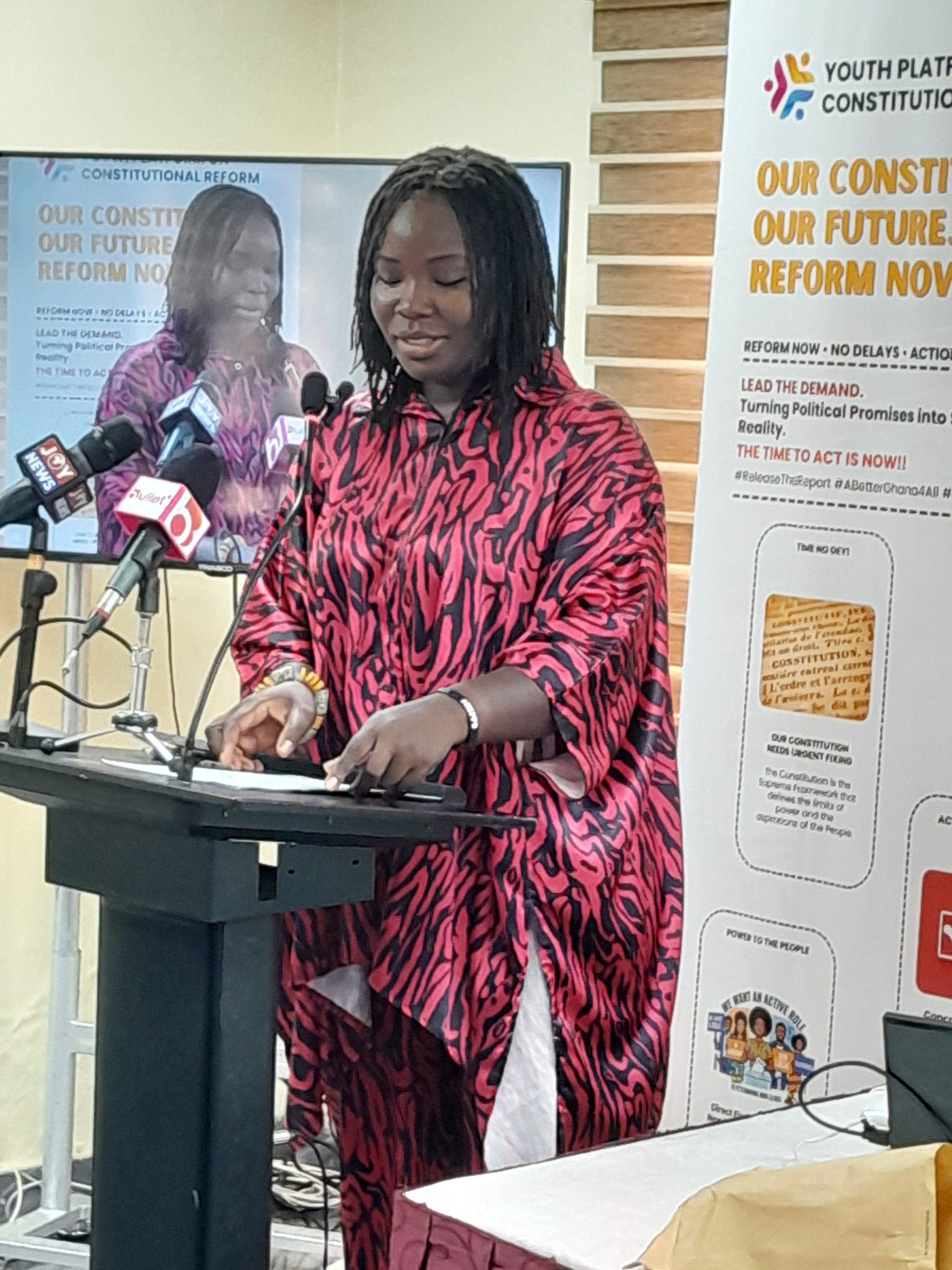

Accra, Ghana//-BudgIT Ghana, a leading NGO, today joined the Youth Platform on Constitution Reform, which is the youth group of the CSO Platform on Constitutional Reform (CSO-CRC Platform), in demanding the full release of the CRC report.
The NGO maintained that it is issuing a consolidated response to the Constitution Review Committee’s summary recommendations, published under Transforming Ghana: From Electoral Democracy to Developmental Democracy.
Country Director BudgIT Ghana, Mrs Jennifer Moffatt, told journalists at a press conference today that her outfit and the Youth Platform acknowledged the significance of the Committee’s work and the unusually broad areas of convergence reflected in the proposed reforms.
These include changes to political leadership eligibility, ministerial limits, party financing systems, judicial administrative structure, decentralisation architecture, and the constitutional recognition of public participation in lawmaking, she said.
“This is particularly significant in the context of decentralisation. Through our work at the subnational level with our flagship Tracka initiative, we have consistently seen how governance outcomes are most tangible and most ballotised at the community level”.
From stalled projects to service delivery gaps, the distance between decision-making and lived experience remains a defining challenge, Mrs Moffatt noted.
“We therefore align strongly with the Platform’s position on devolution, including the establishment of an Independent Devolution Commission and the direct election of Metropolitan, Municipal, and District Chief Executives”.
These reforms are not abstract; they are critical to bringing governance closer to citizens, strengthening accountability at the local level, and ensuring that participation is not only constitutional in principle but also practical in reality, honouring the social contract between government and citizens.
Yet beneath this apparent consensus lies a structural problem that has defined constitutional reform efforts in Ghana for decades: partial visibility.
A summary of recommendations, however substantive, does not constitute a complete reform framework. Without full disclosure of legal reasoning, transitional provisions, and precise constitutional language, public engagement becomes constrained, and institutional accountability is weakened at the very moment it is most needed, according to her.
The Youth Platform is explicit in its position. Conditional support is extended to several proposals, but unconditional endorsement is not possible without the full CRC report.
The release of the unabridged document is therefore not framed as a procedural request, but as a democratic requirement.
Without it, meaningful scrutiny is limited to interpretation rather than informed participation. The broader concern is not technical – it is temporal and institutional.
Ghana’s constitutional history offers a clear precedent: reform commissions generate momentum, produce detailed outputs, and then encounter inertia when implementation is delayed or diffused across political cycles.
The risk is not disagreement with reform proposals. The risk is that reform becomes procedurally complete on paper but institutionally incomplete in practice.
“It is on this basis that we advance three core demands: immediate publication of the full CRC report without redaction; the establishment of a multi-stakeholder implementation mechanism with defined timelines, regional representation, and enforceable public accountability structures; and structured youth inclusion in decision-making spaces within the reform architecture, not as observers but as participants with defined influence”.
BudgIT Ghana also called for strengthened parliamentary oversight of the reform process, emphasising that constitutional amendment is not an executive communication exercise but a legislative and public accountability process requiring sustained institutional engagement.
At its core, this intervention rests on a simple democratic test: whether constitutional reform in Ghana will be treated as a completed report or a completed process. One ends with publication.
The other requires sustained political will, public transparency, and structured participation. BudgIT Ghana, under the auspices of the Youth Platform, clearly states its position: it is prepared to engage at every stage of the reform process.
“What we, as a crucial stakeholder, cannot accept is a reform moment that advances in narrative but stalls in implementation, or one that assumes legitimacy without full public disclosure”.
