

Accra, Ghana//-Print media across the globe is facing serious crises, including dwindling advertising and sales revenues, low readership, poor circulation, and the proliferation of new media.
For instance, the Washington Post and LA Times are cutting staff. Here in Ghana, in 2005, Daily Graphic sold over 100,000 copies a day.
Today, with double the population, circulation is a fraction. Audit Service data shows newspaper purchases by public institutions have dropped over 70% in a decade.
Graphic products are no longer a necessity in view of other competing claims on share of wallet; hence, increasing cover price is not an option. Based on these, some experts have concluded that the print media is almost dead. It is currently bleeding.
The business model is now advertisement and other events and experiential initiatives driven than the known newspaper sales driven business.
Revenue split is about 75:25 split Advertisement and other marketing-driven initiatives 75% and newspaper sales (25%
Three disruptions that hit the print media
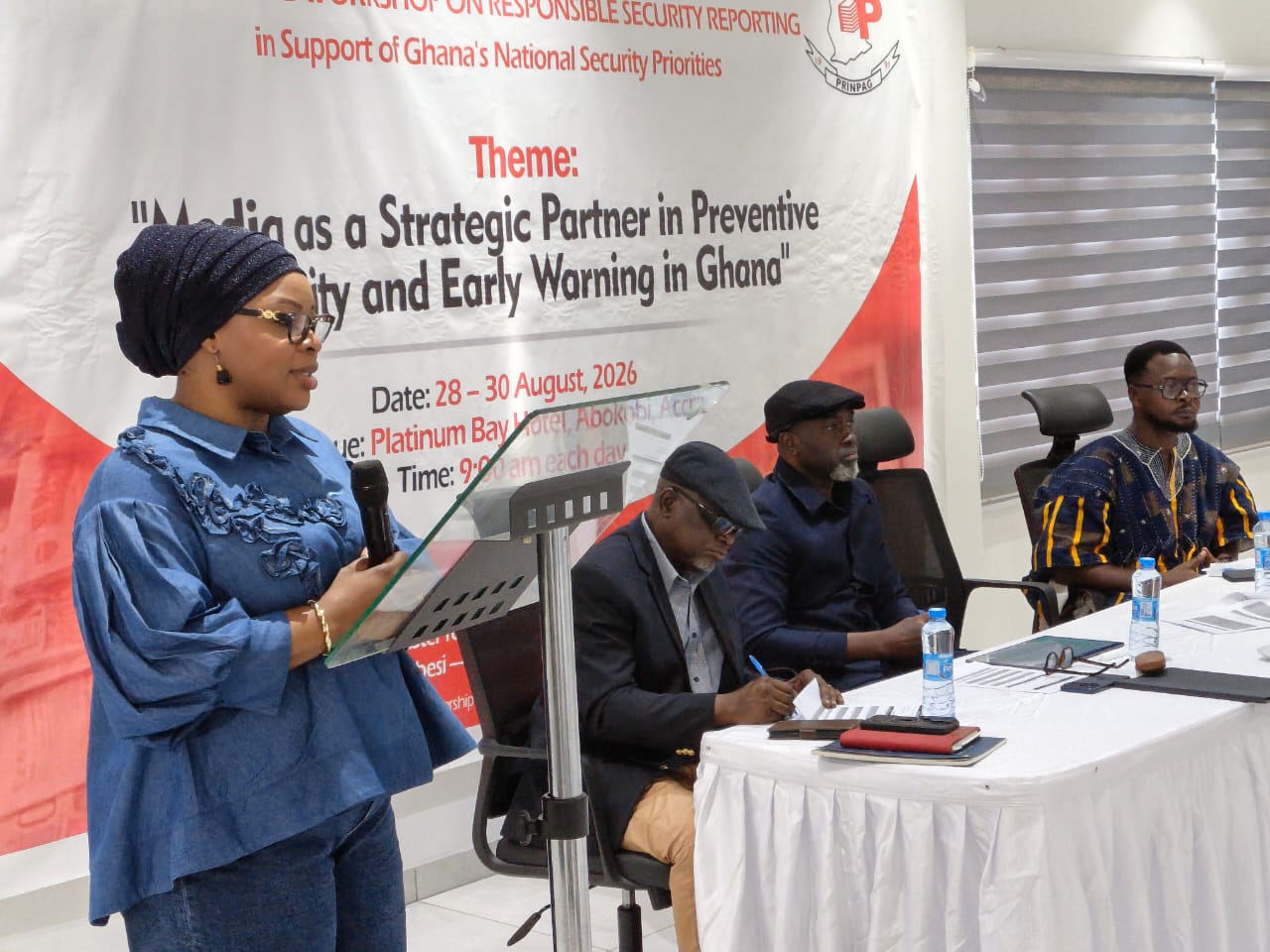
Speaking at the opening ceremony of a three-day capacity building on responsible security reporting at Abokobi in the Ga East Municipal Assembly of the Greater Accra Region, Minister for Government Communications, Felix Kwakye Ofosu, outlined three disruptions that hit the print media in a speech read for him.
Reading the speech, the Deputy Presidential Spokesperson, Shamima Muslim, said: “First, platform disruption: Ghanaians wake up to TikTok, not the front page. The advertisers followed them”.
In 2016, print took about 30% of ad spend in Ghana. Today, less than 7%. Google and Meta take over 60% without employing a single reporter in Accra, according to Mr Kwakye Ofosu.
The second disruption he mentioned is cost disruption. “Newsprint is imported. One tonne was $600 in 2020; today, it is over $1,100. You cannot raise cover price; your reader is already struggling”.
Third, and most painful, credibility disruption. When anyone with a smartphone can publish, professionals are forced to compete on speed with rumour. Some papers, to survive, traded depth for sensationalism. The very thing that made print powerful- credibility- is at risk.
Print media cannot be allowed to die
Radio is fast. TV is dramatic. Online is viral. But in Ghana, print media cannot be allowed to die. These are the reasons why print media cannot be allowed to die.
“Print is record. Print is what we cite in court, in Hansard, in history books. If print loses relevance, we lose our national memory”, Mr Kwakye Ofosu told some selected members of the Private Newspapers and Online News Publishers Association of Ghana (PRINPAG) at the workshop.
The workshop, which was organised in collaboration with the National Security Council Secretariat under the theme “Media as a Strategic Partner in National Security,” was intended to enhance the capacity of private newspapers and online news publishers to report accurately, responsibly, and professionally on contemporary security issues.
It also formed part of efforts to strengthen the media’s role as a strategic partner in promoting public awareness, national cohesion, democratic governance, and public safety.
Linking the theme of the workshop, the Minister noted: “Social media gives us heat, not light. It tells us there is anger in Bawku, but not why.
It shows a video of soldiers, but not whether it is from Ghana or Mali, 2025 or 2021”.
Mr Kwakye Ofosu continued: “Only you, professional print and credible online, can provide what security needs: verification, context, and record”.
In this era of AI deepfakes and disinformation, a fake letterhead of a Minister can cause a bank run. A careless headline “Soldiers Invade Town” for a routine patrol can erode 30 years of civil-military trust, he added.
It must evolve from newspaper to early warning partner, Mr Kwakye Ofosu charged.
For the National Security Coordinator, Commissioner of Police (COP) Osman Abdul Razak, this workshop is therefore not a mere activity- it is one of the important legs of preventive security.
Delivering the keynote address at the workshop, he assured the editors, publishers and senior journalists that his outfit was to establish a standard channel of dialogue between the security services and newsrooms to enhance security reporting in the country.

In his own words: “My office is ready to establish a standard channel of dialogue between the security services and your newsrooms so that clarity replaces regulations in moments of national anxiety and to work with you on guidelines of security reporting drawn up with you and not for you”.
Periodic training events
He disclosed that periodic training events would be organised in collaboration with PRINPAG for journalists and editors on how to report on key national security issues.
Field trips would be organised for the participating journalists to visit warring countries to enable them to appreciate the essence of peace and stability being enjoyed in Ghana.
Call for government
The President of PRINPAG, David Tamakloe, used the occasion to call on the government and state institutions to provide stronger financial, regulatory and institutional support to private media organisations.
He warned that the survival of the sector is critical to Ghana’s democracy, saying the private media organisations remain an essential pillar of democratic governance by informing the public, holding duty bearers accountable, exposing wrongdoing and giving voice to vulnerable groups.

PRINPAG’s Enduring Legacy
“PRINPAG has stood as a pillar since 1991, yes, even before the 1992 Constitution was inspected and birthed the Fourth Republic.
We have been the peer review platform, the conscience, and the watchdog of the private press. We have provided technical and financial support to our practitioners with meagre resources, often left to fend for ourselves”.
Mr Tamakloe added that the association had maintained standards and ethics when it was easier to abandon them. “For over three decades, we have been a strategic partner to democracy, and we remain one today”.
