

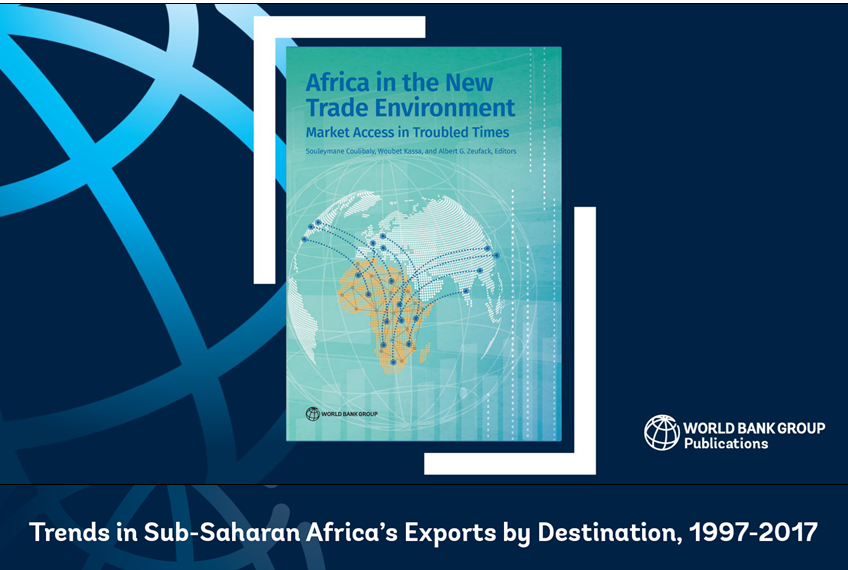

Accra, Ghana//– Latest World Bank book has asked African countries to expand and diversify their participation in international trade and global value chains to reduce poverty on a large scale and transform their economies.
The book titled ‘Africa In the New Trade Environment: Market Access In Troubled Times’, said the continent must go beyond trade in raw materials and link its production and trade to the global economy to take advantage of the unlimited demand and innovation along the supply chain.
This requires comprehensive and dynamic efforts that bolster Africa’s export market access and diversifies its markets to new regions and new products while also strengthening regional trade, it added.
Speaking via a video at the book launch in Accra, the World Bank Vice President for Western and Central Africa, Ousmane Diagana, said: “The global economy is a source of growth that African economies cannot afford to ignore.
While African exports of goods and services have seen their fastest growth in the past decade, the volumes remain low at just 3 percent of global trade.
The time is ripe for policymakers to expand their thinking beyond traditional approaches and traditional markets if they want to play an active role in international trade in the 21st century”.
The World Bank Chief Economist for Africa and co-author of the book, Albert Zeufack, added: “African countries need to undertake bold domestic structural reforms to scale up the supply capacity of the region.
This can be achieved by improving digital and physical connectivity, maintaining smart macroeconomic management with stable and competitive exchange rates and low inflation, and increasing the efficiency of regulatory, legal and judiciary institutions”.
Ghana’s Minister of Trade and Industry, Alan Kyerematen, said one of the biggest challenges that Africa should devote the greatest time at addressing is prioritization of trade.
This he argued is because with all natural resources endowment on the African continent, it controls 3% of global trade. “You can’t trade without production”.
The World Bank Vice President for Eastern and Southern Africa, Hafez Ghanem, called for the: “Deepening regional integration to scale up supply capacity and build regional value chains is essential to the continent’s economic transformation.
The establishment of the African Continental Free Trade Area (AfCFTA) presents major opportunities to boost intra-African trade, strengthen the complementarities of production and exports, create employment, and limit the impact of commodity price volatility on the participants”.
The book noted that unilateral trade preferences have the potential to promote economic transformation through exports and calls for evaluating and re-engineering trade with traditional partners.
Utilization rates of many African countries for the existing trade preferences -such as African Growth and Opportunity Act (AGOA) and Everything But Arms (EBA) are systematically low, it added.
Evidence on AGOA shows that natural resources mainly oil, account for the bulk of African exports. There is a need to integrate unilateral trade preferences with other efforts to deepen trade and investment between Sub-Saharan African (SSA) countries and the OECD countries, mainly the US and the EU, the book emphasized.
This includes integrating preferences with foreign aid policy instruments to address structural challenges limiting export capacity. Recent initiatives such as Compact with Africa (CwA) with a strong focus on improving the business environment, building infrastructure, and promoting effective regulations and institutions appear to be in line with this comprehensive approach.
The rapidly growing middle class and demand from East Asia, accompanied by rising relative wages, along with the shifting structure of global value chains, offer new market opportunities for Sub-Saharan African countries to strategically diversify trade with Asia.
Over the past decades, trade relationships between Sub-Saharan Africa and Asia have expanded, and for some SSA countries their key trading partners are increasingly becoming China, India, and Indonesia, replacing EU, US, especially after 2010.
Going forward, the book highlighted that the approach to strengthening integration for a successful AfCFTA should focus on: improving physical integration – such as cross-border energy and transport infrastructure and connective infrastructure;
strengthening political cooperation – such as harmonizing customs rules and procedures and sacrificing some level of sovereignty in rule making and implementation in favor of regional frameworks and; facilitating business integration – such as regional electronic settlement system, electronic cargo tracking system, one-stop shops and easing restrictions on services trade.
The costs of distance and fragmentation can be reduced through intensive investment in these areas.
The book therefore recommended that the international community could also commit to increasing financial support for growth-sustaining regional infrastructure; shift from bilateral engagements to engagements with “economic areas” that tie together the economic interests of leading and lagging countries in each regional neighborhood.
A complementary activity under the World Trade Organization’s (WTO) Aid for Trade initiative could also help bolster investment in sectors other than natural resources, as helping to build up non-resource exports from countries within neighborhoods or regional economic communities is critical.
Download the book here: eBook__Africa_in_the_New_Trade_Environment.pdf
African Eye Report
