

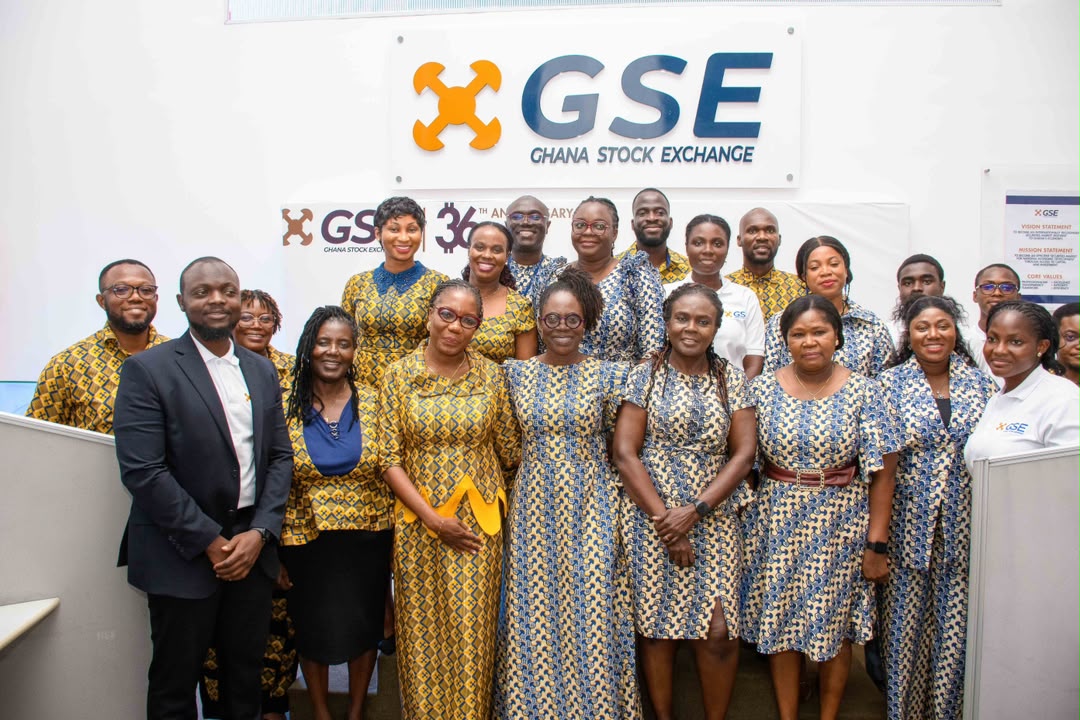

Accra, Ghana//-The Ghana Stock Exchange (GSE) today celebrated its 36th anniversary with a thought leadership programme themed “Digital Assets and the Future of Capital Markets: Disruption, Opportunity and Regulation”.
The Ghana Stock Exchange began trading on 12 November 1990. Today, the local bourse marks 36 years of connecting Ghanaian savings to Ghanaian enterprises.
Delivering her welcome address at the programme, the Managing Director of the Ghana Stock Exchange, Madam Abena Amoah, noted that each of the three words in the theme carries a distinct task for the experts, investors, business leaders, regulators, among others at the event.
Disruption
According to her, digital assets change how securities are issued, held, traded and settled. Market infrastructure that does not adapt will be bypassed.
Opportunity
Tokenisation can widen access to capital for issuers and lower the entry point for investors through fractional ownership, Madam Amoah explained.
Regulation
She added that clear rules decide whether innovation earns investor trust or erodes it. The Virtual Asset Service Providers Act, 2025 (Act 1154) and the SEC’s regulatory sandbox give Ghana a foundation to build on.
Why digital assets
Madam Amoah said: “The revival of primary issuance gives the digital agenda a working market to build on. Tokenisation extends what an exchange does. It does not replace the fundamentals of listing, disclosure and investor protection”.
Globally, tokenisation is already in use. Singapore’s Project Guardian has financial institutions using tokenised bonds and foreign exchange products for near-instant settlement.
SIX Digital Exchange in Switzerland runs regulated infrastructure for digital securities. South African exchanges and regulators are testing digital bond issuance to cut costs and friction.
For investors, fractional ownership lowers the barrier to entry. For institutions, issuance and settlement become more efficient.
Tokenisation does not guarantee profit, liquidity or safety. Investor education and clear safeguards stay in place.
The GSE’s position
We are developing a Digital Strategy to settle three questions: what role the GSE plays in issuing and trading tokenised securities, how digital assets connect to our clearing, settlement and depository systems, and which technology capabilities we need to acquire, she stated.
Madam Amoah, who is the current Chartered Institute of Market Ghana (CIMG) Marketing Woman of the Year, revealed that they are working with the World Federation of Exchanges and the International Capital Market Association to align with emerging global standards, operating models and risk frameworks.
“Our test for any digital product is the same: legally enforceable rights, integration with existing custody and depository frameworks, and proven cybersecurity and operational resilience”.
Clarity from the Securities and Exchange Commission (SEC), Ghana and the Bank of Ghana on virtual assets, through Act 1154, gives issuers and investors a legal basis to work from.
Madam Amoah indicated that the SEC sandbox is where tokenisation of gold, treasury bills, bonds, and trade finance instruments is being tested. Sandbox results show where the cybersecurity, liquidity and custody problems sit before products reach the wider market.
“The GSE intends to learn from the sandbox outcomes and work with regulators so that any product on our platform meets the same standard of investor protection as the equities and bonds listed today”.
We will measure the success of our digital journey by whether it strengthens market confidence, deepens capital formation and supports economic growth, not by the number of tokens issued, she assured.
The Deputy Director General of the Securities and Exchange Commission (SEC), Ghana, Mensah Thompson noted that at its heart, tokenisation is the representation of ownership of an asset, whether an equity, a bond, a fund unit, a building or a receivable, as a digital token on a shared ledger.
Four changes
Settlement: Ownership and payment, Mr Thompson observed, could move together in minutes rather than days, shrinking counterparty risk and freeing capital currently trapped in the settlement cycle.
Access: Fractional ownership lowers the ticket size, so that the trader in Makola, the young professional in Wa and the Ghanaian in the diaspora can hold a slice of a bond or an infrastructure asset that was once beyond their reach.
Third, products. Real-world assets such as infrastructure, commodities, real estate and SME receivables can be packaged and traded in forms our market has struggled to deliver.
For a market that is still working to widen its listings, that is a significant opportunity.
Fourth, programmability. Coupons, dividends and even compliance rules can be built into the instrument itself, and trading can extend beyond traditional market hours, according to him.
Position Ourselves
Mr Thompson was emphatic that the future of the capital market is moving toward digital, tokenised and more inclusive platforms.
“The GSE and all of us who operate in this market must position ourselves there, with the investor protected and the market’s integrity intact. The SEC will be a committed partner on this journey”.
