

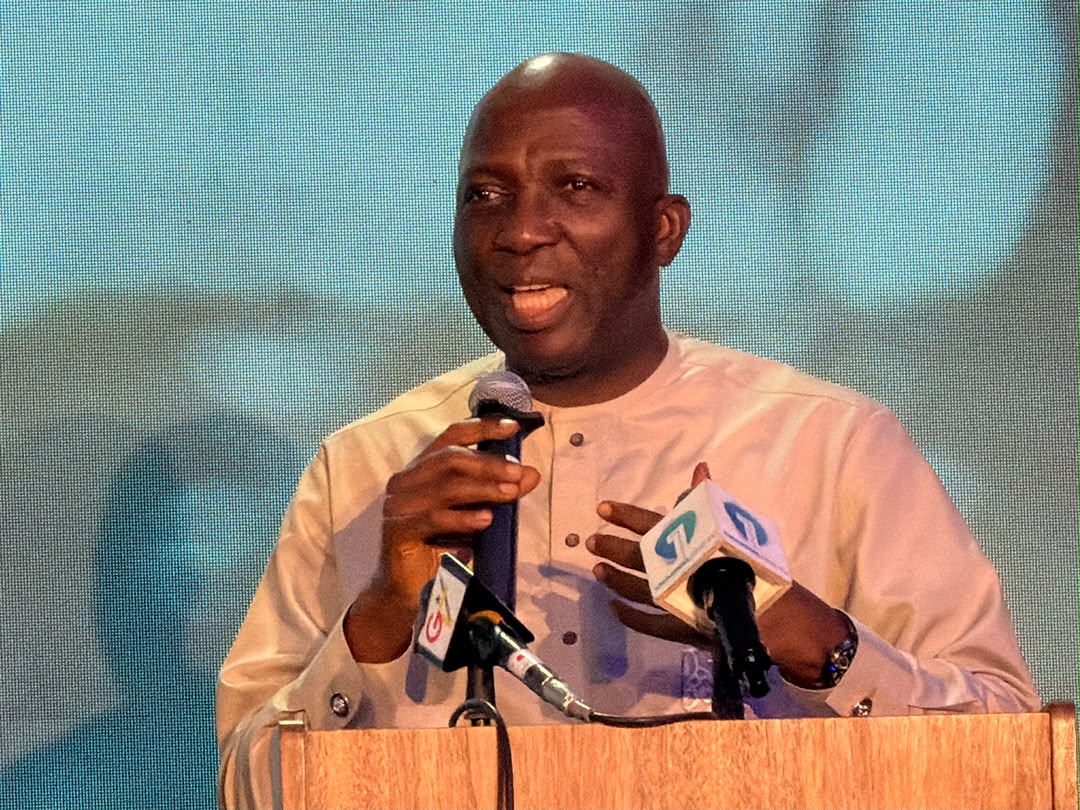

Accra, Ghana//-The Chief Executive Officer (CEO) of MobileMoney Fintech LTD (MMFL), Shaibu Haruna, says adopting Digital Financial Services (DFS) has a profound impact on people’s access to digital credit in the country.
“Digital credit”, as defined under the Digital Credit Services Provider (DCSP) Directive issued by the Bank of Ghana (BoG), is short-term credit products (under 12 months), of low value (maximum loan amount does not exceed GHȻ 10,000), and delivered through digital channels, such as websites, mobile applications, self-service machines, or any other electronic channel.
MMFL, which is the independent financial technology (fintech) subsidiary responsible for MTN Ghana’s Mobile Money (MoMo) business, provides and expands digital credit services as part of its broader financial inclusion roadmap in Ghana.
Mr Haruna made this known when he addressed editors and senior journalists at the second MMFL Media Development Series on Friday 9, October 2026 in Accra.
Expanding Digital Financial Services
Products which are running on the MMFL platform are- IC Liquidity Fund, Flexi Pensions-Peoples Pensions Trust, Coronation SME Insurance, and Misika by Adehyeman Savings & Loans.
He added through the provision of digital credit, they have seen a lot of businesses that have sprung up in terms of building technology that is able to better score customers and partner with banks and other ecosystem actors to provide credit to millions of people in Ghana.
“In our case in Ghana, we have seen quite an explosion in terms of the number of customers accessing credit in Ghana and also actively using and paying. The vast majority of our customers do pay through MoMo”, Mr Haruna said.
The CEO also disclosed that the number of offerings on insurance is increasing. However, the way this is happening is that most of the traditional insurance companies typically want to extend the service offerings that they have in their current forms and just put them into the mobile money ecosystem, and that is making adoption a little difficult.
Mr Haruna explained: “This is because the assumption is that once you expose insurance offerings and other services onto your mobile money reel, people should naturally buy the services, but we are realising that we need to adapt that to ensure that we accelerate growth of the service”.
It is not just the question of putting it on the platform, and it is not just the question of marketing it in the traditional way, but perhaps we have to rethink it.
“And for services like this, the way we are thinking about it is to say: how do you embed insurance into people’s natural transaction flow? So, let’s say I am doing an investment and I have a very small part of it which will also provide me with insurance coverage.
That way, we are busy testing some of these things with our partners to see whether that will help us unlock and get a lot of people to participate in the insurance ecosystem. So, there is a lot of work to be done on that side. It is an evolving area globally, but we are actively engaging with our partners to be able to drive that to happen”.
Mr Haruna, who took the media through the entire MoMo economy, mentioned a few challenges faced by the digital financial services ecosystem in Ghana and the world at large.
These, according to him, include the inactive of some of the MoMo wallets which is a global one. Fraud remains widespread. It is one of the biggest risks to financial adoption globally. The issues around artificial intelligence (AI) and cross-border transactions.
In every ecosystem, the providers will find some who abuse it. They are also responsible for engaging them on how that impacts the entire ecosystem. So, that is a big area in terms of what they see happening, Mr Haruna told the journalists.
“Customers expect our platform to behave in a certain way, which is a trusted platform, but we also know that there are vulnerabilities that emanate from how people are interacting with different services, how people are interacting with different tools, and how some of these creative individuals have used other channels to now attack us”.
For Chief Products and Services Officer at MMFL, Sylvia Otuo Acheampong, Ghana remains a very important market in terms of its regulatory framework and digital adoption.
Momo in numbers
Significantly, transaction activity grew even more dramatically, with total volumes increasing 18.4% from 7.1 billion to 8.4 billion, and transaction values surging 53.8% from GH¢2.7 trillion to GH¢4.1 trillion.
Recent Data from the Bank of Ghana (BoG) indicates that mobile money has become the backbone of retail financial transactions, dominating payments for goods and services, utility bills, remittances, and microloans.
Unlike traditional banks, which rely on branch networks and formal account processes, mobile money platforms leverage mobile phones, agent networks, and USSD technology to deliver services instantly and at lower cost.
This accessibility has made mobile money indispensable for small businesses and informal sector operators, enabling seamless transactions, access to credit, and participation in the digital economy.
