

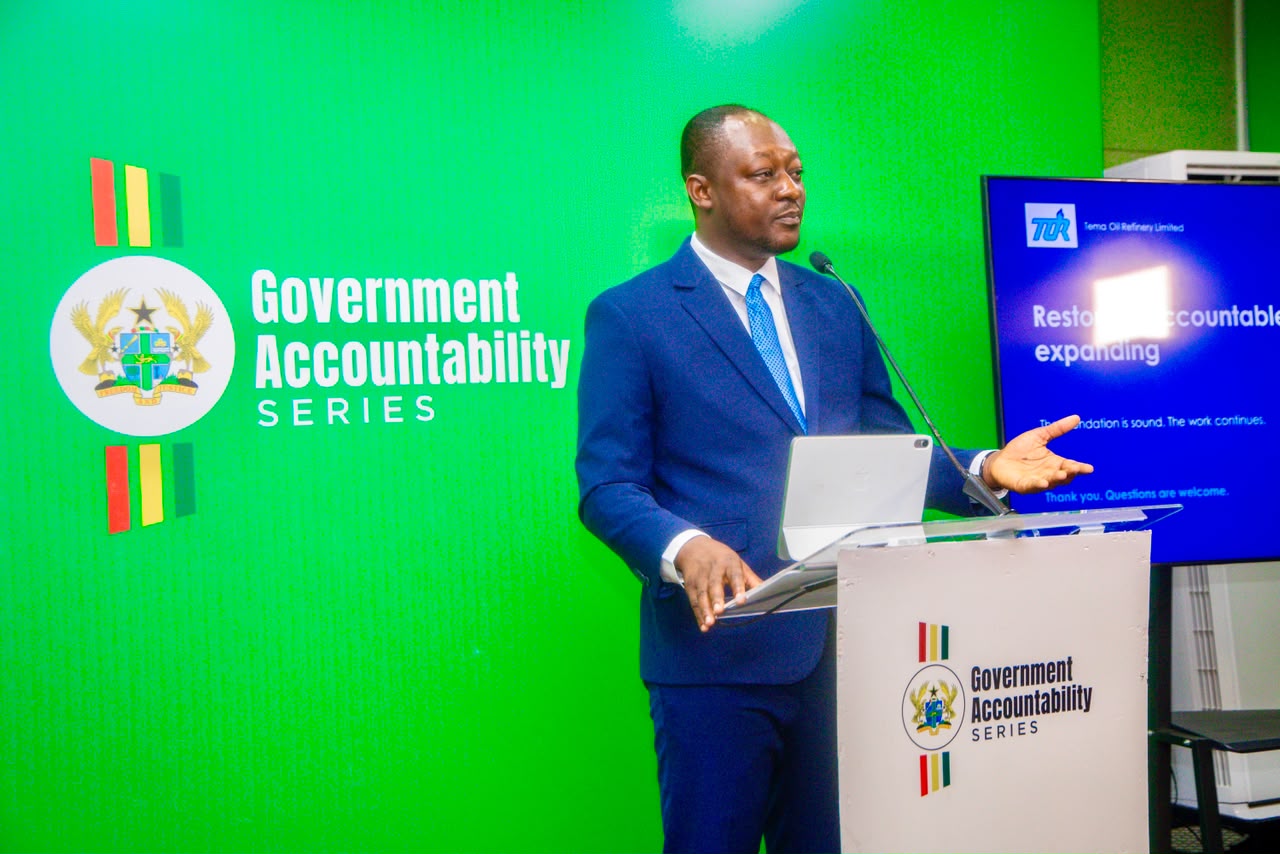
Edmond Kombat Esq., the Managing Director of Tema Oil Refinery (TOR), the oldest state-owned refinery in Ghana, on Monday, 26, October 2026, briefed journalists at the Jubilee House in Accra on the state of the refinery.
His statement below
Permit me to begin by taking you back in history. Sixty-three (63) years ago, Ghana’s first President, Osagyefo Dr Kwame Nkrumah, commissioned what was then known as the Ghanaian-Italian Petroleum Company (GHAIP).
The refinery was part of his vision to build an industrialised Ghana and refine crude oil here at home. Sixty-three years on, TOR remains an important national asset.
It is therefore a great privilege for me to have been appointed by H.E. President John Dramani Mahama as the youngest Managing Director in TOR’s 63-year history.
On behalf of the good people of the Bunkpurugu Constituency, the North East Region and on my own behalf, I am grateful to H.E. the President for the confidence placed in me and for the opportunity to serve my country through this national institution.
This morning, I will take you through the state of the refinery we inherited in May 2025, the decisions we have taken under H.E. President John Dramani Mahama’s RESET Agenda, the progress we have made and what TOR’S recovery means for Ghana’s energy security.
I will also speak about the work that remains to be done.
TOR as at the January 2017 government transition
When the NDC government handed over to the NPP administration in January 2017, TOR was operating. The company’s debt had been reduced from about US$650 million to about US$300 million under a restructuring supported by the Energy Sector Levies Act, and its exposures to four banks had been settled.
The refinery had processed about five million barrels of crude in 2016, and about two million barrels remained in storage at the handover.
Key infrastructure and equipment had been secured, including the offshore mooring facility, which injected a capital of approximately US$90 million in March 2017, as well as a new furnace and boiler to support continued operations.
The refinery had also shown that Ghana could refine its own crude. In December 2016, TOR received its first delivery of Ghanaian indigenous crude from the TEN field for domestic refining aboard MT Bodeira.
The position inherited in 2025
By the time the current management took office in 2025, TOR’s position had deteriorated. The company had accumulated losses of about GH¢10 billion, and its debt had risen from $300 million in 2016 to about US$517 million..
The Crude Distillation Unit (CDU) had been out of operation since April 2021, while the Residue Fluid Catalytic Cracking (RFCC) Unit had been shut down since 2019.
These major units had not received the required maintenance, and TOR had been reduced largely to renting out storage space to petroleum service providers, instead of carrying out its core mandate.
We met a refinery that was not refining and a tank farm used only for limited storage. Much of the infrastructure was run down or obsolete, and 18 out of the refinery’s 59 storage tanks were out of service.
Some of the storage tanks had been out of service since 2004. TOR had not filed audited financial statements for six consecutive years, 2019 to 2024.
For six (6) years, the Refinery had no Audited Accounts. The company owed GHS 200 million to the Ghana Revenue Authority and GHS 20 million to SSNIT, in addition to amounts owed to ECG and Ghana Water Company, as well as GHS 190 million in outstanding obligations to the staff provident fund, retirees and resignees.
TOR was several years delinquent in statutory payments. Staff morale was low, staff were leaving, the workforce was divided, and more than 300 petitions over delayed promotions, some dating back to ten (10) years, were awaiting review.
The refinery also owed other commercial entities and 3 state-owned companies, including GNPC and VRA. The refinery was on the verge of being sold or leased for $21m. By the end of 2024, TOR had negative equity of GHS 7.6 billion.
Between 2019 and 2024, TOR sold third-party products belonging to three petroleum services providers, valued at millions of dollars, to pay staff salaries without the knowledge of the product owners.
What has changed since May 2025
Since May 2025, under H.E. President John Dramani Mahama’s RESET Agenda, management has taken steps to rebuild the company from within, beginning with people and stronger cash controls.
We reviewed the outstanding promotion petitions and addressed eligible cases. We also extended the operating hours at the refinery’s loading gantry, improved cash controls and accountability in product handling, worked to restore confidence and won back private petroleum companies and regional partners to store and lift products at TOR.
These measures formed part of Project Restore TOR, a broader recovery program to return the refinery into operations, improve its financial position and prepare it for long-term sustainability.
Management made the rehabilitation and restart of the Crude Distillation Unit (CDU) its immediate operational priority. A Turnaround Maintenance Committee was constituted, and the work was funded solely from TOR’s IGF and carried out by TOR’s engineers and technicians.
This was necessary to address years of deferred maintenance and prepare the plant for safe and reliable operations. Work also resumed on critical stall projects, including Boiler No. 8, the F-61 Crude Heater, the Residue Air Cooler and the Steam Turbine Generator.
Management also began a financial restructuring program, commissioned an independent assessment of TOR’s liabilities and opened discussions with SSNIT, the Ghana Revenue Authority, and other creditors on sustainable repayment arrangements.
We pursued outstanding receivables, reviewed the company’s unaudited accounts and improved financial controls to support the financial position of the company.
Management also began improving the support systems needed for efficient operation. These included the procurement of operational vehicles, staff buses and other logistics to support movement within the refinery and transport staff working on shifts.
We improved access control, installed CCTV systems in critical areas, engaged additional security and enhanced collaboration with National Security Agencies.
Steps were also taken to rebuild confidence in TOR through regular stakeholder engagement, especially with the four (4) worker Unions and their mother national unions, including the TUC, improved and clearer communication and visible improvements to the refinery’s facilities. Staff welfare and human-resource reforms were pursued, including a review of conditions of service, job descriptions and performance-management systems.
Beyond the immediate recovery work, management is developing a five-year strategic plan to guide investment decisions, business reforms and the future growth of the refinery.
The turnaround maintenance ran from August 1 to October 30 2025. Following the completion of the maintenance works, the National Petroleum Authority (NPA) inspected the plant, confirmed compliance with the mandatory safety and operational requirements, and cleared TOR to resume refining.
Crude processing started on December 19, 2025, with all product streams going to storage for the first time in years. Since May 2026, TOR has received four five-million-barrel crude cargoes: Bonga, Baleine, Bonnie Light, followed on July 15 by Ghana’s Jubilee Medium Sweet crude, an indigenous crude delivered aboard MT Apache.
TOR paid for the Jubilee cargo in full, making it the refinery’s first Jubilee cargo in a decade. On August 1, 2026, H.E. the President commissioned the refurbished Crude Distillation Unit.
The refinery then received another parcel of Ghanaian indigenous crude of 950,000 barrels of Sankofa crude on 25 September 2026 from our sister agency, the Ghana National Petroleum Company (GNPC).
The restoration of operations at the Tema Oil Refinery (TOR) is a testament to the power of visionary leadership, inter-agency collaboration, and the commitment of the Government of President John Dramani Mahama under his Reset Agenda.
Recognising TOR’s strategic importance to Ghana’s energy security and economic transformation, we worked closely with our sister agencies and institutions, including the National Petroleum Authority (NPA), the Ghana National Petroleum Corporation (GNPC), the Ghana Oil Company Limited (GOIL), the Bulk Oil Storage and Transportation Company Limited (BOST), and other stakeholders across the energy value chain, to mobilise the technical, operational, commercial, and logistical support required to restore refining operations.
This collective effort has been instrumental in bringing TOR back into operation, demonstrating that when our national institutions work together towards a common purpose, we can overcome longstanding challenges and deliver results for the Ghanaian people.
On behalf of the Board, Management, and staff of TOR, I wish to express our profound gratitude to His Excellency President John Dramani Mahama for his decisive leadership, unwavering commitment, and clear directive to restore the refinery as part of his Reset Agenda.
We are equally grateful to the Honourable Minister for Energy and Green Transition for his strategic guidance, continued support, and leadership throughout this process.
We remain committed to consolidating these gains, strengthening operational efficiency, and positioning TOR as a commercially viable and competitive refinery that contributes meaningfully to Ghana’s energy security, industrial growth, job creation, and national development.
The Results so far
These decisions have produced clear results. We completed the turnaround maintenance of the Crude Distillation Unit and restarted refining operations after years of inactivity on December 19th, 2025.
Safety remained a priority throughout the maintenance and restart. We recorded no fatalities or disabling injuries during the CDU turnaround.
We also completed the required safety reviews and emergency-response exercises and renewed the permits, licences and insurance policies needed for refinery operations.
We have also made progress commercially. Commercial operations generated more than 36% in revenue in 2025 compared to 2024 and almost 60% revenue growth as at September 2026 this year.
We recovered outstanding receivables, improved financial controls and continued upgrading the Quality Control Laboratory. We addressed more than 300 staff petitions and promotion-related cases that had remained unresolved for over a decade.
TOR has maintained a steady supply of crude oil for refinery operations, reflecting the renewed confidence among suppliers and business partners, who are once again willing to do business with the refinery.
We have received over 5million barrels of crude compared to Zero in 2024. Tema Oil Refinery recorded a remarkable improvement in product storage volumes, increasing from 426,954 metric tonnes in 2024 to 1,107,389 metric tonnes in 2025, representing an impressive 159.37% year-on-year growth.
In 2026, storage volumes increased further to 1,350,000 metric tonnes, representing an additional 21.91% growth over 2025. Overall, this represents a 216.19% increase between 2024 and 2026, demonstrating significant growth in TOR’s product storage activity and its contribution to Ghana’s petroleum supply chain.
These results have helped restore confidence in TOR among staff, regulators, customers, suppliers and business partners. They have also placed the company in a better position to contribute to Ghana’s energy security and pursue its longer-term plans for refinery modernisation, increased storage capacity and a petrochemical plant.
Financial reporting and performance
We have also dealt with the backlog in financial reporting. The audited accounts for 2019 to 2024 were completed by April 30, 2026, followed by the 2025 accounts on May 30, 2026. This brought the total to seven audited financial reports submitted to the State Interests and Governance Authority (SIGA), and presented at our 18th Annual General Meeting on June 30, 2026.
SIGA commended TOR and confirmed that the submissions brought TOR up to date for the first time since the 2018 accounts were filed. TOR also held its first AGM in a long time to consider a ten (10) year financial statement backlog covering 2017, 2018, 2019, 2020, 2021, 2022, 2023,2024,2025 to ensure transparency and accountability and meet statutory obligations.
TOR recorded a profit before tax of GH¢1.24 billion in 2025, its first return to profit in a decade, according to SIGA. Micro-Economic Stability and Prudent Management contributed to the result.
What matters more is that trade and other payables fell from GH¢7.1 billion to GH¢5 billion in a single 7-year period, and receivable days fell from 1,099 to 652.
The team is focused on delivering even better results for 2026. TOR also ranked second among all public institutions in the inaugural PFM Compliance League Table.
What the recovery means for Ghana
TOR’s progress has received public recognition. The Chief Executive of the National Petroleum Authority has publicly commended the refinery’s revival. The Ministry of Energy and Green Transition named me Energy Sector Recovery Program Champion of the Year, while the Ghana CEOs Network presented me with an Outstanding Public Sector Leadership Award.
These honours belong to the entire TOR family. We also held TOR’s first-ever passing-out ceremony for security personnel.
TOR’s recovery has created 1,657 permanent and temporary jobs. This includes 415 young engineers recruited into permanent positions, 301 temporary workers engaged for the CDU maintenance, 287 engaged for the RFCC maintenance, and 654 employed by 35 local contractors working at the refinery.
In effect, direct employment for 1,657 Young Ghanaian Engineers, and more than 6,500 indirect and temporary workers were engaged during the turnaround works.
At its nameplate capacity of 45,000 bpd, TOR’s crude throughput is equivalent to roughly 35% of the 128,000 barrels a day of clean products Ghana imported in 2025.
Refining crude oil locally reduces the volumes of finished petroleum products the country must import, while careful scheduling of crude deliveries helps keep the refinery’s tanks stocked.
On August 1, 2026, H.E. the President noted that, because of the role played by TOR, Ghanaians were largely spared the effects of the Iran conflict on fuel supply.
This is why local refining capacity matters when international supplies are disrupted. Refining Ghanaian crude in Ghana keeps value onshore. It fulfils the value addition vision of His Excellency the President for Ghana.
We are witnessing Ghanaian Crude being refined by Ghanaian Engineers in a Ghanaian refinery, effectively linking the Ghanaian Petroleum Upstream, Midstream and Downstream together.
Our Offtake partnerships, including our 8 engagement with GOIL on 2 September 2026, were intended to increase the supply of locally refined products, improve security of supply and support greater price stability at the pump.
But for the restoration of TOR and other domestic production with government intervention, fuel prices in the last 2 windows could have sold between Ghs22/litre and Ghs32/litre.
The revamp of TOR has guaranteed Ghana and our Sahelian Neighbors Fuel Security and Availability. TOR’s close working relationship with NPA, BOST and other Petroleum Service providers has ensured Burkina Faso’s National Oil Company has increased its petroleum products movement through Ghana from 15% in 2024 to 40% as of today.
Expansion and work ahead
In the near term, engineers from Verga Engineering are working with TOR’s technical team to complete the tie-in and commission the F-61 this month.
This will allow the Crude Distillation Unit to move from its current throughput of about 28,000 bpd to its nameplate capacity of 45,000 bpd to 55,000 bpd. In the medium term, we plan to install a new air cooler to raise capacity to 60,000 bpd and replace the 6,500 barrel-a-day catalytic reformers with a 10,000 barrel-per-day continuous catalytic reformer.
The new 120-ton boiler has been installed, while work on the RFCC turnaround and SCADA system continues. On August 1, 2026, H.E. the President directed the Hon. Minister for Energy and Green Transition to work with the TOR Board and management on a strategic roadmap to raise processing capacity to 100,000 barrels a day, with a further plan to increase it to 200,000 barrels per day as the end state.
He also announced plans to restructure TOR so that it can operate on sound commercial principles, without undue political interference.
The Ministry of Finance is currently working with TOR to consider writing off $120million of TOR’s legacy debt owed to the GoG or convert it into equity.
TOR is part of a national plan. With the refinery’s expansion from 45,000 to 100,000 barrels a day, the Government is targeting about 70 per cent of national fuel demand from local refining by 2028.
Beyond the existing plant, management is advancing plans for a new 100,000-barrel-a-day greenfield refinery and petrochemical facilities, with additional storage capacity that meets current environmental standards. Our Restoration and Legacy Projects program for 2026 to 2029 looks further ahead.
It proposes a brownfield expansion of the existing refinery from 45,000 to 85,000 barrels per stream day, and a new greenfield refinery with a capacity of 115,000 barrels per stream day will bring the total to 200,000 bpd.
The program also includes a specialist hospital with a burns and trauma centre, so that TOR’s revival leaves behind something that serves people as well as the plant.
TOR is also working closely with the Ghana Home Ownership Fund to build staff housing project on existing TOR lands to ease accommodation challenges within the Tema Enclave on TOR’s existing lands.
We will pursue these projects with strategic partners, within the climate compliance principles the President has set, and we will report on progress publicly.
The record, in contrast, can be set side by side. When the NDC handed over in January 2017, debt had been halved to about US$300 million, about five million barrels had been processed, crude was in storage, and Ghanaian crude had been delivered for refining.
By the end of the NPP administration in 2024, losses stood at about GH¢10 billion, debt had risen to about US$517 million, the Crude Distillation Unit had been idle since 2021, the RFCC since 2019, six years of accounts were unaudited, creditors were unpaid, and staff morale had gone.
These are not matters of opinion. They sit in the audit files, on the balance sheet and on the distillation column.
Closing
In ten months of the NDC’s return to office, TOR has resumed refining, cleared the audit backlog, returned to profit before tax, received five one-million-barrel crude cargoes including Ghanaian Indigenous Jubilee Crude, and a further 950,000-barrel Sankofa cargo, and had its refurbished Crude Distillation Unit commissioned by H.E. the President.
The CDU turnaround was funded from TOR’s internally generated funds, without central 10 government funding for the repair works. Restoring TOR was a pledge H.E. President Mahama made to Ghanaians, and the pledge has been fulfilled. 47.We do not claim the work is finished.
The refinery’s throughput stands at about 28,000 barrels a day. Engineers from Verga Engineering are currently on site, working on with TOR’s technical team to increase the throughput to between 45,000bpsd to 55,000bpsd. Once completed, the refinery will be able to operate at its nameplate capacity of 45,000bpsd to 55,000bpsd.
We also remain focused on addressing TOR’s legacy obligations and sustaining the progress made so far. 48.I thank the staff and Board of TOR, the Minister for Energy and Green Transition, the National Petroleum Authority, and above all H.E. President Mahama for the confidence placed in this refinery.
