

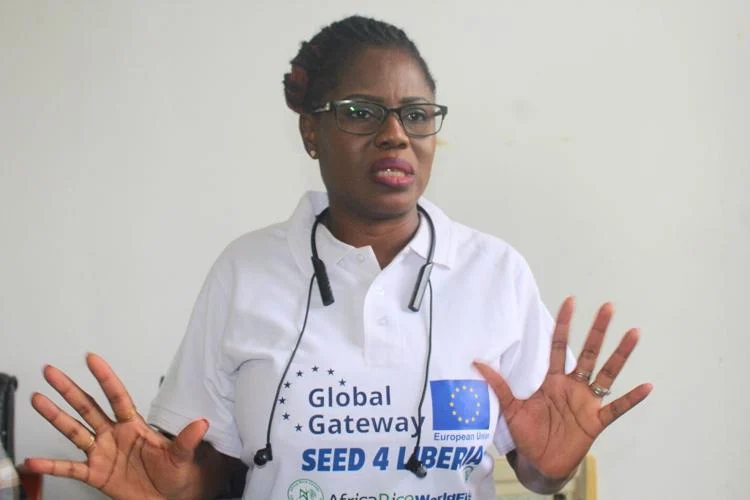
The 2025 Africa Food Prize Laureate and the International Institute for Tropical Agriculture (IITA)’s Dr Mercy Diebiru-Ojo described cassava as the “new white gold”.
Dr Ojo, who also works as the Cassava Lead for IITA on the EU-funded Seeds4Liberia Project, asserted at the opening of a three-day cassava certified seed producers training in Suakoko, Bong County, where she spoke to participants.
“Cassava is the new white gold,” Dr Mercy Ojo said to participants. “Beyond food, cassava is now considered a strategic component in driving industrialisation in Liberia. Also, we at IITA have proven across countries that people can make real money from selling cassava stems and tubers. Our role is to open your eyes to what is possible.
Through the EU-funded Seeds4Liberia Project, we have introduced new varieties, and the project will continue to teach Good Agronomic Practices (GAPs) and, very importantly, focus on commercialisation of stems of the improved varieties, because that is where sustainability lies.”
About the training
The EU-funded Seeds4Liberia Project’s cassava component, led by IITA, concluded training for cassava certified seed producers and national extension agents at the Central Agricultural Research Institute (CARI) in Suakoko, Bong County.
In Liberia, cassava is the second staple food after rice. About 60% of the country’s farming households cultivate the crop. Yet despite being the country’s second staple, the cassava sector faces several challenges, including weak propagation methods and poor planting materials.
Farmers often recycle stem cuttings from previous harvests for propagation, but this method is susceptible to pests and diseases, limiting field yields and affecting farmers’ income.
The training sought to enhance participants’ understanding on critical aspects of cassava certified seed production. With the support of trainers and coordinators from IITA (Michael Edet, ThankGod Ogwuche, Kayode Olasupo and Jerry Tokao) participants were drilled on several topics including cassava seed production fundamentals, cassava seed quality assurance, phytosanitary measures, cassava seed business and marketing skills, developing a certified seed business model for CSEs in Liberia, cassava seed handling and storage, and record-keeping in the cassava seed business.
What was said?
Earlier, the Director General of the Central Liberia Agricultural Research Institute (CARI), Dr. Arthur B. Karnuah, officially welcomed the project team and participants to the station. He further urged participants to make the most of the opportunity, stressing that every actor has a part to play in Liberia’s agri-economic growth journey.
“Today’s training is not a three‑day holiday. If you come here and leave the same way you arrived, then we have failed. All these efforts from our partners form a complete package that is intended to help us as a nation to grow, specifically in the agriculture sector. And you, in the cassava sector, have your own essential role. Just as the body cannot function without each part, agriculture cannot progress without each actor performing their role correctly,” said Dr Karnuah. “ I am therefore asking you all to be attentive, engaged, and serious. Whatever you learn here should be transferred to your cooperatives so that all of you can work together and succeed.”
The training, held at the Central Agricultural Research Institute (CARI) in Suakoko, Bong County, brought together private cassava seed producers and national extension officers from Bong, Montserrado, Margibi, Nimba, and Lofa Counties. National implementing partners, including the Ministry of Agriculture (MoA) and the Seeds Development and Certification Agency, were also represented at the training opening.
Also addressing participants at the training opening, the Director General of the Seed Development Authority (SDCA), Jobson Momo, emphasised the importance of his agency in Liberia’s quest to build resilient seed systems and encouraged registered seed enterprises to seek guidance from the SDCA when producing certified seeds.
“SDCA is involved not as a research institution, but as the regulatory authority. Our responsibility is to ensure that the materials you produce are true-to-type, high-quality, and fit for trade within and outside Liberia,” said DG Momo. “So, this is why you must get us involved at every stage of your production because we are to inspect, tag, and certify your fields. Only then can you sell. We will also help you identify markets.”
Launching the training, the Deputy Minister of Agriculture, Extension and Services, Hon. Moses R. Gbanyan, applauded the EU-funded Project and its team for their contribution to strengthening human capacity in agri-extension in Liberia. He further challenged extension officers participating in the training to continue engaging with seed producers and the farming community, stressing that extension officers are also key drivers of the sustainability of the EU-funded Seeds4Liberia.
Extension in Liberia?
In Liberia, extension delivery services face issues ranging from mobility to capacity-strengthening opportunities. According to an assessment under the EU-funded DeSIRA Integrated Rice-Fish Farming System Project (DeSIRA-IRFFS), the ratio of farmers to extension officers in Liberia is very low, far below the recommended ratio of 1:600, which is 1:35,000, one extension officer to 35,000 farmers, the report reveals.
However, the EU-funded Seeds4Liberia Project is also strengthening extension officers’ competencies to deliver better advisory services, ensure seed producers’ compliance with national seed standards, and support the production of quality-assured foundation and certified seeds for Liberia’s emerging soybean seed system.
The training also concluded on a very high note, with participants applauding the EU-funded Seeds4Liberia technical team for imparting cutting-edge knowledge. One beneficiary, Mary Ama, from Kolahun, Lofa County, said, “I would like to thank all the facilitators. I am so impressed. We just want to appreciate you all. All the activities were well understood. I would like to say that such training should not be the last we experience. Once again, I would like to thank the EU, our facilitators, and the Government of Liberia for making this opportunity possible.”
About the EU-funded Seeds4Liberia Project
The EU-funded Seeds4Liberia Project is building resilient seed systems for rice, cassava, coffee, soybean, and fish in Liberia. It does this through demand-driven, structured, and regulated seed systems for target value chains
The EU-funded project is jointly implemented by Africa Rice Center (AfricaRice), the International Institute of Tropical Agriculture (IITA), and WorldFish in collaboration with the Ministry of Agriculture (MoA), the Central Agricultural Research Institute (CARI), the National Fisheries and Aquaculture Authority (NaFAA), the Seed Development and Certification Agency (SDCA), and the Liberia Agricultural Commodity Regulatory Authority (LACRA).
