


Accra, Ghana//-The maiden Ghana Center for Democratic Development’s Mining Districts Development Scorecard (MDDS) has ranked the Birim North District in the Eastern Region as the overall top-ranked district in its 2023 MDDS league table.
The district, which has an economically large deposit of gold is currently being exploited by companies including Newmont scored 42.4 out of 100 points in the league table.
It was followed closely by Tarkwa Nsuaem Municipal in the Western Region which ranked second (2nd) with a score of 41.9 points, and Wassa East District in the same region ranked third (3rd) with 41 points.
The three bottom-ranked districts according to the 2023 scorecard are Obuasi Municipal in the Ashanti Region, which ranked sixth (6th) with a score of 35.4 points; Asutifi North District in the Ahafo Region ranked seventh (7th) with a score of 34.2 points; and Prestea Huni-Valley Municipal in the Western Region ranked eighth (8th) with a score of 33.1 points.
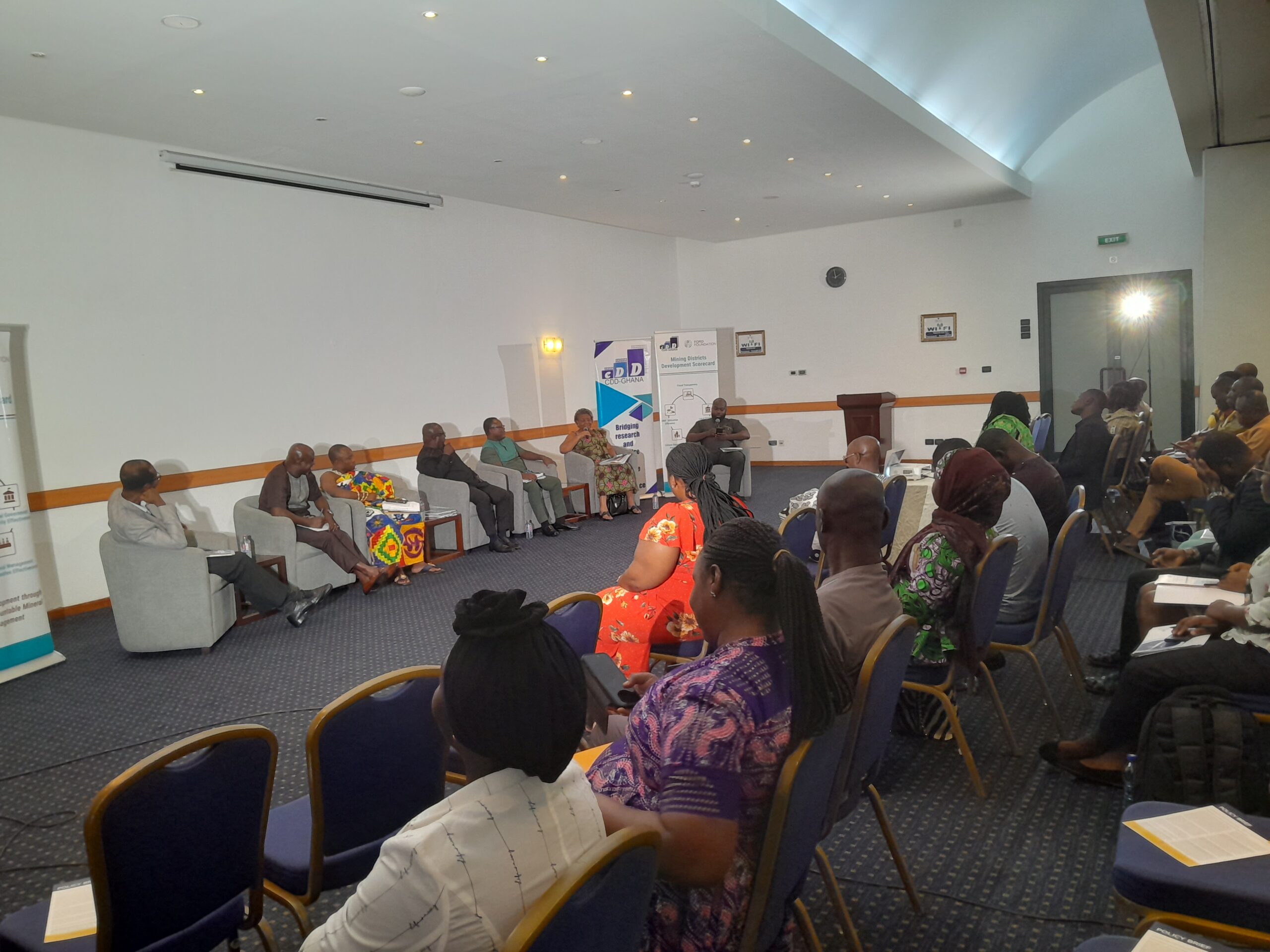
Presenting the MDDS report findings to stakeholders including district chief executives and chiefs in Accra, Research Manager/Team Lead for Social Accountability and SDGs Programming at CDD-Ghana, Awal Mohammed disclosed the MDDS average district performance score across the eight-mineral resource-rich districts featured in the report is 38.4 out of 100 points.
This score indicates poor overall quality of governance in managing and utilising mineral royalties at the district level, he explained.
This evidence of weak governance practices in mineral revenue management has significant implications for the potential to achieve sustainable and inclusive social development outcomes in Ghana’s mineral resource-rich districts and communities, Mr Mohammed added.
He however noted that there are significant variations in the performance scores and ranks of individual districts across the components of the MDDS, as well as among rural and urban mineral resource-rich districts.
Five mineral resource-rich districts- Birim North District (42.4 points); Tarkwa Nsuaem Municipal (41.9 points); Wassa East District (41.0 points); Upper Denkyira West District (40.1 points); and Bibiani, Anhwiaso Berkwai Municipal (39.0 points) scored above the average MDDS district performance score.
While three districts that scored below the MDDS average performance score are Obuasi Municipal (35.4 points), Asutifi North District (34.2 points), and Prestea Huni-Valley Municipal (33.1 points).
Districts generally performed well on the MDDS league table in three component areas namely- Fiscal Transparency (FIT), Local Government Effectiveness (LGE), and Citizen Participation and Engagement (CPE).
The overall district’s average performance score on these three components is higher than the overall MDDS average district performance score. However, we observe a common trend among these three components that has facilitated the improvement in districts’ MDDS scores, Mr Mohammed told the stakeholders in the mining industry at the report launch.
All the districts had high administrative data scores on the three MDDS components. All districts had 100 points in the three sub-components used to measure FIT.
The three sub-components are: a) Preparation and publication of the District Quarterly Financial Report; b) Availability of approved annual budget and action plan; and c) Presentation of the 2020 Auditors General’s Report to the General Assembly. This means that all districts performed very well in these areas of the assessment.
All districts had a 100-point score on the single sub-component used to measure CPE, namely a) “District Assemblies’ (DAs) Organization of Town Hall Meetings and Engagement with Communities.”
All districts had a 100-point score in three of the five sub-components used to measure LGE. These sub-components are a) Approval of the DA Budget and Annual Action Plan for 2020, b) Inclusion of Local Economic Development (LED) activities in the Annual Action Plan, and c) Plurality (90%) of Implemented Activities in the Annual Action Plan. This means that all districts performed very well in these areas of assessment.
However, district scores based on a key community informant survey showed very poor citizen evaluation of the district’s performance on the three components. Citizens scored districts poorly (an average score of 24.0 points out of a possible score of 100 points) on the two sub-components used to measure FIT, namely: Citizens’ awareness of MDF Allocation to Districts’; and Availability of MDF Information Dissemination Platforms.
The citizens scored district poorly (an average score of 17.7 points out of a possible score of 100) on the only sub-component used to measure LGE, namely: ‘Regularity of Opportunity for Citizens’ Participation in DAs Planning and Budgeting Process’.
They also rated districts poorly (an average score of 17.2 points out of a possible score of 100 points) on the two sub-components used to measure CPE, namely, Citizens’ Participation in DAs Development Plan Preparation in 2020; and Participation (including the vulnerable) in DAs Budget Preparations.
The spectacular performance of districts, as indicated by administrative data sources, raises concerns about the accuracy and quality of the data.
This is particularly evident when comparing the assessments provided by key community informants (such as Assemblymen/women, unit committee and area council executive members, representatives of women, youth, disability, and civil society organizations, traditional leaders, and media personnel) with the self-appraisal conducted by the districts themselves, as documented in their administrative reports used for the assessment and scoring.
Recommendations
The results of the 2023 MDDS indicate that the quality of sub-national institutional and governance practices in mineral royalty management and utilization is generally weak across the eight-pilot mineral resource-rich districts.
This finding highlights the urgent need to enhance the overall governance framework for managing mineral royalties at the local level, according to the maiden report.
It also recommended that to address the governance challenges in sub-national mineral revenue management in Ghana, it is crucial to prioritize improving transparency and accountability practices, focusing on resource utilization transparency and accountability.
Additionally, efforts should be made to increase citizen awareness and participation in managing mineral resource revenues at the sub-national level. These practices have the potential to foster informed, inclusive, and accountable decision-making that can ultimately contribute to achieving broad-based social welfare gains for communities and social groups.
Launching the report the Vice-Chair of Ghana Center for Democratic Development (CDD-Ghana), Clara Kasser-Tee said to contribute to efforts to improve mining revenue governance and to address the ‘local resource curse’ in Ghana, CDD-Ghana secured support from the Ford Foundation to pilot an intervention to strengthen social accountability in mineral royalty governance to promote socio-economic development in Ghana.
The project, titled “Strengthening Transparency and Accountability in Mineral Revenue Utilization for Socio-economic Development in Ghana’s Mining Districts,” aims to track the transfer, management, and utilization of mineral royalties in selected mineral resource-rich districts in Ghana.
The project aims to enhance transparency, participation, and accountability in managing mineral revenues to promote socio-economic development outcomes in mining districts in Ghana. To achieve these project goals, CDD-Ghana developed and piloted a “Mining Districts’ Development Scorecard (MDDS)”.
What is the MDDS Initiative
The Mining District Development Scorecard (MDDS) is a tool designed to assess and rank the levels of transparency, accountability, and citizen participation in managing mineral royalties in mineral resource-rich districts in Ghana. It aims to improve the socioeconomic development outcomes in these districts.
The MDDS is an innovative and robust tool that provides stakeholders, including local government authorities, traditional authorities, mining companies, civil society actors, media, and citizens, with evidence of how districts are performing in the governance, management, and utilization of mineral royalties.
This information can then be used to strengthen accountability in managing mineral royalties. Additionally, the MDDS will serve as a social accountability tool, facilitating public dialogue to enhance policy and practice in sub-national level governance of mineral royalties, with the ultimate goal of fostering inclusive development.
Specifically, the MDDS has three main objectives: 1. Make freely available information about the state of transparency and accountability practices in the management of mineral royalty in mining districts to improve citizens’ and
other community-level stakeholders’ awareness and knowledge; 2. Support evidence-informed dialogue between local government authorities, citizen groups, and communities on the governance, management and utilization of mineral royalties; and 3. Incentivize the use of evidence to foster transparency, and citizen engagement as a mechanism to strengthen accountability in the use of mineral royalty at the national and sub-national levels and expenditure by local government authorities at the district level.
MDDS Methodology and Approach
The MDDS tool aims to assess the performance of Ghana’s mineral resource-rich districts in terms of governance, management, and utilisation of mineral royalties. Its goal is to promote accountable governance in the management of mineral royalties for better social development outcomes.
The MDDS tool utilizes the following five key dimensions to evaluate the quality of district-level governance in the management, and utilization of mineral royalties:
Local Government Effectiveness (LGE) – measures the quality of planning and budgeting processes, program implementation, and local resource mobilization capacity of District Assemblies (DAs) in mineral resource-rich districts in the country.
Fiscal Transparency (FIT) – measure the adherence to public financial management information disclosure practices and the available channels, for sharing information and reports relating to mineral royalties’ transfers
Local Management Committee Effectiveness (LMCE) – measures the organizational, operational, and management effectiveness of the Local Management Committees (LMCs) in overseeing the management of the Mining Community Development Schemes (MCDS)
Citizen Participation and Engagement (CPE) – measures citizens’ participation and engagement (including vulnerable groups such as youth and women) in local government decision-making processes (planning and budgeting)
Mineral Development Fund Utilization Efficiency (MDF-UE) – measures the efficiency in the utilisation of mineral royalty revenues by DAs and LMCs to promote inclusive local socio-economic development.
These ‘good’ governance practices in the governance, management, and utilization of mineral revenues constitute the five major components of the MDDS. The five components have 22 subcomponents and 115 measurement indicators. To assess district performance, the MDDS tool combines administrative data and key community information experiential survey data to score and rank district performance on these components.
The community key in the formant experiential survey provides data for 97 measurement indicators for 10 out of the 22 sub-components. The surveys in the districts were conducted in November 2022. Administrative data sources provide 18 measurement indicators for 12 subcomponents of the MDDS.
The baseline year for the key administrative data sources is 2020.
The MDDS overall composite scores are computed as the sum of the mean scores of the five component scores. The MDDS overall composite and component scores are scored on a scale of 0-100, where values less than 30 correspond to “poor” performance; values from 30 to 44 correspond to “weak” performance; values from 45-59 correspond to
“satisfactory” performance; values from 60-74 correspond to “good” performance; and values greater than 75 correspond to “very good” performance in mineral royalty revenue governance and management practices.
The MDDS tool was piloted in eight out of 21 mineral resource-rich districts spread across Ghana. The selected districts are Asutifi North District, Bibiani Anhwiaso Bekwai Municipal, Birim North District, Prestea Huni-Valley Municipal, Tarkwa Nsueam Municipal, Obuasi Municipal, Upper Denkyira West District, and Wassa East District.
Instructively, revenues from extractive mineral resources, such as gold, bauxite, and diamond, significantly contribute to government revenue in many resource-rich African countries, including Ghana. If well managed, these revenues have the potential to improve local economic growth and provide social infrastructure, positively impacting the lives of citizens.
However, across Africa, the abundance of mineral resources and their revenues have not led to inclusive socio-economic development outcomes, particularly in rural communities where mining activities occur, resulting in the phenomenon known as the ‘local resource curse’.
Ghana is among a few African countries that have committed to decentralizing a portion of mineral royalty revenues to communities to address the challenges of the local resource curse and transform mineral resource-rich communities.
Despite having a large extractive sector and a well-structured de centralized mineral revenue-sharing framework between the central government and local government authorities and entities, mineral resource-rich districts and communities in Ghana remain among the poorest.
This observation suggests that mineral royalties are not used efficiently to improve social development outcomes. Again, there is a widespread perception that mining has brought little to no benefit to affected communities, and the failure to translate mineral wealth into broad base socio-economic development at the district level is attributed to governance failures.
The governance failures are manifested in weak transparency and accountability practices and mechanisms sur rounding mineral royalties’ transfer, management, and utilisation. The report is available here.
