

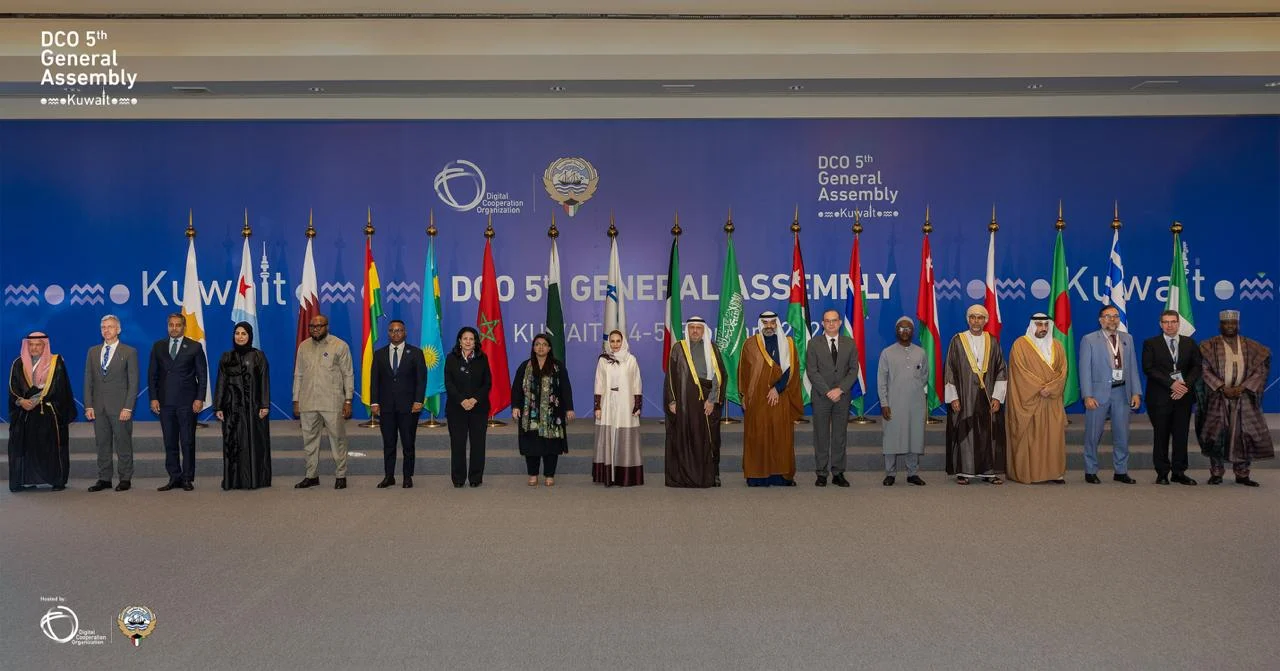

Digital Cooperation Organisation (DCO), which is dedicated to achieving social prosperity and the growth of the digital economy by unifying the efforts of its over 16 members to advance digital transformation and promote common interests, has once again shown class on the international stage.
The DCO is among a few international bodies that have treaties on Artificial Intelligence (AI), aiming at establishing comprehensive governance of technology to serve the interests of all countries, including Ghana, the Gambia, Kenya, Rwanda and Nigeria.
The body’s International Treaty on AI was launched at Kuwait City, Kuwait, during the opening of the ministerial roundtable session as part of the DCO’s fifth General Assembly, attended by about 450 participants from 4-5 February 2026.
The session, which took place immediately after the opening ceremony of the event, was attended by all 16 ministers responsible for communications, information technology, and the digital economy in DCO member states, as well as multilateral partners, government officials, among others.
Launching the innovative AI treaty, the Kuwaiti Minister of State for Communications and Information Technology and Acting Minister of Information and Culture, Omar Al-Omar, was emphatic that the “treaty represents an opportunity for all countries willing to contribute to shaping AI governance for the benefit of all”.
He continued that “artificial intelligence does not recognise national borders, and its risks to labour markets, information integrity, security, and the fabric of our economies are systemic and transboundary. No country, regardless of its capabilities, can confront these challenges alone.”
Mr Al-Omar also used the occasion to affirm Kuwait’s commitment, through its outgoing presidency of the DCO to combating misinformation and promoting inclusive growth in the age of AI.
While noting that misinformation poses a direct threat to national security and social cohesion, among others and urged members to collaborate to address the AI threats.
According to Mr Al-Omar, “digital transformation places growing responsibilities on governments to deliver secure and reliable digital services, enhance economic competitiveness, and build education systems capable of equipping future generations with the skills required for the future, while emphasising the importance of safety and security in cyberspace”.
Rapid pace of AI development
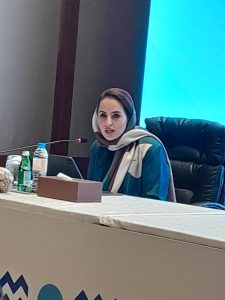
The DCO Secretary-General, Deemah Al-Yahya, noted that the rapid pace of AI development is beginning to surpass the ability of individual states to regulate it on their own.
She went on to state that today’s AI models far exceed, in terms of capabilities, those that existed just a few years ago.
This accelerating trajectory presents both challenges and opportunities simultaneously, Madam Al-Yahya told delegates at the session.
AI’s vast potential
AI Madam Al-Yahya said offers vast potential to boost productivity, accelerate scientific discovery, and improve public services, but also entails cross-border risks.
These risks she mentioned are the spread of misinformation, disruptions to labour markets, and the concentration of capabilities in the hands of a limited number of countries or corporations.
AI Madam Al-Yahya therefore underscored that AI governance is not merely a technical issue, but a value, justice, and a shared future, emphasising: “Today, we have taken the first step to ensure that this future is shaped by the voices of all, not by the voices of a few.”
What the UN is doing
The United Nations Secretary-General António Guterres, who addressed the participants via a video message, lauded the Assembly’s focus on the theme “Inclusive Prosperity in the Age of Artificial Intelligence.”
He said through the Global Digital Compact, UN member states have acknowledged the need for humanity to guide and control the trajectory of technology—rather than allowing technology to control humanity—stressing the importance of sound governance of rapidly evolving digital technologies.
Mr Guterres also noted that the United Nations is currently advancing this agenda through three main tracks, including the imminent launch of an independent scientific panel on artificial intelligence, which will provide neutral, evidence-based assessments of AI opportunities, risks, and impacts.

He also announced that the first Global Dialogue on AI Governance will be held in July at United Nations Headquarters, in a step aimed at strengthening international cooperation and establishing shared frameworks for regulating this technology.
Why AI has become a buzzword
AI has been around for decades, but suddenly, AI has become a buzzword.
Experts have attributed it to three key things.
These are the key reasons: One of them is engagement or engagement. Every time we do any action, it creates AI. Any time that we send a text message, every time we take a phone to make a call, any time that we watch our favourite series on Netflix, it is creating data, Partner In-charge of Data Science and Analytics at Deloitte West Africa, Jania Okwechime, told African Eye Report in an interview.
“So, there is a huge data explosion. 90% of the data that we use today was created in the past. So, you can imagine. Now, we have no choice but to harness technology like AI for our use.”
On the other hand, we also have infrastructure solutions. So, storage is no longer an issue as it was a decade ago. So, because of this, now businesses are trying to leverage AI to transform their organisations.
Generative AI and traditional AI
Touching on generative AI and traditional AI, Madam Okwechime first drew the differences between the former and the latter.
In her words: “The difference is that generative AI can perform tasks predominantly done by humans. Like reading documents, creating documents, generating videos, generating reports, etc.
Now, it is making AI more accessible to businesses in a way that they can harness in three different ways.
They can change the way they interact with their customers and increase customer experience internally within their network and their internal organisations. So that they can improve internal statistics”.
By harnessing AI and generative AI, they can reduce costs by automating tasks, and they can make things more effective and efficient because now you can only put humans in the loop to gain better insight and supervision.
One thing that is key to mention is why AI and generative AI are used today for automation tasks and improving the set of processes that businesses already have.
Only businesses that are going to be successful and thriving in the next five years or those which are harnessing AI to transform what they are doing. And this needs some more thinking, she stated.
Concerns
On concerns of AI leading to job losses and other things, she said: “So, that is the concern, right, because I mentioned that there are certain things that AI and generative AI can do today that were predominantly done by humans. So, that is a concern, and we understand why. However, it doesn’t need to be”.
By Masahudu Ankiilu Kunateh, African Eye Report, back from Kuwait City, Kuwait
