

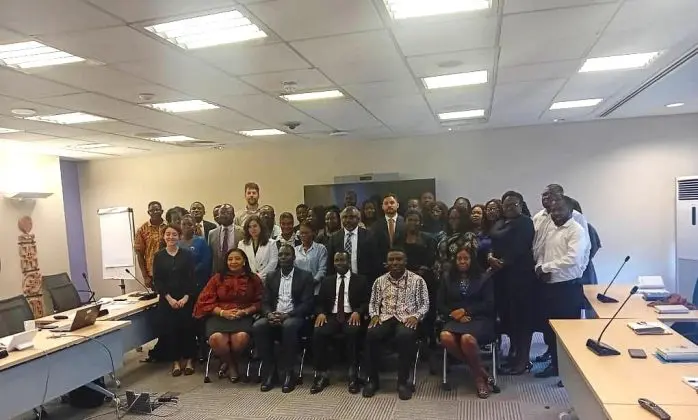
The World Bank Group today partnered with the Swiss State Secretariat for Economic Affairs (SECO) and the Ghana Revenue Authority (GRA) to organise a two-day capacity-building workshop aimed at equipping GRA officials with social behavioural communication strategies to strengthen voluntary tax compliance and improve taxpayer engagement in the country.
The workshop, themed “Leveraging Social and Behavioural Change Communications for Tax Compliance in Ghana,” brought together officials from the GRA’s Communication and Planning Department to enhance their capacity to develop evidence-based communication strategies that encourage voluntary tax compliance, build public trust and foster stronger relationships between taxpayers and the tax authority.
The initiative forms part of ongoing efforts by the World Bank and its partners to support Ghana’s domestic revenue mobilisation drive by strengthening taxpayer education, promoting voluntary compliance and building public confidence in the country’s tax administration system.
The participants were taken through practical sessions on taxpayer education, trust-building, message design, campaign implementation and the application of behavioural science to address tax administration challenges in the West African country, which has been struggling to improve its tax mobilisation..
Speaking at the training, Lead Public Sector Specialist at the World Bank, Raymond Muhula, said the importance of domestic revenue mobilisation to Ghana’s socio-economic development could not be overemphasised.
He went on to acknowledge that sustainable financing for public services depends largely on citizens’ willingness to fulfil their tax obligations.
Mr Muhula added that investments in roads, schools, hospitals, digital infrastructure, social protection, climate resilience among others, require a public finance system capable of mobilising resources fairly, efficiently and sustainably.
“As external financing becomes more constrained and citizens rightly demand better services and accountability, strengthening voluntary tax compliance becomes central to the national development agenda”.
Mr Muhula thanked the Government of Switzerland through SECO for supporting the initiative, saying the workshop was an important step towards strengthening Ghana’s tax administration through behavioural science and strategic communication.
Improving tax compliance requires more than legislation, audits and enforcement measures, adding that trust, fairness and public confidence are key drivers of voluntary compliance, he noted.
People comply when they understand their obligations, when processes are simple, when they believe others are also contributing, when they see fairness in the system, and when they trust that public resources are being used for the common good.
According to him, Social and Behavioural Change Communications (SBCC) goes beyond traditional public awareness campaigns and provides a structured approach to understanding the motivations, perceptions and behaviours that influence taxpayers’ decisions.
It is not simply publicity. It is not a slogan, a poster or a one-off campaign. It is a disciplined approach to understanding what people know, what they believe, what they fear, what motivates them and what prevents them from acting, Mr Muhula said.
Ghana has made significant progress in expanding the tax base, simplifying tax procedures and strengthening digital tax administration, with some reforms supported under the World Bank’s US$150 million Public Financial Management for Service Delivery Programme, he noted.
However, according to him, policy and technological reforms alone would not deliver the desired results without effective communication strategies that influence taxpayer behaviour.
“Taxpayers must know what is expected of them, understand how to comply, and feel that the system is fair, accessible and responsive, while urging communication officers at the GRA to see themselves as drivers of behavioural change and key actors in strengthening the relationship between government and citizens.
He stated: “You are not merely communicators of policy; you are architects of public understanding. You help translate technical reforms into language citizens can trust and use, helping transform tax compliance from a legal obligation into a shared civic responsibility”.
Mr Muhula used the occasion to call for stronger collaboration among government institutions, local authorities, civil society organisations, professional bodies, traditional leaders, educational institutions, technology providers, development partners and the media to build a stronger culture of tax compliance.
In welcome remarks, Commissioner of the Support Services Division at the Ghana Revenue Authority, Dr Alex Adomako Mensah, acknowledged that effective communication is now key to modern tax administration and boosting voluntary compliance.
To this end, he said the workshop reflects the GRA’s commitment to how it engages taxpayers and to building public trust in the tax system.
“Communication is not simply about sharing information. It is about building trust, promoting transparency, encouraging understanding, and creating positive experiences for taxpayers”.
Dr Adomako Mensah observed that while enforcement and audits remain important tools in tax administration, sustainable compliance is achieved when taxpayers understand their obligations, feel respected and receive timely, accurate and consistent information.
According to him, the training aligns with the GRA’s top management vision of “Transformation for Impact and Growth” and supports the Authority’s target of mobilising GH¢360 billion in revenue by 2028.
Achieving the target requires not only improved systems and digital technologies but also a deeper understanding of taxpayer behaviour and experiences, he said.
“Our investments in digital transformation are helping us modernise our systems. Effective communication complements these efforts by ensuring that taxpayers understand our services, can navigate our processes with confidence, and remain engaged throughout their interactions with the Authority,” he said.
Dr Adomako Mensah therefore urged the GRA staff to view taxpayers not merely as transactions but as individuals whose decisions are shaped by their experiences, perceptions and everyday realities.
On his part, the Governance and Public Financial Management (PFM) Specialist at the Swiss Cooperation Office in Ghana, Dr Charles Othniel A. Abbey, reiterated that their journey with the GRA has come a long way.
“For those of you who have been around for a long time, you would know that during the transition period of the unification with the IRS, Customs and GRA and the setup of the management unit and other reforms that have taken place, Switzerland has walked the journey with you. That is why this support through the World Bank, we see it as furthering what work we have done with other partners like GIZ and others”.
Taking the participants through the workshop, a Behavioural Scientist at the Mind, Behaviour & Development Unit of the World Bank Group, Madam Nour Nasr, told them that effective campaign messages should provoke emotions to achieve the desired purpose.
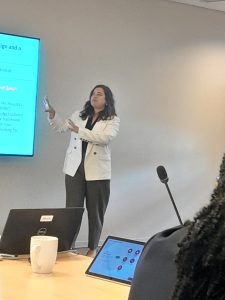
She added that emotions and emotionality are very important factors that the participants need to put into any campaign if they really want the campaigns to go viral and catch the attention of the people.
Madam Nasr explained that behavioural communication focuses on influencing beliefs, attitudes and social norms rather than merely providing information.
She added that social and behaviour change communications are not just about providing information; they’re about shifting beliefs, attitudes and norms around tax obligations. By bringing these insights into the GRA, taxpayer engagement can improve for better revenue collection and stronger trust with the GRA
Speaking in an interview with journalists at the event, an Economist at the Mind, Behaviour & Development Unit of the World Bank Group, Jonathan Karver, noted that the World Bank has observed a shift in the GRA’s communication strategy from an enforcement-driven approach to a more facilitation-oriented model focused on trust-building.
“We found that there’s been a very important shift away from more enforcement-heavy communication with taxpayers to a more facilitation-oriented approach focused on trust-building.
This workshop is about building on what the GRA has already started by making its communication more evidence-based and data-driven”
Mr Karver noted that integrating behavioural insights into tax administration would enable the GRA to design more targeted communication campaigns, improve taxpayer experience and support Ghana’s domestic revenue mobilisation efforts.

