

Accra, Ghana//-United Nations Office on Drug and Crime (UNODC) says Ghanaians from all walks of life paid GH¢5 billion as bribes to public officials to facilitate public service delivery in public institutions in the areas of health, education, transportation, security, and justice delivery in 2021.
“To put the numbers into perspective, this corresponds to almost one third, 32.9 per cent, of the 2021 budget of the Ministry of Education,” the 139- page which preface was signed by the Government Statistician, Professor Samuel Kwabena Annim and the Deputy Commissioner of the Commission on Human Rights and Administrative Justice, Richard A. Quayson, cited 17.million instances of the bribery incidents.
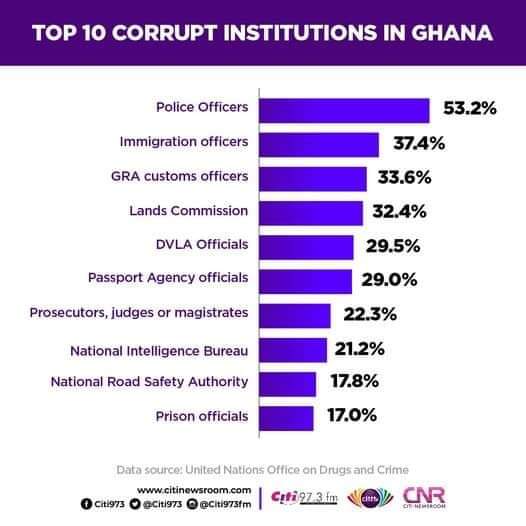
According to the report, the prevalence of bribery is highest in relation to police officers, 53.2 per cent, followed by Ghana Immigration Service Officers, 37.4 per cent, and Ghana Revenue Authority (GRA) Customs Officers, 33.6 per cent.
At the other end of the scale, the prevalence of bribery is one of the lowest in relation to health workers other than doctors, nurses and midwives, at 3.3 per cent, and elected government representatives, at 2.9 per cent, despite having more contact with respondents, it added.
Below are the aforementioned institution are the most rated to be bribe takers
- Lands Commission: This agency under the Ministry of Lands and Natural Resources was identified as the institution that receives the highest average bribe size, with an average of 1669.
- Judicial System (Prosecutors, Judges, and Magistrates): The judicial system came second on the list with an average bribe size of 1204.
- Ghana Immigration Service: Officials of the Ghana Immigration Service ranked third, with an average bribe size of 950.
- Local Government Representatives: Local government representatives ranked fourth in the list of top bribe-taking institutions.
- GRA Customs Officers: Customs officers of the Ghana Revenue Authority (GRA) were fifth on the list.
- Passport Agency Officials: Officials of the Passport Agency occupied the sixth position in terms of bribe-taking.
- Teachers, Lecturers, and Professors: The survey indicated that teachers, lecturers, and professors ranked seventh among the institutions.
- Public Utility Officials: Public utility officials were listed eighth in terms of bribe-taking.
- Doctors, Nurses, and Midwives: Healthcare professionals, including doctors, nurses, and midwives, ranked ninth on the list.
- Driver and Vehicle Licensing Authority (DVLA) Officials: Officials of the DVLA were listed as the tenth institution associated with bribery.
Oti is the region with the highest bribery whiles Western North region is the lowest in taking bribe.
The survey also provided insights into regional variations in bribery requests.
The Oti Region recorded the highest percentage of public officers requesting bribes (91%), followed by the Northern Region (89.2%), Upper East (83.4%), North East (81.2%), Upper West (80.3%), and Ashanti (70.4%).
The full report is https://www.unodc.org/documents/corruption/Publications/2022/GHANA_-_Corruption_survey_report_-_20.07.2022.pdf
