

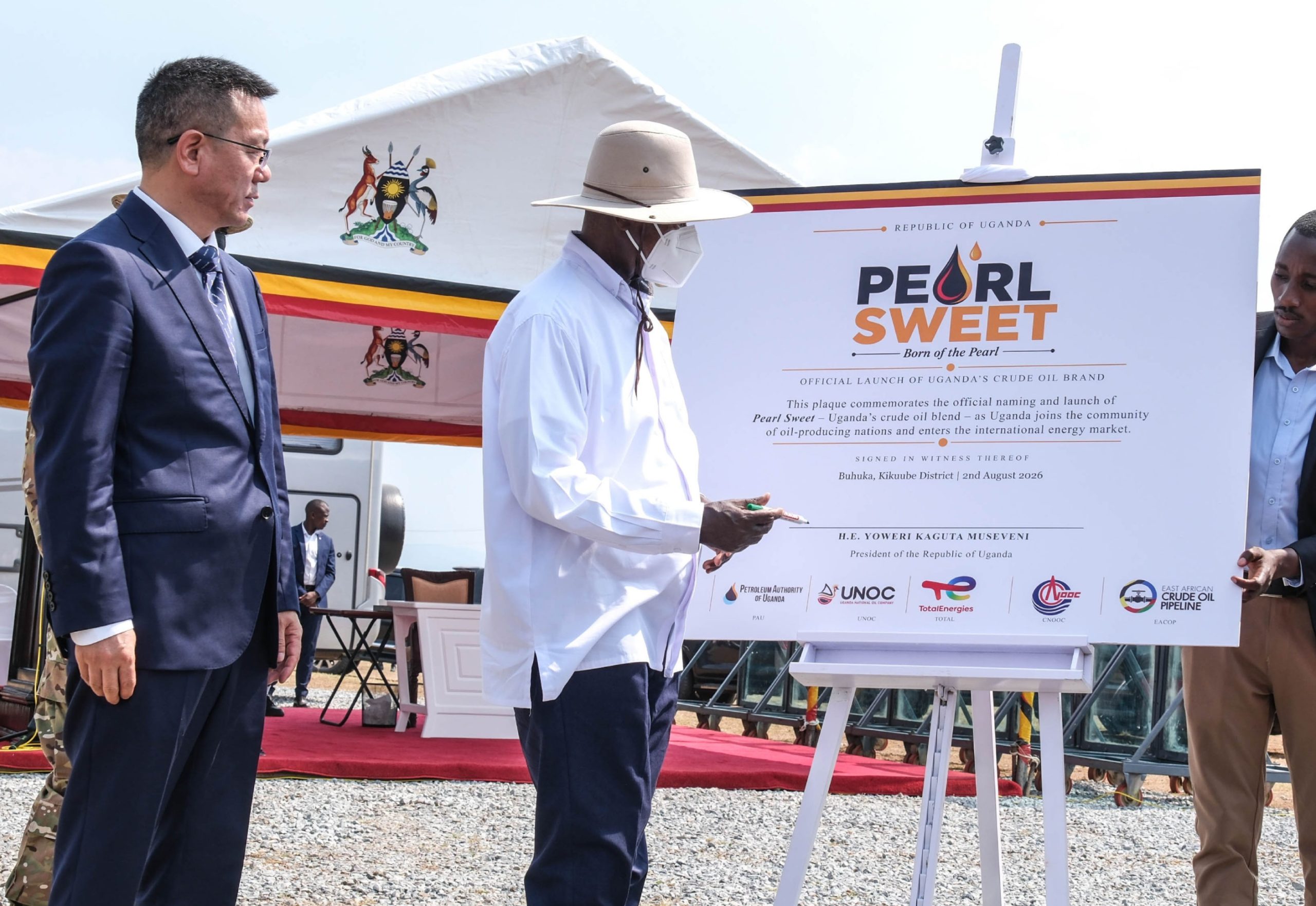
Lake Albertine Graben, Uganda// – Uganda today gave its emerging oil industry a global commercial identity as President Yoweri Kaguta Museveni officially unveiled Pearl Sweet, the name under which the country’s export crude blend will be introduced to international energy markets.
The official naming at a special ceremony at the Kingfisher Development Area marks the point at which Uganda’s crude becomes a recognisable traded product.
International crude oils are bought and sold as identifiable grades, allowing refiners, traders, shipping companies, price-reporting agencies and analysts to recognise their origin and quality and to build pricing histories around them.
Pearl Sweet will give Uganda that market identity for the first time, appearing on cargo documentation, refinery specifications and international trading databases.
The chosen name deliberately carries both national identity and commodity information. “Pearl” reflects Uganda’s historic title as the ‘Pearl of Africa’, a monicker given to the country by Winston Churchill after he was struck by the country’s exceptional natural beauty and resources.
“Sweet” is a petroleum classification reflecting the crude’s low sulphur content, an important characteristic for refiners seeking lower-sulphur feedstocks.
In addition, the blend is considered medium light with an API gravity falling in the 28-31° range. This is a good feature for product yield/value, with a higher API usually meaning more light products and easier refining and a better price.
President Museveni told attendees: “What you sow is what you reap” recounting that Uganda sought a strategy to domesticate the oil industry.
He said the benefits of refining at home included support for the local economy and protection of the environment. Especially because the government has forbidden flaring of gas, he added that oil is a finite resource, and its benefit must be for future generations.
Uganda’s Minister of Energy and Mineral Development, Dr Monica Musenero Masanza, said: “Uganda’s oil journey is anchored on efficiency, responsibility and ensuring that our resources create lasting value for Ugandans.
The naming of Pearl Sweet marks an important step as Uganda prepares to take its place in the international oil market.
The progress at Tilenga and Kingfisher shows that we are ready to produce responsibly, safeguard the environment and build an industry whose benefits are felt across the Ugandan economy.”
UNOC Chief Executive Officer Proscovia Nabbanja said: “Pearl Sweet gives Uganda’s crude what every traded grade needs: a clear identity, a defined quality and a name the market can recognise. The Pearl speaks to Uganda.
The Sweet tells refiners something important about the crude itself. For UNOC, the naming opens the next phase: taking Uganda’s barrels to market, building long-term relationships with refiners and traders and capturing maximum value for the country.”
Chairperson of the sector regulator PAU, Lynda Biribonwa, said: “As Uganda prepares to enter the era of oil production, our collective responsibility is to continue converting petroleum resources into skills, enterprises, infrastructure, technology, industrialisation, energy security, and shared prosperity.
Uganda’s crude oil, Pearl Sweet, will be known for its quality and the positive impact it creates in the lives of Ugandans.”
The name was selected following technical assessment of the crude, stakeholder consultation and evaluation against commercial, cultural and international branding criteria before final Presidential endorsement.
Pearl Sweet was chosen because it connects a distinctively Ugandan identity with a technically meaningful market designation.
The new crude will combine processed crude from Tilenga and Kingfisher at the Kabaale Shared Facilities in Hoima before entering EACOP, a 1,443km heated export pipeline connecting Uganda to Tanzania’s Tanga port.
The Lake Albert Integrated Development is built around approximately 1.65 billion barrels of recoverable oil resources.
Tilenga, operated by TotalEnergies EP Uganda, is designed to produce about 190,000 barrels per day at peak production. Kingfisher, operated by CNOOC Uganda Limited, is designed for about 40,000 barrels per day. Together they are expected to deliver approximately 230,000 barrels per day at peak.
UNOC holds a 15% participating interest on behalf of the Government of Uganda in both upstream developments. Through its wholly owned National Pipeline Company Uganda Limited, it also holds a 15% interest in EACOP alongside TotalEnergies, Tanzania Petroleum Development Corporation and CNOOC.
Projects move into commissioning
EACOP provides the export route that turns landlocked Uganda into an Indian Ocean crude supplier. As the longest electrically insulated crude pipeline in the world, the 1,443 km buried pipeline runs from Kabaale in Hoima District to the marine export terminal at Chongoleani near Tanga, Tanzania.
It will ensure flow assurance, consistent quality and temperature management, and reliable transit to export markets.
From project development to commercialisation
Pearl Sweet was launched today following years of investment in one of the largest industrial developments in Uganda’s history.
Tilenga, Kingfisher and EACOP represent an investment programme of around US$15 billion, with more than US$12 billion already invested across the three projects as Uganda approaches First Oil.
The investment is also building domestic capacity. Total employment in the sector as of March 2026 was 22,234, with 85% being Ugandan nationals.
Across the sector, more than 14,000 Ugandans have been trained and certified in oil and gas disciplines, while local-content requirements have retained a significant share of project spending in Uganda.
