

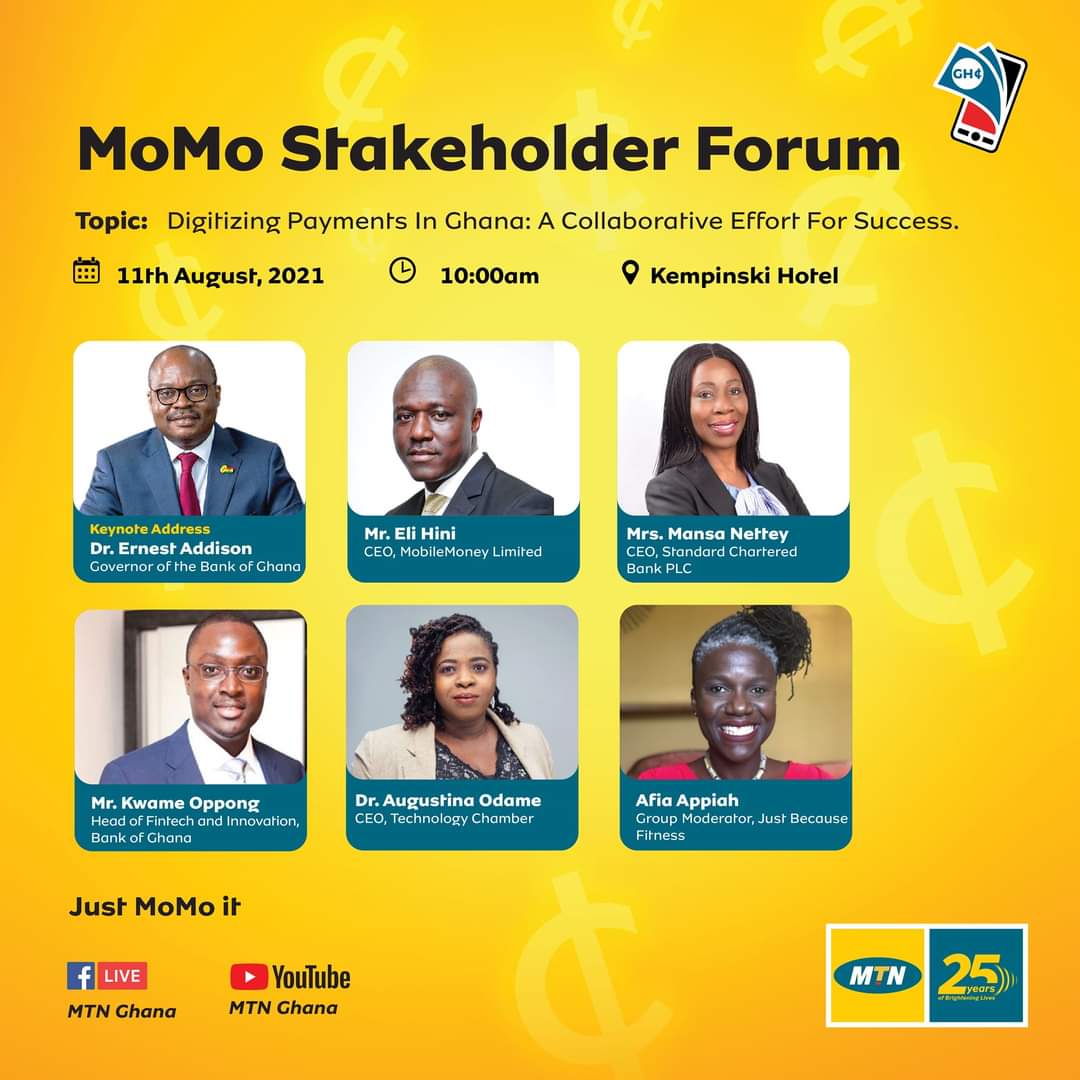

Accra, Ghana//-Stakeholders at this year’s MTN MoMo Forum have expressed worry over the high cash usage despite giant strides in Ghana’s financial digitization process over a decade.
According to the stakeholders comprising Mobile Money (MoMo) operations, banks, regulator, and consumers, more than 70% of transactions are still being done in cash.
Setting the tone for the discussion on the theme: ‘Digitizing Payments in Ghana: A Collaborative Effort for Success’, the Governor of the Bank of Ghana (BoG), Dr Ernest Addison in a read for him by the Director of Payment Systems Department at the BoG, Dr Dr Setor Amediku, said: “With such giant strides in Ghana’s financial digitization process, one would have thought that cash usage would go down to the barest minimum. Unfortunately, this is not so, despite the attendant risks with cash usage”.
This clearly shows that the adoption of digital payments still remains uneven and there is room for improvement to move the frontier towards financial inclusiveness through broad-based digital payments, he added.
Giant strides
The BoG which is the regulator of the digital payments space as well as the banking and finance sector has provided the requisite leadership in the development of electronic payments in the country.
Over the years, the Bank has revamped the payment systems regulatory and legal frameworks and created an enabling environment to foster innovation and competition.
This also paved way for payment service providers, especially during this pandemic era to scale up access to digital financial products and services.
These efforts according to Dr Addison have yielded positive results and the mobile money space has contributed significantly to Ghana’s financial inclusion progression.
“Mobile money slots are visible all across the country, and the volume and value of transactions are on the ascendancy”.
MoMo accounts have increased thirty-fold
He revealed that over the past decade, mobile money accounts have increased thirty-fold, to 44 million in June 2021.
The volume of mobile money interoperability transactions have also increased twenty-four fold since its launch in 2018 to 10.3 million in June 2021, while GHIPSS Instant Pay volume of transactions has also increased significantly since 2016, according to the Governor.
New business models emerged
Dr Addison told participants at the forum organized by MobileMoney Limited, the mobile financial services subsidiary of MTN Ghana, that: “Beyond this outstanding performance of electronic transactions, new business models have emerged on the back of financial technology, providing a further boost to electronic payments”.
Currently, financial technology companies (fintechs) are collaborating with traditional financial institutions to provide innovative financial service solutions such as digital savings, credit, pension and insurance, he noted.
“Indeed, financial digitization has expanded to include products that support government revenue collections, utility payments, and disbursement of financial aid to vulnerable groups in society.
Banks and other financial institutions have all intensified efforts to move operations to digital platforms to better serve customers”.
Collaborations
To take advantage of the existing opportunities, the Bank’s long-term strategy for the payment systems is to push for more collaboration among providers of financial digital products and electronic financial services.
In some jurisdictions, such collaborative efforts have fostered greater economies of scale through resource pooling of infrastructure and minimized cost of testing new technologies, which have helped accelerate digitization of the value chain for both merchants and users, Dr Addison noted.
“Under the current regime, our consolidation of ATM networks, introduction of the Cheque Codeline Clearing, Instant Pay services, the mobile money interoperability platform, and the Universal QR Code services were all part of the collaborative strategy aimed at eliminating fragmentation and duplication”.
These collaborative initiatives have provided open and fair access to a shared payment infrastructure for banks and non-banks. It also serves as a good example of a strategy of collaborative competition which has been shown to increase scale and widen the scope of mobile money operations.
In the same direction, the Bank, as part of the policy to provide a safe financial system, has collaborated with the financial services industry to establish a Financial Intelligence platform.
This platform collates analyses and disseminates real-time information on cyber threats and trends to enhance the detective capabilities of the industry.
The success story of the payment service industry cannot be told without reference to the strong collaboration between the Bank and market players.
On several fronts, the BoG he said has worked with stakeholders to institute the sound regulatory frameworks that now guide the industry.
These Dr Addison mentioned include issuance of the Branchless Banking Guidelines, Electronic Money Issuers Guidelines, and the passage of the Payment Systems and Services Act 2019 (Act 987); and the Payment systems Advisory Committee, which includes all the key stakeholders in the payment ecosystem, continues to provide a shared platform for accelerating digital payments.
The strong partnership that exists between banks and non-bank financial institutions for the provision of digital payments is expected to strengthen further, with the delivery of innovative value-added products and services to enhance financial digitization.
To sustain the process, market players should continue to harness customer data to develop targeted value-added products but the confines of the data protection act and regulations.

Incumbents, for instance, have large volumes of data but the current legacy systems may inhibit their ability to glean insightful information from this data for product development.
With more agile technological capabilities and artificial intelligence, new entrants into the industry could collaborate with incumbents to deploy new products and services based on existing data that could foster a more vibrant payment ecosystem and penetrate the unserved segment of the market.
Beyond these, banks and non-banks should collaborate and intensify efforts on education campaigns and awareness-building on issues of payment fraud and general use cases.
The successful implementation of such consumer education programmes could impact positively on behavioural change and build confidence in digital payments and services.
In addition, collaboration between agents and merchants should be strengthened to spur growth in digital payments, eliminate duplication of efforts and lower costs.
On his part, the Chief Executive Officer of MobileMoney Limited, Eli Hini, said the stakeholders need to do more to rope in the informal sector operators into in the digital payments space.
African Eye Report
