

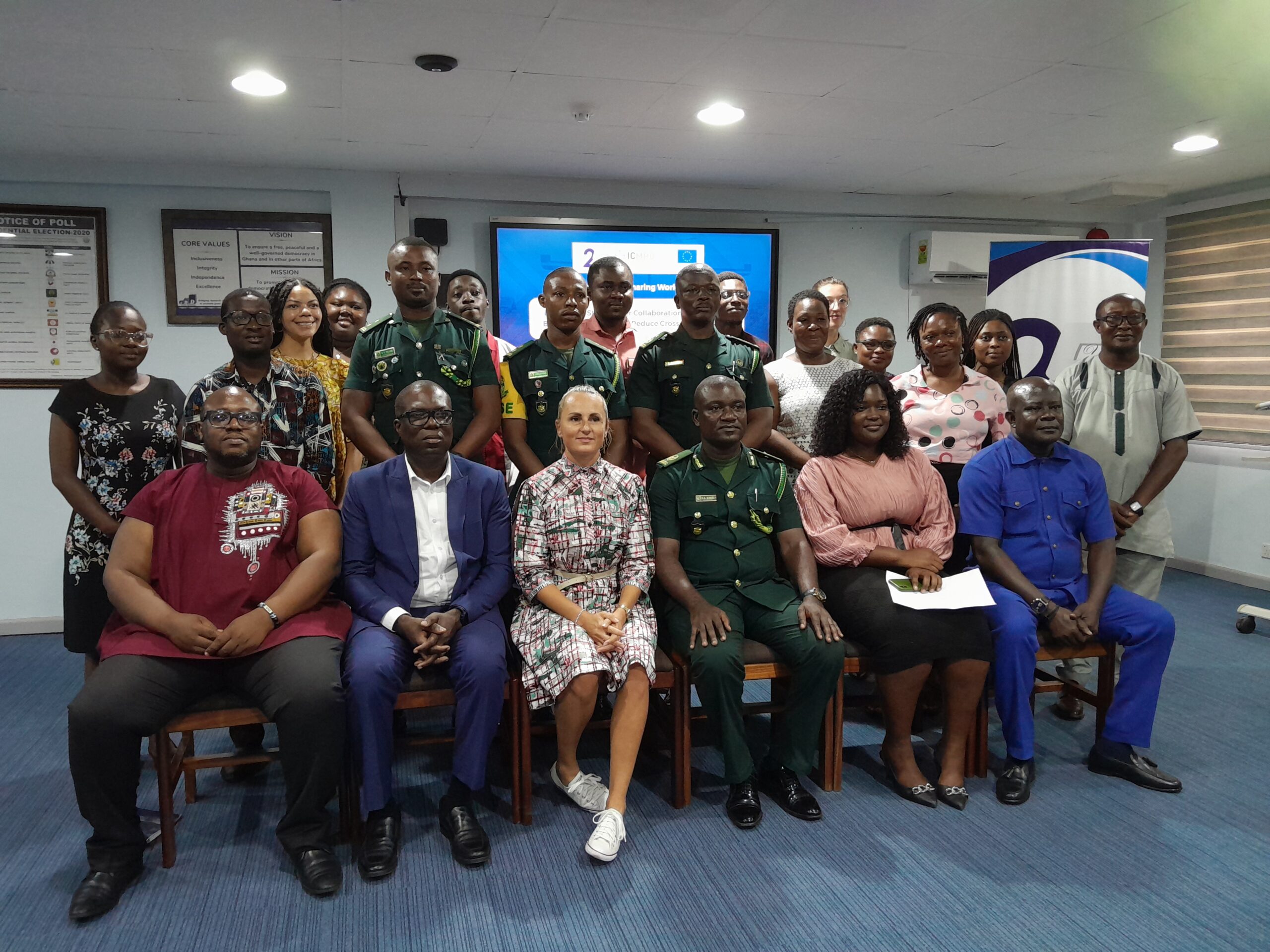

Accra, Ghana//-Stakeholders at an experience-sharing and policy uptake meeting organised by the Ghana Center for Democratic Development (CDD-Ghana) have called for holistic education and policy action to address security challenges in border communities across the country.
According to them, continued holistic education and policy action are the surest ways that Ghana’s territorial borders marked with significant challenges that affect border management can be addressed.
Presenting the findings of a survey-‘Improved Border Management to Reduce Cross-border Crimes’, a CDD-Ghana and ICMPD Project, Programmes Manager and Team Lead, Local and Urban Governance of CDD-Ghana, Paul Nana Kwabena Aborampah Mensah mentioned that there are numerous border challenges confronting the country.
Some of the challenges he cited include inadequate security personnel to patrol the borders; inadequate logistics particularly firearms for security officers; unavailability of border fences; and smuggling and transnational criminal activities along the country’s borders.
Caution
Mr Aborampah Mensah who delivered the presentation before the open discussion cautioned that although Ghana has never experienced extremist acts like Burkina Faso and other neighbouring countries, “it doesn’t mean that it can’t happen to us”.
He revealed: “When we did the baseline survey last year, 26% of citizens thought there was the need to report suspected crimes to the security agencies.
Two years down the lane, recently the baseline survey indicated that 78% of the citizens now know that there is the need for them to collaborate with the security agencies to address crimes in the border communities”.
Respondents scored border crimes in terms of their rates of occurrence as follows: Smuggling of goods and other products, including fertiliser — 33 cents; irregular migration — 25 cents; child trafficking — eight cents; small arms smuggling — seven cents, and human trafficking — three per cent.
Mr Aborampah Mensah however noted that; “behavioural is gradual and it is not instant, so we need to keep hammering on the security issues. But we have seen a bit of improvement”.
Unstable sub-region
“We are living in an unstable sub-region particularly Burkina Faso which is a key neighbour of Ghana, and ongoing insurgency in Niger and Mali”.
The fears of terrorists entering Ghana through Hamile have been heightened. The Burkina Faso mayhem also brought terrorists into Ghana, while recently somebody traced a terrorist into Ghana among others creating fears among people living in the border communities and the country at large, Mr Aborampah said.

“So, some of these things tell you that in the context of the kind of borders that we have that makes it difficult for the limited number of our immigration officers to man them.
We all need to be cautious and educate ourselves and find solutions and resilient mechanisms as to how in the case of the worst scenario our community people will be able to withstand the shocks”.
Withstand the shocks
Ghana according to him would be able to withstand the shocks so that is the aspect from which civil society organisations including CDD-Ghana and others are coming.
“Of course, our counter-terrorism framework or our national security framework allocates core mandate for the media and civil society organisations to support security.
The security mantra is security is shared responsibility. So, it is based on this that CDD-Ghana and its partners surveyed to find out the perception and orientation of people living in the border communities to some of these security challenges.
As the data said when they started, they never thought that issues of violence aggression and extremism could engulf Ghana. They had similar projections or data from WANEP in 2015 in Burkina Faso which indicated that 76% of Burkinabes thought that they wouldn’t be experiencing violent extremism.
However, in 2017 and 2018, they experienced about 25 bombings. So, that is the optimism and dangers that it poses. So, it is good that they remind themselves.
While conducting the survey, Mr Aborampah Mensah said they also realised that there were bits of policy challenges. That is the essence of this stakeholders meeting, he told the participants drawn from the Ghana Immigration Service (GIS), National Security, and representatives of civil society organisations, among others.
More entry routes are needed to improve security
The survey which was conducted by the CDD-Ghana in collaboration with the GIS and funded by the EU and the International Centre for Migration Policy Development (ICMPD) called for the creation of more approved entry routes, in and out of the country.
The move the report said would go a long way to minimise cross-border crimes and increase revenue for the country.
The report also called on the Ministry of the Interior to facilitate a review of the Immigration Act, 2000 (Act 573) to create additional approved entry points to reduce the use of unapproved routes which posed threats to the country.
Currently, there are 48 approved routes and an increase in the number, the report indicated would ultimately help to reduce the surging threats of violent extremism, small arms smuggling, human trafficking, child trafficking, irregular migration and smuggling of goods, among others.
Open discussions
The open discussions were facilitated by the Director of Programmes and Policy Engagement of CDD-Ghana, Dr Kojo Asante and participants called for the amendment of the Immigration Act, 2000 (Act 573) to add more approved routes to facilitate the smooth movement of people and goods.
They further asked the government to improve the welfare of security officers manning the country’s borders, among others.
On her part, the Project Manager in charge of Strengthening Border Security in Ghana, Julia Socea, said the experience-sharing meeting was significant in the ongoing joint effort to enhance migration management in the country.
She added that the meeting also provided an opportunity for participants to share experiences and how best to help shape migration policies for the betterment of Ghanaians.
