

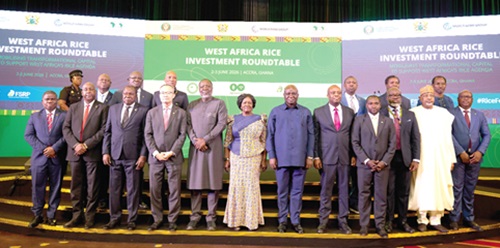
Accra, Ghana//-West African leaders and partners ended the West Africa Rice Investment Roundtable with a clear and strong message: the region needs more investment in rice to boost food security, cut imports, and create jobs.
The two-day event –organised as part of the AgriConnect Initiative, convened by Economic Community of West African States (ECOWAS), the World Bank Group and the African Development Bank, and hosted by the Government of Ghana— brought together ministers, 15 country delegations, investors, agribusiness leaders, and technical experts.
Their goal was to support the sourcing of concrete financial and technical partnerships to support their National Rice Investment Action Plans.
With demand for rice rising faster than local production, participants stressed the need for large, coordinated investment to help West Africa move closer toward rice self-sufficiency by 2035.
Targeted Investment Areas
The roundtable focused on practical investment opportunities across the rice value chain. These included irrigation, seed systems, machinery, milling, storage, transport, and trade. A major outcome was the presentation of a strong regional pipeline of projects based on national rice strategies.
Participants also called for better policy coordination, risk-sharing tools, and stronger public-private partnerships to turn plans into real projects.
Regional Collaborations
The meeting also strengthened commitment among governments, regional bodies, development partners, and the private sector to work more closely together.
Participants backed stronger follow-up through regional coordination platforms, including the ECOWAS Rice Observatory, and built the momentum for a Regional Rice Investment Compact to guide the next steps.
By bringing key public and private actors around one regional agenda, the roundtable showed development value, commercial and job creation potential for the rice sector.
It also highlighted the importance of strong partnerships to build a more competitive, resilient, and inclusive rice economy in West Africa.
Launch of Ghana’s AgriConnect Compact
On the sidelines of the event, the Government of Ghana, supported by the World Bank Group, launched its AgriConnect Compact on June 3, 2026.
This country-led initiative puts agriculture at the centre of Ghana’s economic transformation, job creation, and resilience agenda.
It aims to create more than 2.6 million jobs, improve food and nutrition security for nearly 3 million people, and attract a $3.5 billion investment program over five years.
The Compact focuses on priority value chains such as rice, maize, cocoa, oil palm, and poultry, while supporting reforms to raise productivity and attracting private investment. With a systems approach that includes irrigation, mechanisation, climate- smart agriculture, and digital innovation, the initiative shows Ghana’s commitment to modern, market-led agriculture and offers a strong example for the region.
What Speakers Say at the Event
Vice-President of the Republic of Ghana, Professor Jane Naana Opoku-Agyemang, said: “The challenge before us is not just about growing more rice, but also about mobilising the scale of capital required to transform agriculture from a subsistence sector to commercial production, and from fragmented production to integrated value chains”.
We must therefore also see rice as a strategic economic asset. It is about jobs for young people, incomes for farmers, and strengthening the resilience of our economies against future global shocks,” she added.
The President of the ECOWAS Commission, Dr Omar Alieu Touray, said: “Our ambition is clear: to build more competitive, inclusive, and sustainable agrifood systems that strengthen food sovereignty, create economic opportunities, contribute to shared prosperity, and progressively achieve regional rice self-sufficiency by 2035.
This Roundtable must therefore serve as a catalyst for action. It must strengthen investor confidence, reinforce partnerships, accelerate financing for bankable opportunities, and help build a more competitive, resilient, and self-sufficient regional rice economy.”
The World Bank Group Vice-President for Planet, Guangzhe Chen, noted: “West Africa has both the pipeline and leadership to accelerate real transformation in the rice sector. Ghana’s AgriConnect Compact demonstrates how this agenda can deliver jobs, strengthen resilience, and drive inclusive growth at scale.”
The Director, Agricultural Finance and Rural Development at the African Development Bank, Richard Ofori-Mante, said: « Agriculture must no longer be treated as a social sector; it must be recognised as a productive economic sector capable of driving growth, creating jobs, and powering industrialisation.
At the centre of this transformation is Africa’s youth. The rice value chain offers substantial opportunities across irrigation services, mechanisation, processing, logistics, digital agriculture, and agribusiness entrepreneurship. Harnessing this potential is essential to turning Africa’s demographic growth into an economic dividend.”
