

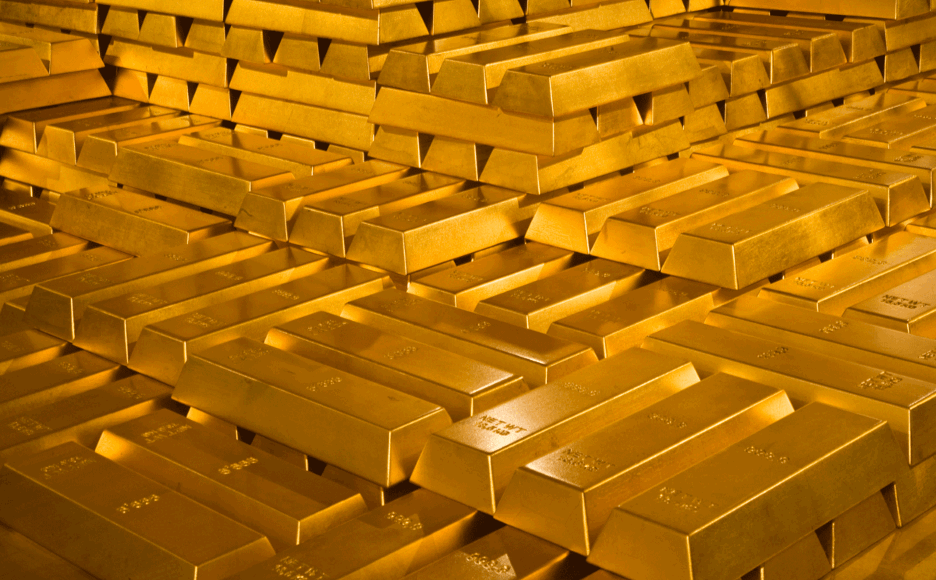

Gold has jumped past $5,100 an ounce, setting a new record as the dollar weakened to a four-month low, reinforcing gold’s classic inverse relationship with the greenback.
Escalating trade tensions driven by President Trump’s tariff threats, concerns over Fed independence, and rising geopolitical risks are shaking confidence in U.S. assets, pushing investors toward gold as the ultimate haven. In light of this, I am sharing insights from our report, highlighting the largest national reserves of gold around the world as well as the countries leading in gold purchases and sales.
Gold prices began climbing sharply in 2024 as central banks and investors alike turned to the precious metal as a haven amid mounting geopolitical tensions and global economic uncertainty.
While some countries accelerated their gold purchases to strengthen reserves, others seized the opportunity to cash in on elevated prices by selling significant volumes. The team at BestBrokers analysed the World Gold Council’s December release, covering all of the available data for 2025, to identify the world’s largest buyers and sellers of gold during this period. The complete dataset behind the report can be accessed on Google Drive via the following link.
Global gold reserves are now estimated at $5.99 trillion, buoyed by a series of record-breaking gold prices that have propelled the holdings of the world’s largest reserves to unprecedented levels. The United States maintains its lead in absolute terms, with reserves valued at around $1.33 trillion, followed by Germany at approximately $549.79 billion. Italy and France remain key players in the global gold arena, with holdings of roughly $402.36 billion and $399.92 billion, respectively.
Countries with the largest gold reserves as of January 2026:
- United States: 8,133.46 tonnes, now valued at $1.33 trillion
- Germany: 3,350.25 tonnes, now valued at $549.79 billion
- Italy: 2,451.87 tonnes, now valued at $402.36 billion
- France: 2,437.00 tonnes, now valued at $399.92 billion
- Russian Federation: 2,326.52 tonnes, now valued at $381.79 billion
- China: 2,305.37 tonnes, now valued at $378.32 billion
- Switzerland: 1,039.94 tonnes, now valued at $170.66 billion
- India: 880.18 tonnes, now valued at $144.44 billion
- Japan: 845.97 tonnes, now valued at $138.83 billion
- Turkey: 644.28 tonnes, now valued at $105.73 billion
Other highlights from the report:
- At a market price of $5,104.20 per ounce as of 26th January, the total value of global gold holdings stands at approximately $5.99 trillion, elevating the world’s largest reserve holders to record valuations. The United States remains the largest owner with 8,133.46 tonnes of gold, followed by Germany at 3,350.25 tonnes. Italy and France round out the top four, with reserves totaling 2,451.84 tonnes and 2,437 tonnes, respectively.
- The market value of U.S. gold reserves has climbed to a record $1.33 trillion, reinforcing the country’s position as the world’s largest official holder of the precious metal. While the United States has kept its gold stockpile unchanged at 8,133 tonnes for decades, the unprecedented rally in gold prices has lifted the value of those holdings to historic levels, pushing them beyond the $1 trillion threshold for the first time in 2025. If current price dynamics persist, the valuation of U.S. gold reserves could continue to rise sharply, placing further distance between the United States and all other reserve holders.
- Poland emerged as the world’s most aggressive central-bank gold buyer in 2025, adding 95.10 tonnes, despite record market prices. The country’s reserves grew to 543.35 tonnes, representing 27.6% of its total reserve assets and valued at $89.17 billion, a move driven by heightened geopolitical uncertainty. Kazakhstan and Brazil followed similar accumulation patterns, reflecting a broader regional shift toward hard-asset security, with Kazakhstan adding 49 tonnes and Brazil increasing its holdings by 42.80 tonnes over the year.
- Turkey and China continued to build their gold reserves through steady accumulation, adding 33.70 and 25.80 tonnes, respectively, with the Czech Republic close behind at 19.60 tonnes. China ranks as the world’s sixth-largest holder, with gold valued at $378.32 billion, while Turkey sits in tenth place with reserves worth $105.73 billion. The Czech Republic, by contrast, is far lower at 45th, holding 70.79 tonnes valued at $11.62 billion.
- Measured per capita, Switzerland leads the world with $19,030.87 in gold reserves per citizen (115.97 grams), followed by Lebanon at $8,047.05 (49.04 grams), Italy at $6,802.81 (41.45 grams), and Germany at $6,539.27 (39.85 grams).
‘The ongoing surge in gold prices and record valuations of national reserves suggest a sustained shift in global investment and reserve strategies. Central banks appear increasingly focused on hard assets as a hedge against economic volatility, currency fluctuations, and geopolitical uncertainty. This trend could accelerate further if the U.S. dollar continues to weaken or if geopolitical tensions persist, prompting even traditionally cautious reserve managers to increase their gold holdings.
European nations with high per-capita reserves, such as Switzerland, may see growing influence in international gold markets, while emerging-market buyers like Poland, Turkey, and Kazakhstan signal a diversification away from conventional financial instruments. Looking ahead, the interplay between central-bank policies, currency movements, and investor sentiment is likely to keep gold at the center of both national reserve strategies and global market volatility, reinforcing its role as a key safe-haven asset in 2026 and beyond.’
– comments Alan Goldberg, lead data analyst at BestBrokers.
More information about countries’ demand for gold is available in the full report. It includes more details about the latest changes in the official national gold reserves reported to the International Monetary Fund, as well as the complete methodology behind our findings. The complete dataset is also available on Google Drive via the following link. Feel free to use any data or graphics for publication by providing a link to the original report.
Ben Goldstein
Senior data analyst
MarketsChain
