


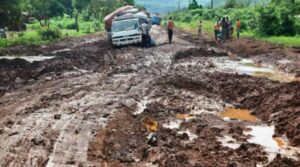
Accra, Ghana//-It is a daily ritual to see young and aged farmers getting down to push vehicles and tricycles transporting their farm produce to the market centres due to poor roads, making prices of foodstuffs very expensive for people to afford.
“We have plenty of foodstuffs in this area. But whenever it rains, the road becomes impassable, making it difficult for us to cart our goods to the market centres to sell”, Kwaku Yeboah, a 65-year-old farmer, lamented.
Mr Yeaboh, who has been a cassava and maize farmer for the greater part of his life, does not believe that the government cares about farmers in the country.
“It is only during electioneering that politicians drive their big cars from Accra to Donkorkrom in the Afram Plains, North of the Eastern Region and other farming communities across the country to canvas for our votes. But after the elections, they don’t deliver on the good roads they promised us”, he added.
While pointing at a muddy and bumpy road, Nana Esi Ama, another farmer, noted: “We farmers are the ones supplying foodstuffs to the people living in the urban areas. However, our roads are very bad”.
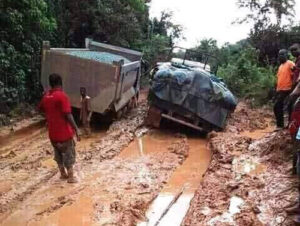
Because of the bad roads, we sometimes get involved in road accidents, leading to injuries and destruction of farm produce. Sometimes, some farmers and traders meet their untimely death in their attempt to transport the foodstuffs to feed their compatriots in the urban and peri-urban areas, Opanyin Adu also lamented.
“So, we will hold back food production if the challenges of the poor roads are not addressed on time”, they have threatened.
The above ordeals narrated by the farmers are not unique to them alone. Farmers across the country are facing the same challenges of poor roads in transporting their food commodities to feed the urban people.
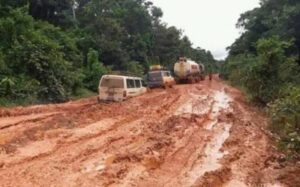
The poor road network debacle is not only affecting farmers alone. It is also affecting the traders, mostly market women who travel long distances from the capital city of Accra and other cities in the country to transport the foodstuffs to the cities where markets are available.
Rising food inflation
Coupled with these, as the market women travel over several kilometres to transport the farm produce to the cities, their costs of transportation also go up, which they intend to pass on to the consumers.
This is the reason why Ghana has been recording high food inflation since the outbreak of COVID-19 in March 2020.
For instance, food inflation rose to 61.0% in January 2023, from 59.7% recorded in December 2022, according to the January 2023 Consumer Price Index (CPI) released by the Ghana Statistical Service (GSS).
It also indicated that inflation for locally produced items was 50.0%, while inflation for imported items inched up to 62.5%.
Consequently, the rising food prices pushed the CPI up. Although transport inflation dropped for the first time in several months due to the recent reduction in fuel prices.
However, transport fares of commercial vehicles, which are used by more than 70% of the population, are still very high in the country.
Post-harvest losses
The Head of Food System at the World Food Programme (WFP), Steven Odarteifio, indicated that Ghana loses about $1.9 billion of its crop production to post-harvest losses annually.
He attributed the huge losses to factors including poor road network, lack of processing, and storage facilities, which successive governments have done little to address.
What can be done to address the poor roads?
Present and successive governments have prioritised the construction of roads in food-producing areas of the country to ease the burden that farmers, market women and other users go through smoothly.

The then Minister of Finance, Ken Ofori-Atta, told Members of Parliament (MPs) on Wednesday, November 15, 2024, to address poor roads, which are holding back food transportation and others, the government is working hard to improve the road network in the country.
He indicated that routine maintenance activities of the Ministry of Roads and Highways, comprising grading, pothole patching, shoulder maintenance, and vegetation control, had been carried out on 4,809km of the trunk road network; 8,984km of the feeder road network; and 2,318km of the urban road network.
“In addition, periodic maintenance activities comprising asphalt overlay, re-gravelling/spot improvement and resealing works were carried out on 49km, 327km and 148km of trunk, feeder and urban road networks, respectively.
Under the Department of Urban Roads’ (DUR) asphaltic overlay programme, a total of 1,814km of asphalt overlay works were completed from 2017 to date, of which 37km was done in 2023.
Further, minor rehabilitation works covering upgrading and the construction of culverts and drainage structures were carried out on 268km of trunk roads, 415km of the feeder and 40km of the urban road networks, respectively, Mr Ofori-Atta said.
The government, according to its 2024 Budget Statement and Economic Policy, is piloting the implementation of performance-based road contracting through the rehabilitation and maintenance of about 1,052km of trunk and feeder roads.
These roads are located in the Bono East, Northern and Upper West regions. Physical works in the Bono East and Upper West regions involving 214km and 670km of feeder roads are at 67 per cent and 64 per cent complete, respectively. The rehabilitation of the Yendi–Zabzugu–Tatale road is 41 per cent complete, while the Tamale–Yendi road is 44 per cent complete.
As part of measures to improve mobility and accessibility in urban areas, the Kumasi Lake Road and Drainage Extension project was completed. Works on selected roads in Sekondi and Takoradi. Phase one is 28 per cent complete.
Works on Phase two of the Tema Motorway Roundabout, which involves the construction of the 3rd tier of the interchange, is 56 per cent complete, while construction of the Flyover over the Accra-Tema Motorway from the Flowerpot roundabout is 60 per cent complete, the budget document added.
Construction of a four-tier interchange at Suame in the Ashanti Region has also commenced, while efforts to improve safety and capacity along major trunk roads are ongoing on the dualisation of the Nsawam – Ofankor road.
It involves the widening of the road to 10 lanes with a six–lane expressway and four–lane service road with interchanges at Amasaman, Pobiman, Medie and Nsawam Junction, it noted.
In spite of these numerous roads across the country, farmers are still grappling with poor roads, as pictures in this story have shown.
Bottom line
Indeed, agriculture is a very crucial part of development and poverty reduction in Ghana and other developing countries.
In that regard, agriculture, especially farming activity, depends on good roads for the transportation of the farm produce to the market centres in the urban parts of the country.
