

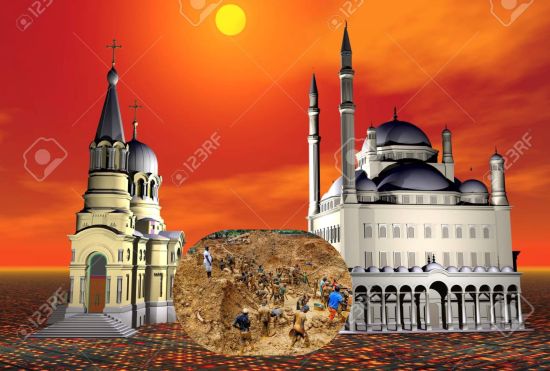
Dear Esteemed Religious Leaders,
I write to you not in anger, but in deep concern – and with profound respect for the sacred responsibility you carry as shepherds of conscience in our nation.
Galamsey has long ceased to be merely an environmental issue. It has become a moral collapse – a crisis that exposes the widening gap between what we profess in our places of worship and how we live as a people.
Across Ghana today, rivers that once sustained life now run brown and toxic. Forests that once breathed for the nation lie stripped and silent. Farmlands are poisoned. Communities are sickened. And yet, many of those directly involved – and many more who benefit quietly or look away – identify as Christians or Muslims.
This compels an uncomfortable but necessary question: Do Christian and Muslim galamseyers truly read – or understand – their own holy books?
And perhaps even more troubling: What of those who watch in silence?
Stewardship Is Not Optional
Both Christianity and Islam speak with one voice on humanity’s responsibility toward the Earth.
The Bible states clearly:
“The Lord God took the man and put him in the Garden of Eden to work it and take care of it.” – Genesis 2:15
And again:
“The earth is the Lord’s, and everything in it.” – Psalm 24:1
No individual, chief, politician, company, or institution owns Ghana’s rivers, forests, or soil. They are entrusted to us for generations yet unborn.
The Qur’an affirms the same truth:
“Indeed, I will place upon the earth a steward (khalifah).” – Qur’an 2:30
A steward who destroys what he is entrusted with has abandoned his mandate.
Destruction Is Explicitly Condemned
Scripture leaves no ambiguity on environmental destruction. The Bible warns:
“Do not pollute the land where you are… Do not defile the land in which you live.”
– Numbers 35:33–34
And again:
“The time has come… for destroying those who destroy the earth.” -Revelation 11:18
The Qur’an is equally unequivocal:
“Do not cause corruption on the earth after it has been set in order.” – Qur’an 7:56
“Corruption has appeared on land and sea because of what the hands of people have earned.”- Qur’an 30:41
This is not a metaphor. It is our lived reality. Rivers are dead. Farmlands are poisoned. Entire ecosystems are collapsing. Over 65% of Ghana’s rivers are now biologically dead.
Silence Is Also Guilt
This crisis is not sustained only by those operating excavators. It is sustained by silence.
_Religious leaders who preach every week yet refuse to confront environmental destruction share in this moral failure._ So do citizens who look away because it is inconvenient or politically uncomfortable.
The Bible is clear:
“Faith by itself, if it does not have works, is dead.” – James 2:17
The Qur’an asks pointedly:
“Why do you say what you do not do?” – Qur’an 61:2
Silence in the face of injustice is not neutrality. It is complicity.
Those in Power Bear the Greatest Burden
There is, however, a deeper responsibility. Those who hold authority – political leaders, traditional rulers, regulators, security agencies, financiers, and crucially, professional bodies such as the Ghana Medical Association and Ghana Registered Nurses and Midwives Association – carry a heavier moral weight.
They are not powerless. They possess influence, authority, and voice. When such power is used to protect interests rather than the future, the damage multiplies.
Scripture is unequivocal:
“From everyone who has been given much, much will be demanded.”
– Luke 12:48
And the Qur’an warns:
“Indeed, Allah does not love the corrupters.” – Qur’an 28:77
Those who allow destruction to persist should not expect to escape consequence – whether from the law, from history, from nature, or from God.
A Call to Moral Leadership
This is no longer a political debate. It is a moral reckoning.
Galamsey is not merely illegal – it is immoral. It is theft from future generations. It is violence of grotesque proportions against the voiceless. It is faith betrayed in daylight.
A nation cannot pray on Friday and Sunday while poisoning its rivers from Monday to Saturday.
Until belief is matched by action, prayers will echo unanswered. The unavoidable question, therefore, remains: Do Christian and Muslim galamseyers – and those who watch in silence – truly read their holy books, or do they merely recite them?
It saddens me that we often fail to see that, at times, the truest expression of faith is not prayer, but the protection of the environment entrusted to us.
Respectfully,
Efo Small, a Steward of the Environment
