

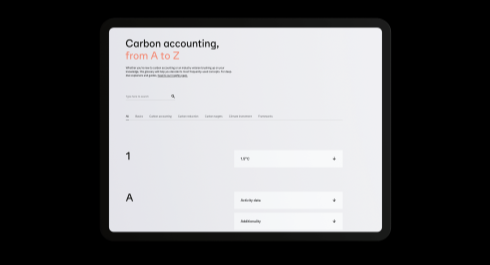

Normative has unveiled the Carbon Glossary, which collects carbon accounting’s most common terms, abbreviations, and frameworks in one place.
“We want to make carbon accounting accessible to all businesses,” Eline Wajon, Head of Climate Strategy at Normative, the world’s first carbon accounting engine.
“The Carbon Glossary is one of the many steps we have taken recently to help businesses globally access accurate and truthful carbon accounting.”
Carbon accounting is a relatively new field, and one that is rife with jargon. The Carbon Glossary helps people decode its most frequently-used concepts, whether they’re new to the area or they’re veterans looking to brush up on their knowledge. It is continuously updated, to keep pace with the rapidly evolving field.
The Carbon Glossary covers carbon accounting’s most common terminology, including:
- the science behind global warming
- the technical details of carbon accounting
- carbon removal technologies
- relevant pieces of legislation
- various sustainability reporting frameworks
To reach the climate targets set out by the Paris Agreement, companies must reduce their carbon emissions to half of pre-industrial levels by 2030, and to net zero by 2050.
The April 4th IPCC report cautioned that action must be taken quickly and comprehensively to stay on track to meet these targets, and stated that reducing business carbon emissions will require coordinated action throughout value chains to promote all mitigation options.
Carbon accounting allows companies to take climate action. A company using carbon accounting can measure its carbon footprint by totaling up the greenhouse gas emissions produced by its business activities. Then, the company can begin to reduce its carbon footprint, starting with its largest sources of emissions.
“In order to reduce our emissions we need to start measuring them, and to trust these measurements we need to understand how they work.
We hope this glossary can be a launching-off point for businesses to understand their emissions and the impact they can make by reducing them” Eline Wajon concluded.
Normative provides accurate and truthful carbon emission accounting, covering businesses full carbon footprints. Their method is based on the Greenhouse Gas Protocol (GHGP), and covers Scope 1, 2, and 3 emissions, accounting for the full supply chain and tracking progress over time.
Normative automates the otherwise costly and time-consuming data collection and calculation process, and provides tailored reduction strategies.
The Carbon Glossary was created to lower the barrier to entry for companies to begin carbon accounting, and subsequently reduce their carbon footprints.
About Normative
Normative is the world’s first carbon accounting engine, helping businesses calculate their entire climate footprint and reduce their greenhouse gas emissions.
Co-founded in 2014 by Kristian Rönn to accelerate the transition to Net Zero, Normative sets a new standard in scientific accuracy for emissions accounting, powered by its market-leading emissions database.
The company, headquartered in Stockholm, has hundreds of customers, and partners with leading climate change organisations including the UN, to deliver actionable sustainability intelligence.
Normative is also the foundational software provider for the UK’s SME Climate Hub through which thousands of small businesses have committed to net zero.
African Eye Report
