

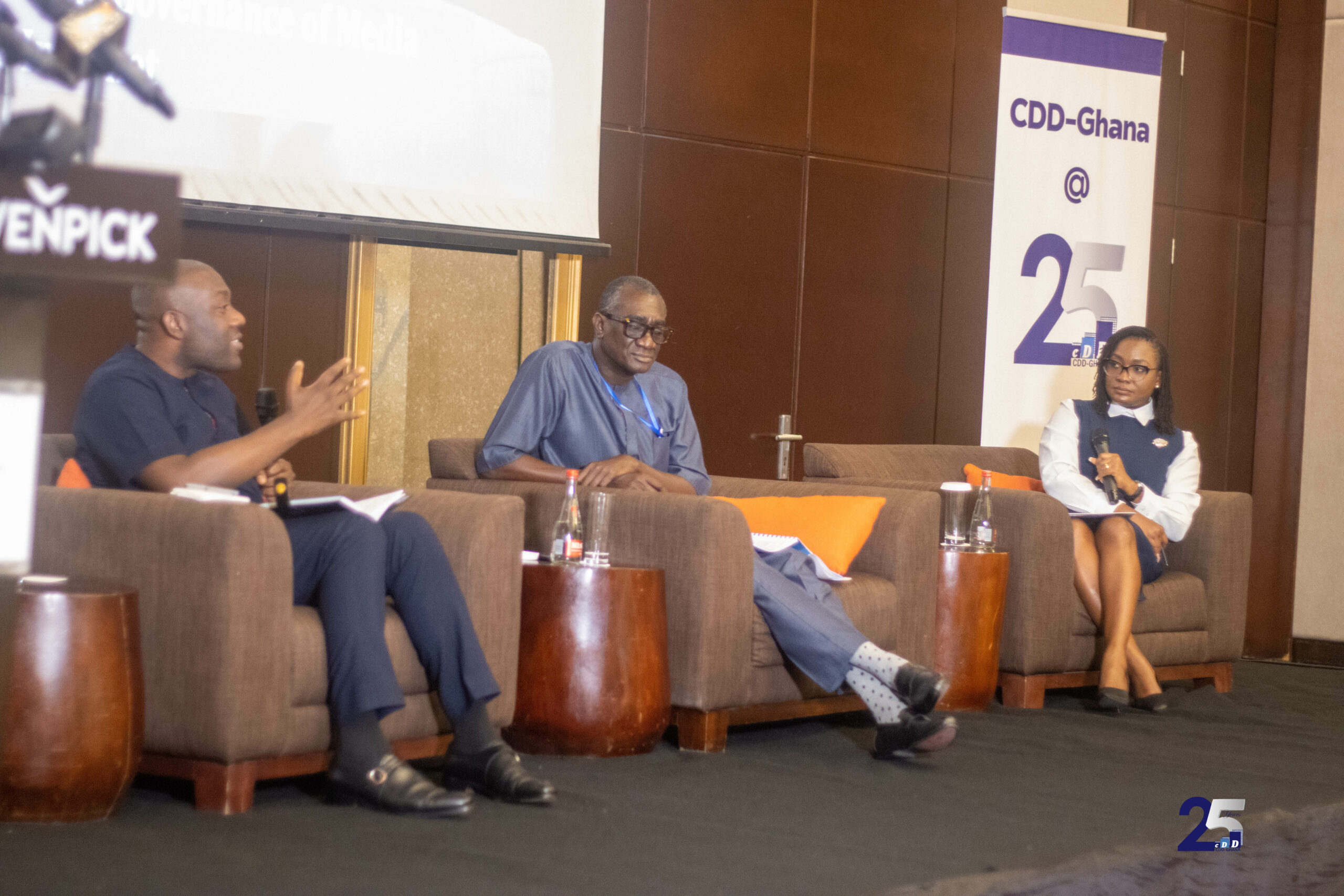

Accra, Ghana//-Latest report by the Ghana Center for Democratic Development (CDD-Ghana) has sounded alarm over the conglomeration of the Ghanaian media through the multiple authorisations.
The report titled-‘Ensuring Accountability in the Governance of Media and the Internet in Ghana’ which launched in Accra found that; “the conglomeration of the Ghanaian media through the multiple authorisations is alarming”.
It has significant implications for journalism, the media landscape and how information is shared, the report added.
Presenting the research findings of the report, the Team Leader
Dr Eliasu Mumuni, noted: “Ownership and control of the media market share remain limited to a few media houses (Multimedia, Despite, Angel, EIB, GBC, Media General, Omni, Class, etc.)”.
These media houses, which are few and have expanded, influence the content, agenda, and narratives for consumers in Ghana, he said.

“Beyond that, when conglomerates form, large corporations or conglomerates acquire media properties like newspapers, TV stations, radio stations, digital media outlets, audience plurality of perspectives and representation from all Ghanaians at the social and cultural level suffers”.
Dr Mumuni who is also Senior Lecturer at the Department of Communication, Innovation and Technology of the University for Development Studies (UDS) explained that these media houses leverage their media outlets to promote their content and products across platforms in all 16 regions of the country.
He cited that water, medicine, and creams produced by Tobinco or Angel Group receive advertising on their TV channels and in their newspapers, resulting in a collaborative effect that positively impacts the corporation’s overall business.
However, advertising on bigger platforms other than theirs can be more profitable than their own smaller platforms or networks, he said.
The findings Dr Mumuni presented also indicated a wider gender disparity between males (68.8%) and females (31.2%) regarding the use of social media platforms in Ghana.
These gender differences in use can be attributed to data and mobile device costs, access to these platforms, and gender social roles.
On emerging business models, study findings showed that most top media houses are now raising significant revenue through subscriptions to their YouTube, Facebook, Instagram, and TikTok accounts.
The print media, for example, has seen a significant growth in the subscriptions of their online versions.
These are not paid subscriptions, but the increasing numbers of subscribers to the digital versions of the media houses increase their viewership, listenership, and readership, hence generating monetisation opportunities for their content.
Also, respondents believe that most of the existing big media houses in the country rely on conglomerates to capture the media market share in Ghana.
Despite this development, most participants believe that the media’s financial sustainability is shaky and weak and so affects the welfare of practitioners in the industry. The situation has
significant implications for journalism, the media landscape and how information is shared.
Recommendations
The study recommended a specific and targeted regulatory framework to empower and strengthen the existing regulatory institution (media and broadcasting law and the regulatory National Media Commission), shaping the media practice in Ghana to improve the standards, ethics, unassailable rights, and responsible content production.
The Minister of Information, Kojo Oppong Nkrumah who was happy with the finding of the report used the opportunity to update Ghanaians on the country’s Broadcasting Bill.
According to him, the bill was not before Parliament yet because portions of it were currently under review.

Furthermore, the report called on the government to develop a social media policy linked to the media and broadcasting law to allow for the optimal use of digital platforms.
This will help curb the threats, violence, and trolls purveyed by social media users.
“There must be a coordinated operational process of working together by these state agencies (the Data Protection Commission, the Right to Information Commission, the National Information Technology Agency (NITA), the National Identification Authority (NIA), the Cybersecurity Authority, and the Ghana Police Service) to help address the disinformation challenge, and online harassments as well as strengthen the fact-checking system by all media houses”, the report demanded.
Contributing to the launch of the report via Zoom, Senior Lecturer at the Department of Media, Language and Communication of the Durban University of Technology in South Africa, Dr Theodora Dame Adjin-Tettey underscored the importance of media literacy in the fight against rapid misinformation.
In her words: “People should be exposed to how to fact-check information, which will prevent the effects of misinformation. It is best not to share information one is not sure of”.
Through the National Communications Authority (NCA), the government must review the authorisation policy by reducing the number it authorises or downsizing for effective regulation of the frequencies, the researchers suggested.

They added: “Aside from that, issuing authorisations to politically exposed or political party sympathisers and businesses linked to governments of the day has to be discouraged, if not stopped, to allow for fairness and inclusiveness of all eligible Ghanaians to have access to the frequencies”.
Sharing his thoughts on the reports, the Chief Operating Officer of Media General, Nuamah Eshun Fameye, noted that there was a direct correlation between content, ratings, and revenue-earnings capacity.
In his welcome address, the Director of Programmes and Advocacy of CDD-Ghana, Dr Kojo Asante noted that the credibility of news sources is more than an asset.
He went further to urge media owners and supporters to work together to ensure the sustainability of their media businesses.

Methodology
Methodologically, the study adopted a mixed-method research approach with a survey of a sample of 1001 respondents and interviews with 15 key informants.
The survey data was gathered through online questionnaires and face-to-face administered to media stakeholders (journalists, editors, managers, owners, directors), media associations, academia, CSOs, and the public.
The interview data was gathered from 15 key informants from the media industry, including editors/managers of media organisations and some members of the Professional Association and the Civil Society (CSO).
