

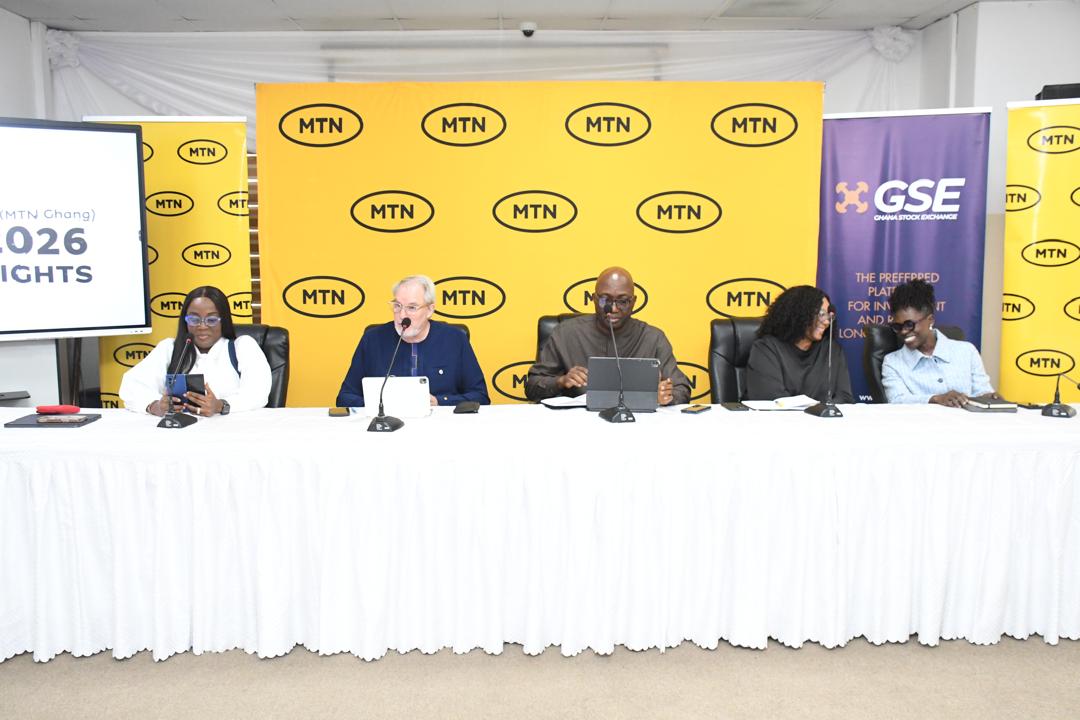

Accra, Ghana//-Scancom PLC, operator of MTN Ghana, has posted impressive first-half (H1) 2026 financial results with profit after tax soaring to GHC5.1 billion compared to GHC3.5 billion in the same period last year.
The company generated significant revenue of GHC15 billion in the first half of 2026 against that of H1 2025, which stood at GHC11.3 billion.
The largest telecom service provider’s subscription increased to 32.8 million, representing an increase of 8.5% during the 2026 h1 that is from January to June 2026.
MTN Ghana’s active data subscribers grew to 21.3 million, while its mobile money users also grew to 18.3 million during the h1 2026.
Taking his turn at the Ghana Stock Exchange (GSE) Facts Behind the Figures session today, CEO of MTN Ghana, Stephen Blewett, explained that “the company’’s performance in the first half of the year was underpinned by sustained commercial execution of our Ambition 2030 strategic priorities and our unwavering commitment to delivering value to customers, shareholders, and the broader communities we serve”.
We continued to drive strong commercial momentum across our data, fintech, and digital businesses during the period, supported by sustained growth in active users, increased service adoption, and disciplined commercial execution, he added.
This momentum, according to Mr Blewett, culminated in the H1 2026 service revenue growth of 32.3% and further reinforced its position as the leading provider of connectivity and fintech solutions in Ghana.
Operational and financial under review
Service revenue increased by 32.3% year-on-year (YoY) to GHS15.0 billion in H1 2026, driven by strong execution across both our Connectivity and Fintech businesses.
Growth was driven by sustained demand for data services, increasing adoption of digital financial services, and higher engagement across our digital platforms, further reinforcing the diversification and resilience of our revenue base, he said.
This growth was also supported by disciplined investment in network expansion, platform modernisation and customer experience initiatives. Guided by our Value-Based Capital Allocation Framework, we invested GHS1.9 billion in ex-lease capex to support the business’s near-term and long-term growth.
On her part, the Chief Financial Officer of MTN Ghana, Antoinette Kwofie, explained that the company, during the period under review, invested in strengthening their network, expanding capacity, and enhancing their digital platforms to meet growing demand for data and digital services, improve customer experience and network quality, and increase the scalability of their operations.
“Data revenue grew by 47.1% YoY to GHS8.8 billion, supported by strong customer demand for data and digital services. This performance was underpinned by a 17.0% YoY increase in active data subscribers to 21.3 million and a 38.0% YoY rise in average monthly data consumption to 19.3GB per active user, reflecting continued smartphone growth and digital adoption, including video streaming services, across our customer base.
As a result, Data’s contribution to service revenue increased to 58.7%, up from 52.8% in H1 2025, highlighting the continued evolution of our revenue mix towards higher-growth and more resilient digital services.
Voice revenue declined by 1.4% YoY to GHS1.9 billion, due to the continued migration of customer communications from traditional voice services to Voice over Internet Protocol (VoIP) services, Madam Kwofie stated.

Despite this structural shift, the decline was partially mitigated by targeted customer value management (CVM) initiatives and disciplined commercial execution, which supported customer engagement and usage across our base.
These efforts contributed to an 8.5% YoY increase in our subscriber base to 32.8 million. Consequently, voice accounted for 12.9% of service revenue, down from 17.3% in H1 2025, reflecting the continued evolution of our revenue mix toward higher-growth, more scalable revenue streams.
This transition enhances the quality of earnings and further supports the long-term sustainability of the business.
Digital revenue increased by 98.0% YoY to GHS377 million. Growth was driven by increased adoption of gaming, video, and content services, owing to rising customer demand for digital lifestyle solutions and deeper engagement across our digital platforms.
Continued innovation, enhanced customer propositions, and strategic partnerships further supported the expansion of our digital business.
As a result, digital revenue contributed 2.5% of service revenue, up from 1.7% in H1 2025, demonstrating continued progress in the diversification of our revenue base and reinforcing our strategy of building scalable, high-growth revenue streams that complement our core connectivity businesses.
Mobile Money revenue increased by 23.3% YoY to GHS3.5 billion in H1 2026. Growth was supported by strong performance across both our core wallet business and advanced financial services, alongside a 3.1% YoY increase in active Mobile Money users to 18.3 million.
Basic services grew by 21.2% YoY to GHS2.3 billion, underpinned by a robust growth in person-to-person transfers. Advanced services revenue increased by 27.3% YoY to GHS1.2 billion, driven by rising adoption of digital payments, lending, and other value-added services.
Transaction volumes and values continued to grow strongly during the period, reflecting expanding ecosystem participation, increased digital payment adoption, and stronger customer engagement across our financial services platform.
Mobile Money contributed 23.4% of service revenue, compared to 25.1% in H1 2025. The continued expansion of our fintech platform, coupled with the successful structural separation completed in Q1 2026 and our inclusive ecosystem play, positions the business well to capture the opportunities arising from increasing financial inclusion, digitisation of payments, and the growing demand for accessible digital financial services across Ghana.
Total costs increased by 21.6% YoY to GHS5.7 billion, reflecting continued investment to support strong commercial momentum across the business, she told participants at the session.
Cost of sales increased by 17.9% YoY to GHS2.3 billion, driven by the execution of revenue-enhancing commercial initiatives across our connectivity and fintech businesses.
Operating expenses increased by 24.2% YoY to GHS3.4 billion, driven mainly by network-related expenditure, rent, utilities, and maintenance costs necessary to support rising demand and maintain service quality.
The robust revenue growth, coupled with ongoing operational efficiency initiatives, enabled EBITDA to increase by 39.8% YoY to GHS9.3 billion. This resulted in an EBITDA margin of 61.8%, representing an expansion of 3.4 percentage points year-on-year.
Depreciation and amortisation increased by 26.0% YoY to GHS1.6 billion, due to continued investment in network infrastructure, capacity expansion, and IT platform enhancements aimed at supporting future growth and improving customer experience.
Net finance costs increased to GHS268.8 million, up 12.6% YoY. While finance costs declined by 2.8% YoY to GHS475.7 million, finance income decreased at a faster rate of 17.4% YoY to GHS206.9 million, resulting in a higher net finance charge for the period.
Tax expense increased by 47.3% YoY to GHS2.3 billion, reflecting higher earnings driven by improved operating performance during the period. Consequently, profit after tax increased by 43.3% YoY to GHS5.1 billion, while earnings per share (EPS) rose by 43.2% YoY to GHS0.388.
Outlook
Looking ahead to the second half of 2026, the global operating environment remains highly uncertain. While the global economy continues to demonstrate resilience, geopolitical tensions in the Middle East, ongoing supply chain disruptions, and rising trade fragmentation remain key risks to growth, inflation, energy markets and global financial conditions, the two executives of the company stated.
Against this backdrop, Ghana’s macroeconomic environment remains broadly supportive. Inflation continues to be moderately paced, external reserves have strengthened, and economic activity has remained resilient.
The Bank of Ghana expects inflation to remain within, and gradually trend toward the lower end of, its medium-term target band of 8% ±2%, supported by prudent monetary policy, ongoing fiscal consolidation and improved external buffers.
These developments provide a more stable operating environment for businesses and support consumer spending and investment activity. In light of this, we will continue to advance our Ambition 2030 strategic priorities.
We will execute with discipline, drive operational efficiencies, and allocate capital selectively to opportunities that generate attractive long-term returns.
The company’s investment focus will remain centred on strengthening network quality and resilience, expanding coverage, enhancing the customer experience, accelerating home broadband adoption, deepening fintech penetration, and scaling our digital services ecosystem to capture growing demand for connectivity, fintech, and digital solutions.
“We remain confident in the structural growth opportunities in Ghana and in the strength of our business model. At the same time, we recognise that external risks persist, particularly from geopolitical developments and global trade dynamics, with their potential impact on inflation, currency stability, and consumer spending”, they said.
Accordingly, they assured that they would continue to actively monitor developments across their operating environment and, where necessary, reassess their assumptions and medium-term outlook to ensure that MTN Ghana remains well positioned to deliver sustainable earnings growth, strong cash flow generation, and long-term value creation for shareholders.
Against this backdrop, they maintain our medium-term guidance for service revenue growth and EBITDA margin.
However, the company said it would continue to evaluate evolving market conditions and, if required, adjust its medium-term guidance covering the next three- to five-year horizon.
