


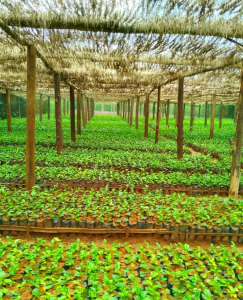
Smallholder tea farmers in Mulanje and Thyolo are transforming tea production in Malawi through farmer-led seedling nurseries supported by Solidaridad’s Pathways to Prosperity (P2P) Tea Project, funded by the Dutch Ministry of Foreign Affairs.
What started as a pilot initiative has now grown into a scalable solution that is helping farmers tackle one of the tea sector’s biggest challenges, which is limited access to quality planting materials.
For years, many farmers depended on ageing tea bushes that produced lower yields, were more vulnerable to pests and diseases, and struggled to cope with climate shocks such as prolonged dry spells and erratic rainfall. Accessing improved seedlings from institutions such as the Tea Research Foundation and private estates was often expensive and difficult because of long distances and limited supply.
Through the P2P Tea Project, farmers have received practical training in clonal propagation, nursery management, soil and water management, pest and disease control, and the selection of climate-resilient tea varieties. This support has enabled farmers to establish and manage their own nurseries while reducing dependence on external suppliers.
The results have been remarkable. During the 2025 to 2026 growing season, three farmer associations namely Chizunga, Thuchira, and Msuwazi collectively produced 200,280 seedlings. This is a major increase from the 80,000 seedlings raised during the 2024 to 2025 season, representing growth of more than 150 percent in just one year.
Approximately 2,000 farmers are expected to benefit from the increased availability of seedlings. Farmers are now able to fill gaps in their tea fields, replace old plants, and expand production areas at a lower cost and with better timing for planting seasons.
“As farmers we are proud that we can now produce our own seedlings even more than we managed in year one. This progress shows that with the right support and knowledge, we can take control of our tea farming future,” said Mr Muhilima, Chairperson of the National Smallholder Tea Growers Association.
Beyond increasing production, the initiative is creating wider social and economic impact. Individual farmers are independently establishing nurseries, creating additional income opportunities for youth and women while strengthening local farmer institutions. Farmer managed nurseries are also contributing to climate adaptation by promoting improved tea varieties that can withstand temperature fluctuations and irregular rainfall.
The initiative is proving that localized innovation and farmer ownership can strengthen resilience, improve livelihoods, and lay the foundation for a more sustainable and competitive tea sector in Malawi.
By: Misozi Magaleta, Project Manager at Solidaridad (Southern Africa)
