

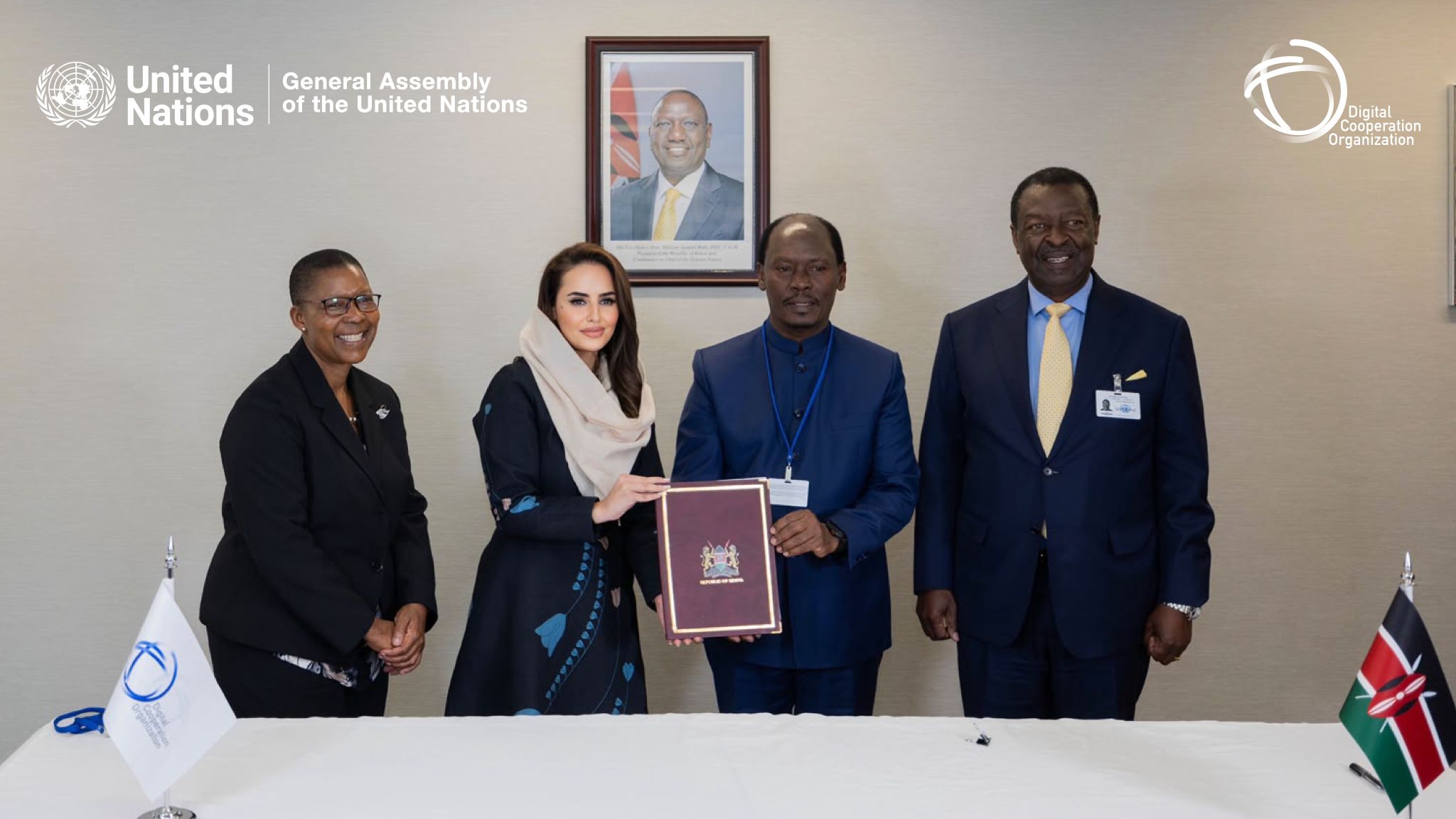

New York, United States// — The Digital Cooperation Organization (DCO) announced that the Republic of Kenya has signed the DCO Charter on the sidelines of the 81st Session of the United Nations General Assembly (UNGA81), becoming a Signatory Member and marking an important step toward completing its accession as a Member State of the Organization.
H.E. Hon. William Kabogo Gitau, EGH, Cabinet Secretary, Ministry of Information, Communications and the Digital Economy of the Republic of Kenya, signed the DCO Charter and formally handed it over to Ms. Deemah AlYahya, Secretary-General of the Digital Cooperation Organization, during a ceremony held in New York, with H.E. Dr. Musalia Mudavadi, E.G.H., Prime Cabinet Secretary and Cabinet Secretary for Foreign and Diaspora Affairs of the Republic of Kenya witnessing the signing and formal handover.
The signing of the Charter opens a new chapter of cooperation between Kenya and the DCO, enabling both sides to advance shared priorities across digital transformation, responsible artificial intelligence, digital policy, skills and talent development, entrepreneurship, innovation and investment.
It also enables Kenya to deepen cooperation and knowledge exchange with DCO Member States and partners, supporting efforts to build an inclusive, trusted and sustainable digital economy.
H.E. Hon. William Kabogo Gitau, EGH, Cabinet Secretary, Ministry of Information, Communications and the Digital Economy of the Republic of Kenya, said: “Kenya’s digital transformation has been driven by innovation, entrepreneurship and a strong commitment to using technology to expand opportunity.
By signing the DCO Charter, we are creating a new platform to exchange knowledge, scale practical solutions and deepen cooperation with countries that share our ambition for an inclusive and competitive digital economy. We look forward to bringing Kenya’s experience to this community while learning from the approaches and capabilities of fellow Member States.”
Ms. Deemah AlYahya, Secretary-General of the Digital Cooperation Organisation, said: “Kenya has shown what becomes possible when a country trusts its people with technology and gives them room to build.
By the end of 2025, mobile money penetration in Kenya reached 98 percent, and the country’s information and communication sector grew by 4.8 per cent that year, ahead of the wider economy.
Behind those figures are entrepreneurs, students and small traders who have made digital tools part of ordinary life. We welcome Kenya to the DCO community with genuine admiration for what its people have built, and in the belief that Kenya’s experience belongs to every country still working to bring its citizens into the digital economy. No country reaches the digital future on its own.
The value of this Organisation lies in what Member States are willing to share — experience, expertise and the readiness to act together. Kenya’s accession brings us closer to the purpose that brought the DCO into being: digital prosperity for all.”
Kenya’s digital economy provides a strong foundation for deeper cooperation with DCO. The country has established itself as one of Africa’s leading digital economies, supported by a dynamic technology and entrepreneurship ecosystem, broad adoption of communications technologies and a globally leading mobile financial services sector.
Kenya’s ICT sector contributed an estimated 9.2% of GDP in 2024, while more than 80% of the population uses mobile payment and money transfer services. The country’s digital economy is valued at approximately USD 4.2 billion and is projected to approach USD 13 billion by 2035, driven by continued investment in communications, digital services, innovation and emerging technologies.
Kenya was among eight countries whose candidature to join the DCO was recently approved by the DCO Council. Upon completion of the accession procedures, the Organization’s membership will expand from 16 to 24 countries, collectively representing approximately 980 million people.
The signing of the Charter on the sidelines of the 81st Session of the United Nations General Assembly reflects the growing role of international digital cooperation in advancing inclusive and sustainable digital prosperity and reaffirms DCO’s commitment to strengthening cooperation among countries at different stages of digital development to work together toward building a digital economy that benefits everyone.
