


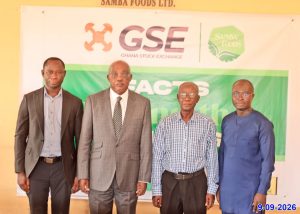
Accra, Ghana//-Samba Foods Limited, a leading Ghanaian-owned food processing and preservation company, today announced that it successfully transitioned from a loss after tax of about GH₵245,000 in 2024 to a net profit after tax of GH₵265,000 in 2025.
The Managing Director of Samba Foods Limited, Dr Mrs Leticia Osafo-Addo, who announced this during a virtual Facts Behind the Figures session organised by the Ghana Stock Exchange (GSE) indicated that 2025 results marked a substantial operational recovery across major areas.
These areas she mentioned include the company’s total income, which more than doubled compared to 2024, increasing to about GH₵1.62 million.
Dr Mrs Osafo-Addo also added that gross-profit margin experienced a sharp rise from about 7 per cent up to roughly 42 percent.
While the business produced about11 million sachets under the Unifa arrangement, she told brokers, institutional investors, journalists, potential investors, among others.
The MD of the Tema-based company which specialises in the condiments and seasoning market, also highlighted key strategic results, showcasing a pivotal shift in business direction and financial performance during the 2025 fiscal year.
While management acknowledged these milestones, leadership emphasised that a single profitable year should not be regarded as a completed turnaround, noting that the proper question is whether the company can sustain this performance, reduce vulnerabilities, and create a broader platform for growth.
According to Dr Mrs Osafo-Addo, over the years, Samba Foods Limited has developed and produced ready-to-eat convenience foods of Ghanaian origin, becoming the first to commercialise the production and distribution of the traditional local pepper sauce known as SHITO.
Constraints
“To understand the 2025 results, we must first understand what had been holding the company back. Samba faced two closely connected problems.
The first was unreliable packaging machinery. Repeated breakdowns disrupted production, reduced consistency and limited our ability to fulfil larger orders”.
The second was insufficient working capital. Even when demand existed, the company did not always have the resources required to purchase raw materials, packaging and other inputs in the quantities and at the times required. These problems reinforced each other.
Machinery cannot produce without inputs, and working capital cannot generate an adequate return if the production line is unreliable.
The underlying constraint was therefore not a lack of manufacturing knowledge or an absence of commercial opportunity. It was the company’s limited ability to execute consistently and at the scale required by the market.
Since 1993, the company has grown into a major player in the processed food industry, she noted.
Instructively, Samba Foods Limited was incorporated in 1993, commenced business the same year and was listed on the Ghana Stock Exchange Alternative Market in 2015.
