

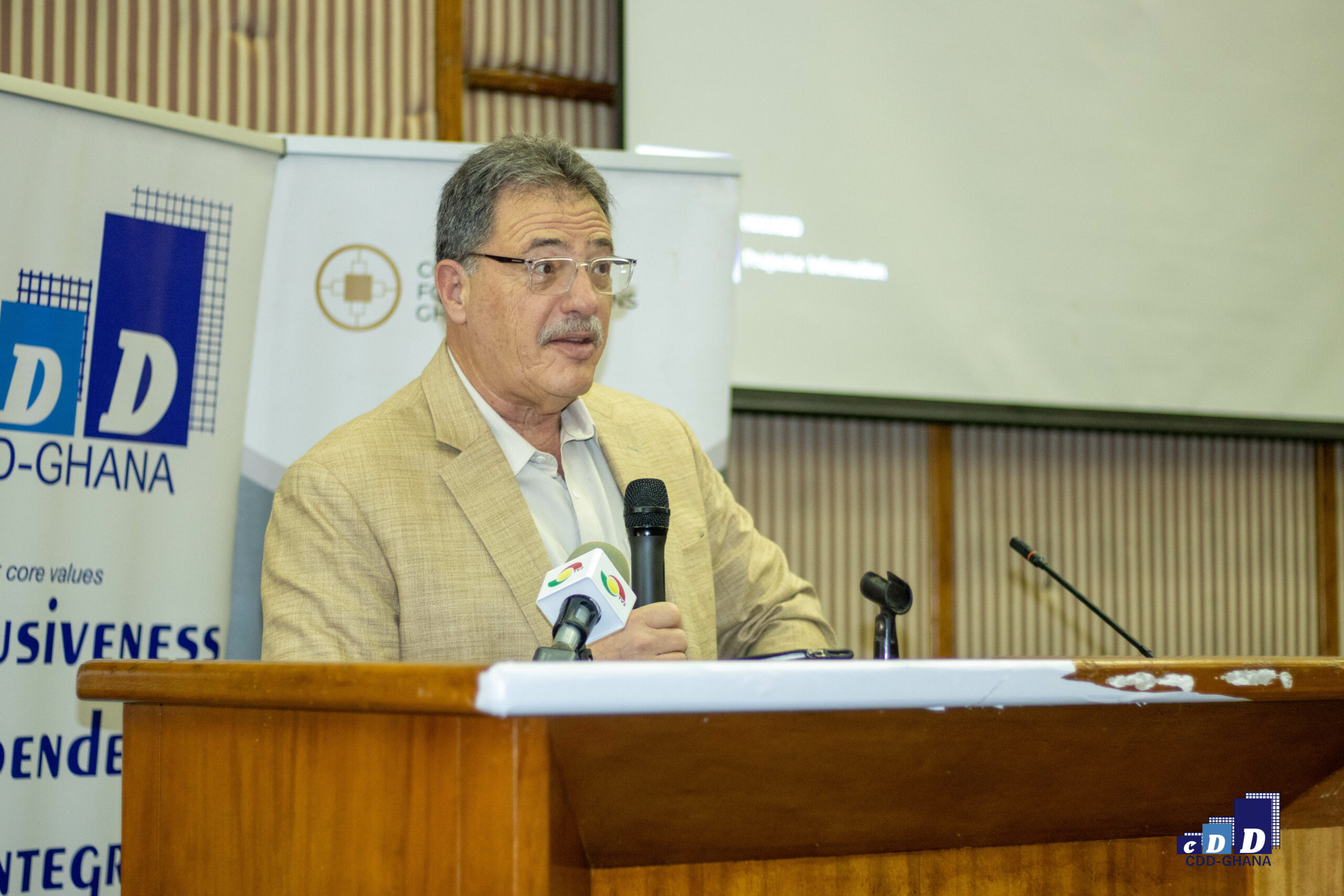

Accra, Ghana//-A leading American political sociologist and democracy scholar, Professor Larry Diamond has urged Ghana and other African countries to come up with their local democratic development models to address the numerous challenges facing the African continent.
According to him, these localised democratic development models if collectively fashioned out and implemented would lift millions of Africans out of poverty.
Prof Diamond made the call when he spoke on the topic: ‘Democracy Decline in West Africa: Challenges and Path Forward’ at a programme dubbed ‘Democracy Decline in West Africa: A Conversation with Prof Larry Diamond’ held in Accra.

The well-attended programme was organised by the Ghana Centre for Democratic Development (CDD-Ghana), the Council on Foreign Relations Ghana, and the Kofi Annan International Peacekeeping Training Centre (KAIPTC).
Delivering a presentation on the topic: “Democracy Decline in West Africa: Challenges and Path Forward”, Prof. Diamond said the importation of external models of development may not best suit the development paradigm of all countries.
The programme was organised by the Ghana Centre for Democratic Development (CDD-Ghana), the Council on Foreign Relations Ghana, and the Kofi Annan International Peacekeeping Training Centre (KAIPTC).

He argued that the development model(s) should originate from the people and be informed and adapted to the conditions of the country or countries.
Prof Diamond who is also the Director of Hoover Institute at Stanford University, added that; “any development model adopted by a country should follow a democratic process to make the country responsive, accountable and uphold rule of law and human rights”.
In his words: “Don’t accept any model (of democracy). There is no one model, and the models need to constantly keep changing and the best system is the one that is reformed and adapted and informed by the circumstances of each country”.
The seasoned global democracy advocate also noted that liberal democracy is experiencing vulnerability globally and expressed concern about the continuous “backsliding” of democracy in recent years.
Democracy has been on the back foot because Africa’s Peer Review Mechanism has not been biting enough to deter would-be coup d’etat makers from abandoning their dreams.
For instance, a study by the Africa Center for Strategic Studies released earlier this month found that disinformation campaigns in Africa had surged nearly four-fold since 2022.
Out of 189 documented disinformation campaigns in Africa, 72 of them targeted 13 countries in West Africa. She said 19 campaigns had targeted Mali, Burkina Faso and Niger since 2018.
Factors to decline democracy
Poor governance, which reduced public trust and confidence in democratic systems; corruption; the influx of disinformation fuelled by social media; among others are some of the factors in the decline of democracy, Prof Diamond said.
“The fact that you have periodic multi-party elections does not in itself mean that you have a democracy,” he said, adding that true democracy must deliver public good and uphold rights and the rule of law”.
Touching on the unbridled monetisation of politics, he stated that the canker threatens democracy and called for swift and comprehensive reforms in political campaign financing to address the menace.
In “Power, performance, and Legitimacy: Renewing global democratic momentum, Prof Diamond added beyond disinformation, which African leaders must tackle with all their strength is corruption.
Every coup d’état has corruption, either abuse of power or resources, playing a key role in triggering the menace, according to him.

Solutions
The Professor of Democracy used the occasion to offer some solutions to the decline of democracy which included judicial constraints of authoritarian executives, legislative resistance, and oversight.
For him, the only remedy to addressing the inglorious tradition is to strengthen institutions with massive investment.
While suggesting a strong economic and political environment that would deal with the issues of employment and basic social amenities such as roads and water, among others.
Prof Diamond therefore encouraged Ghana and its counterpart African countries to conduct periodic reviews of their institutions to identify areas of reform and improve inefficiencies identified by the people.
The Commandant of the KAIPTC, Major General Richard Addo-Gyane called for the re-examination of the practice of the winner-takes-all policy to give room to others to contribute their quota to national development.

He noted that Africa’s political and socioeconomic development could be achieved through deepening institutional effectiveness, inclusiveness, and robust engagement of multiple stakeholders in holding people in office accountable.
“It has become obvious that normative frameworks on democracy and good governance have some limitations and thus require some revision”.
The United States (US) Ambassador to Ghana, Madam Virginia E. Palmer encouraged West African countries to exercise confidence in democracy despite governance challenges.
According to her, a breakdown of democracy could spell more doom for the continent.
She went on to call for urgent measures to tackle disinformation, which had become a tool against democratic governments.
“When democratic governments fail to live up to expectation, the solution is more democracy not less,” Madam Palmer said.

In his welcome address, the Executive Director, CDD-Ghana Prof Henry Kwasi Prempeh observed that the resurgence of coups in Africa should not be treated as an issue for some countries, but as a concern for all countries.
The development he noted could have a ripple effect on the socio-economic development of all countries on the African continent.
The President of, the Council of Foreign Relations Ghana, Ambassador D. K. Osei who agreed to all the statements made by the earlier speakers said: “The youth want balanced growth and equitable distribution of resources” and not needless coups.
