

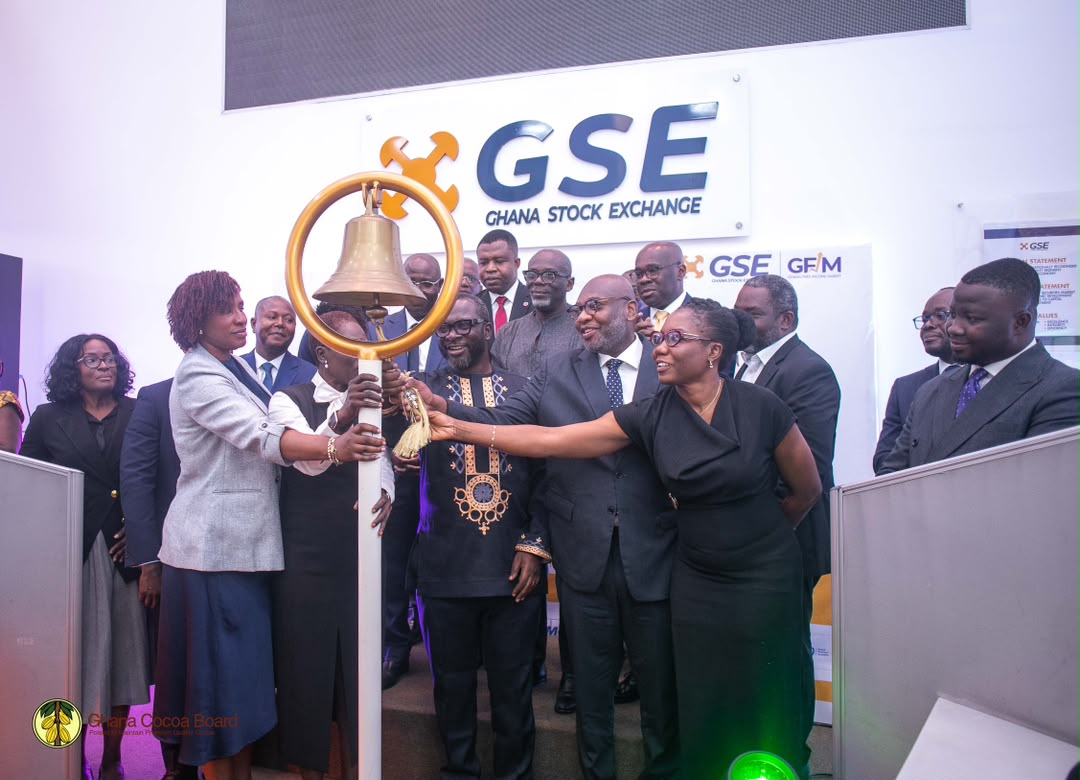

Cocoa Capital PLC today raised a whopping GH¢3.59 billion in 266-day Senior Unsecured Commercial Paper on the Ghana Fixed Income Market (GFIM) of the Ghana Stock Exchange (GSE) , representing the first series issued under its GHS16.3 billion Domestic Cocoa Notes Programme.
The broader programme provides for up to GHS14.0 billion in Commercial Paper to support cocoa purchases and up to GHS2.3 billion in bonds to refinance existing Domestic Debt Exchange Programme (DDEP) Cocoa Bonds.
The programme therefore establishes a scalable domestic capital-market platform through which Ghana’s cocoa sector can meet both its seasonal working-capital requirements and its broader financing needs, CEO of the Ghana Cocoa Board (COCOBOD), Dr Randy Abbey, said at a ceremony to list the programme on GFIM, a secondary market of the GSE.
The transaction recorded strong investor confidence, attracting total demand of GH¢3.59 billion. Of this amount, GH¢3.39 billion was accepted and allocated at a uniform clearing interest rate of 11.00% per annum, according to him.
The proceeds from the issuance, he would support Ghana Cocoa Board’s cocoa bean purchasing requirements for the 2026/27 crop season.
The outcome demonstrates strong market confidence in the structure of the Programme, the strength of Ghana’s cocoa sector, and the renewed commitment to placing cocoa financing on a more sustainable and transparent footing, Dr Abbey noted.
Collections will be paid into designated ring-fenced accounts and applied in accordance with the Programme’s payment waterfall. Cocoa Capital PLC, a subsidiary of COCOBOD, expects to undertake additional Commercial Paper issuances under the Programme in line with COCOBOD’s funding requirements and subject to market conditions, which will mature on 28 June 2027.
On her part, the Managing Director of the GSE, Madam Abena Amoah, was happy and said: “For the first time, Ghana is using its domestic debt capital market, through Cocoa Capital PLC, to mobilise financing for its cocoa purchase programme. This is a significant development in how we finance one of the most important sectors of our national economy”.
Cocoa is more than an agricultural commodity. It supports hundreds of thousands of farming households, contributes to export earnings and foreign exchange, and forms part of Ghana’s economic heritage. Its sustainable financing is therefore a matter of national importance, she added.
COCOBOD’s decision, through Cocoa Capital PLC, to access the domestic capital market broadens financing options for the cocoa sector and demonstrates that our market can support institutions whose activities are central to the Ghanaian economy.
“Today’s event is more than a listing ceremony. It demonstrates how Ghana’s capital market can mobilise Cedi resources for national priorities, diversify financing channels and encourage other institutions to consider the market as a credible partner”, Madam Amoah said.
The Cocoa Capital PLC transaction adds an important dimension to this story: Government’s use of the domestic capital market to finance cocoa purchases.
She was hopeful that this would encourage other public and private sector institutions to identify opportunities to raise funds locally for commercially viable and economically significant activities.
The Board Chairman of Cocoa Capital PLC, John Awuah, assured that the money raised would be used for the intended purposes.
The President of the Ghana Association of Banks, Kwamina Asomaning, said the instrument’s admission to the GFIM on October 14, 2026, real success would be measured not by the size of its launch but by the discipline that follows.
“There’s also a bigger story here. The growing capacity of Ghana to mobilise Ghanaian capital for Ghanaian development,” Mr Asomaning said.
That bigger story matters. Domestic financing can reduce exposure to foreign-currency risk, global refinancing shocks and shifts in international lender appetite. When a strategic export industry earns foreign exchange, but finances parts of its operations in cedis, Ghana can potentially create a more balanced funding model while deepening its capital market.
Director of Planning, Research, Monitoring and Evaluation at the NPRA, Philemon Laar noted that the programme has opened a channel between domestic savings and productive investment, but the National Pensions Regulatory Authority (NPRA) warned that pension funds must not allow ambition to override their duty to protect workers’ retirement assets.
The intervention places a boundary around the enthusiasm generated by Cocoa Capital PLC’s inaugural commercial paper. The transaction demonstrates that Ghana’s capital market can mobilise billions of cedis for a strategic export industry. It tests whether trustees and fund managers can distinguish national economic importance from investment suitability.
