

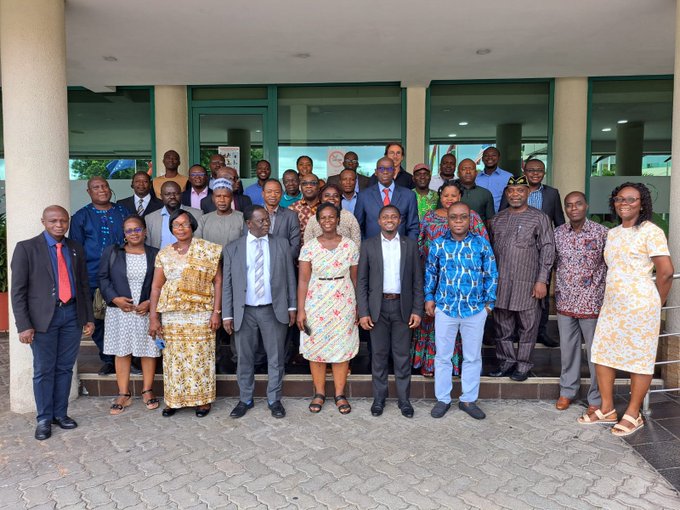

Accra, Ghana//-United Nations Food and Agriculture Organization (FAO) EAF Nansen Fisheries Management Expert, Mathieu Bernardon has advised member countries of the Fisheries Committee for the West Central Gulf of Guinea (FCWC) to take stringent measures to address depleting fish stocks which majority of the people depend on for their food and nutrition security, and employment.
He gave the advice after taking participants from the FCWC member countries comprising-Nigeria, Togo, Benin, Ghana, Ivory Coast, and Liberia through the Ecosystem Approach to Fisheries (EAF) Implementation Monitoring Tool (EAF IMT).
The depletion of fish stocks is a problem in the FCWC region. However, Mr Bernardon told African Eye Report that the solutions to this problem could be found within the countries.
Measures to stop depletion
He said the most important measure to take “is to control the access to the fish resources. The fish stocks must be exploited in a sustainable manner, meaning fishing should be done using sustainable ways and not cruel methods of fishing”.
Also, governments of the FCWC countries must put in robust systems to control and limit the access to the fish resources.
For instance, the issuing of licences, registration and limiting the numbers of vessels, cargoes, and other fishing machines to fish must be encouraged, he said.
Mr Bernardon was quick to add that another way to check the depletion of the fish stocks is for countries to know the state of the fish resources to enable them to avoid over exploitation.
Additionally, overfishing by foreign vessels, according to him, is a policy issue, noting that each country in the region must determine the value of their fish resources.
Are they fish resources meant for food and nutrition security, economic reasons, and employment? The answer(s) to this question, the FAO EAF Nansen Fisheries Management Programme expert noted, would determine the kind of fisheries policies to be formulated and implemented.
“If they are for food security and employment, you should put in place all fisheries management measures to preserve and re-enforce small scale fisheries which is basically the producer of and source of employment in the fisheries sector. It is also the most important source of food production for the local communities”.
Some countries can decide to reserve the fisheries sector for foreign vessels to enable them to earn income for the development of their countries. This can be by policies.
So, it is always about regulating and seeking what is the best for the country and its people, Mr Bernardon explained.
The workshop
Earlier speaking at the closing ceremony of the five-day regional workshop held in Accra from 29 May to 2 June 2023 to score the priority fisheries in the FCWC region using the EAF IMT), he said workshop was held to promote the use of EAF IMT as a tool for fisheries management, in line with the EAF-Nansen’s 2023 Programme’s workplan.
The tool Mr Bernardon further explained is intended to support each partner country’s work towards improving their fisheries management systems and operational planning, by helping the countries identify potential progress and gaps/difficulties.
It can also help determine where training and other support can be needed, he added.
The tool according to him would support the partner countries to have an overview and baseline situation of the fisheries management in the region.
So, after the workshop organised by the FCWC and FAO, each country can assess its priority fisheries which are basically transboundary fish resources. The countries now have a baseline situation and reference to identify the main strengths and weaknesses of their management systems.
Ecosystem Approach to Fisheries
The fisheries management Nansen programme which is one of the oldest programmes in the world developed the tool to assess and monitor the fisheries management system and the approach that is used is called Ecosystem Approach to Fisheries (EAF).
He said the main purpose of the EAF approach is to plan, develop, and manage fisheries in a manner that addresses the multiple needs of societies, without jeopardising the options for future generations to benefit from the full range of goods and services provided by marine ecosystems.
Assurance
Madam Abena Serwah Asante who spoke on behalf of the FCWC Secretary-General, Dr Antoine Gaston Djihinto assured that “they are going to use the EAF approach in fisheries to help them assess their progress of their management plans to help assess the fisheries, taking into consideration the socio-economic aspects”.
With regards to scoring, we have seen that there is a gap when it comes to gender equity. So, if they are going to do any analysis, they will take it into consideration by involving women and men in decision-making.
Gratitude
She thanked the facilitator so much, saying: “We have learned a lot. The knowledge acquired would be put into good use for the benefit of the various countries”.
While Madam Baeta Nkrumah, Fisheries Manager and Socio-economist at FSSD-Fisheries Commission (FC) said the FCWC did not have a regional working plan until 2021 there about.
“So, we are happy to partner with the strong organisation-FAO in fisheries management in our sub-region”.
Dr Ndiaga Gueye, Senior Fisheries Officer for FAO Regional Office for Africa said “FCWC is key and so very important for all of us. This is because FAO is your organisation”.
