

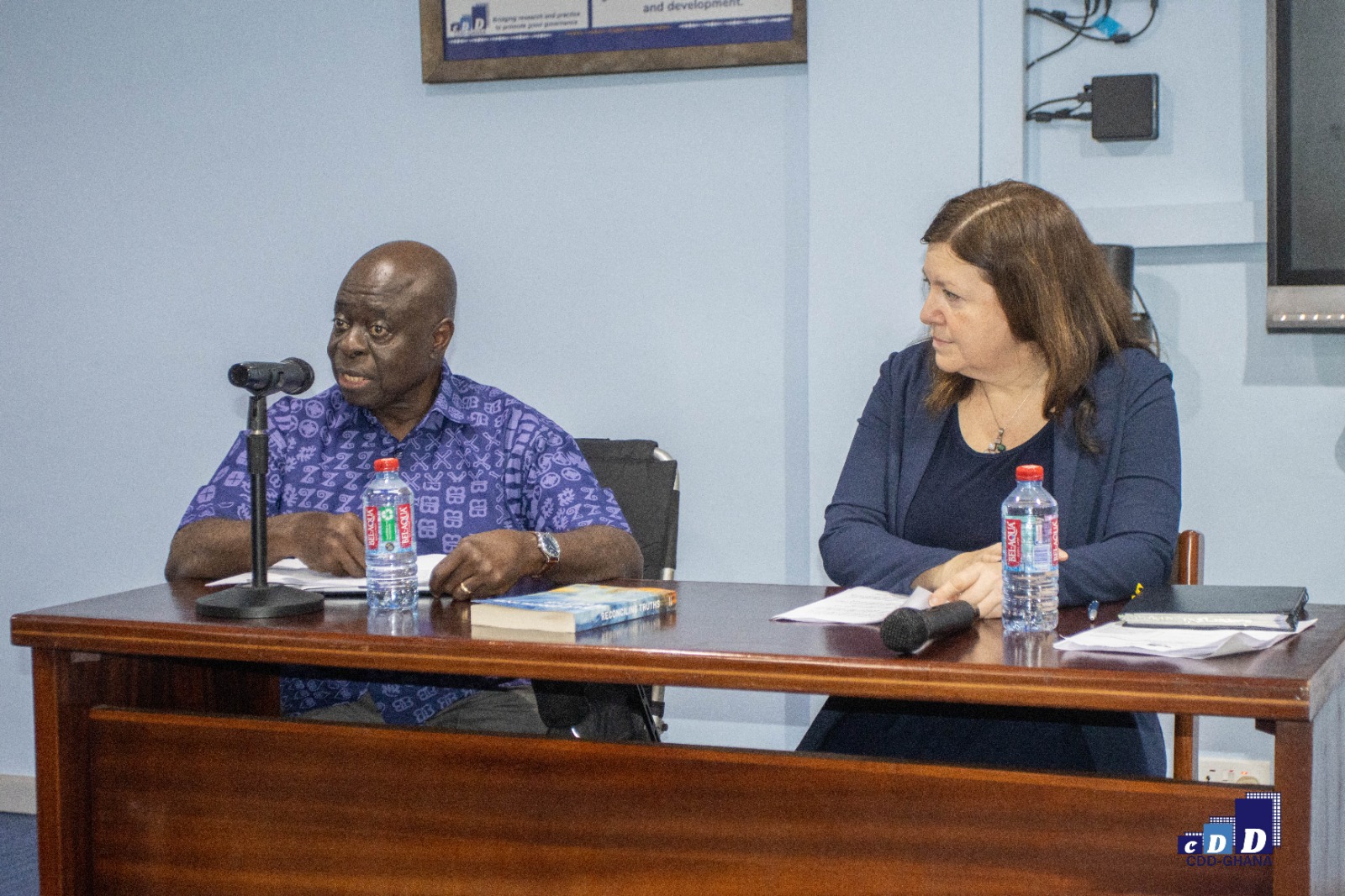

Accra, Ghana//-Experts at a roundtable discussion organised by the Ghana Center for Democratic Development (CDD-Ghana) have called for the inclusion of the country’s National Reconciliation Commission (NRC) report in schools’ curricula at different levels of education to change the mindset of the citizens.
According to them, the move would also enable young people in the country to know the atrocities and guide them against those atrocities committed by some of their leaders 20 years ago.
Contributing to the discussion on the NRC titled “Justice After Truth? An Assessment of the NRC Report”, a security expert, Colonel Festus Aboagye (Retired), said: “This was a piece of work documenting our history that should have found it way into the educational curricula at different levels of education including institutions of journalism and so on”.
He described the non-inclusion of the NRC and its report in the country’s institutions of learning as a “very serious lapse”.
That is the reason why the youth are very ignorant about what happened during the series of revolutions or whatever in the country, Mr Aboagye stated.
The Executive Director of the CDD-Ghana, Prof Kwasi Prempeh was surprised that attempts to mainstream the findings of the NRC into the educational human rights specialisation were not done.
The reason that it is surprising to him is because there is another commission which is the Human Rights Commission in the constitution, part of whose mission is human rights education.
“Post the NRC, the Human Rights Commission-CHRAJ what extent CHRAJ took the NRC report and said what it would do with the report.
Beyond CHRAJ, we have the National Commission on Civic Education (NCCE) also in the constitution funded by the government to promote civic education.
And between these two institutions, it is surprising that you have such a monumental report of this kind that touches on the history of the country relating to human rights and neither commission appeared to have done anything about it and not to talk about the Ministry of Education. But these two commissions should have done something meaningful about the NRC report”.
20 years on, most of the youth at the roundtable did not know much about the NRC and its report as well as the report’s findings and recommendations.
This is because the NRC report is not available to the public and it has not been included in the curricula of the country’s education system.
Also, there is no media discussion or conversation on the Commission’s report. So, it is not surprising that the majority of Ghanaian youth know little about it.
The then Executive Secretary of the NRC, Professor Ken Attafuah however stated that copies of the NCR report were distributed to all the universities in the country that period.
“And yet about two or three years later it was difficult to find a single copy in any public library. It is still the case. A famous journalist borrowed my copy of the executive summary, and it was also basically stolen from him”.
A renowned media scholar, Prof Kwame Karikari, noted that the intent of the NRC and its report got drowned in a polarised Ghanaian atmosphere.

What can be done
Commenting on the record-keeping of reports and other critical national documents, he attributed the lack of interest in keeping records to what he called illiteracy in the Ghanaian media industry.
Prof Karikari explained: “Our media do not focus on salient issues. It appears that our media focus for some time now has been effectively diverted by the petty politics of our politicians.
So, major national issues like the NRC report get sidetracked. Our media whether electronic or print are unable to focus on some of these issues”.
Another reason he stated is that academics nowadays have abandoned the media by not engaging in media activities.

As Prof Karikari puts it: “We hardly engaged in media activities to raise some of these key issues”.
To bring back these national issues, he said: “We need to probably make a concerted effort at lifting those salient issues from the NRC work and infuse them into the national discourse that we are having about democratisation and human rights in the country”.
Youth urged
Co-founder of CDD-Ghana, Professor Emmanuel Gyimah-Boadi urged the youth to pay attention to the NRC and its report to enable them to understand and not to repeat or fall back into such atrocities committed in the past.
“You can also benefit from the experience of those who lived through that episode, and we all get a bit awkward in our appreciation of where we have come from as a nation”.
He added that some of the discussions at the roundtable would animate and stimulate the youth’s interest in reading about the work of the NRC and its report.
Prof Gyimah-Boadi was however worried that young people in the country are glamouring for military rule. So, what have we learnt from this experience, he asked.
Justice is core
In his welcome address, the Director of Programmes and Policy Engagement of CDD-Ghana, Dr Kojo Asante said: “Justice is core in building a strong democracy.
In this light, the Parliament of Ghana passed the National Reconciliation Commission Act 2002 (Act 611) in 2002. At the time, many people believed that the transition from many years of military rule to civilian leadership would not be complete without a Truth and Reconciliation Commission, as seen in South Africa after the end of apartheid. CDD-Ghana and other stakeholders supported the Commission in ensuring it carried out its mandate”.
Dr Asante continued: “This year marks 20 years since the National Reconciliation Commission concluded its work of investigating past atrocities committed by previous governments between 6th March 1957 and 6th January 1993, and most essentially recommend measures to be implemented to ensure that the nation can heal, reconcile, and move forward”.
Let’s revisit the NRC process
20 years later, it is crucial to revisit the NRC process and assess the extent to which the state has gone to implement the recommendations.
With this roundtable, we at CDD-Ghana aim to start a national conversation about revisiting the Commission’s recommendations and involving all stakeholders to ensure its implementation”.
CDD-Ghana’s Senior Fellow, Professor Takyiwaa Manuh said people are treating the human rights violations in the country as episodes because they don’t know the NRC report and other relevant history.
Organise an event to mark the anniversary
She said the government should have organised an event to commemorate the 20th anniversary of the NRC report as a way to shine more light on the report.
NRC prompted interest
Dr Kim Stanton who was an official observer of the NRC on behalf of the civil society coalition facilitated by CDD-Ghana, said working in Ghana at that time prompted her interest in the lack of truth commissions in so-called established democracies despite their lengthy histories of mass human rights violations.
In her words: “As an associate at CDD-Ghana, I wrote grant applications in support of CDD-Ghana programmes and learned about the preference of Western donors for so-called developing nations to have Western liberal style constitutions and truth commissions in exchange for funding”.
But I noticed that those Western countries- my own included had not seen fit to address their histories of mass human rights violations with truth commissions”.

For her, during the NRC hearings, there were instances of reconciliation between individuals, but the process was also criticised at the time as divisive.
According to her, the NRC was established in a legal and political context where the desire to establish constitutionalism and the rule of law was complicated by the existence of a blanket amnesty in the Constitution.
The NRC report emphasises the importance of a just constitution and suggests a democratic review of the blanket amnesty provisions so that the impunity they provide may be revisited.
The NRC
In 2002, the NRC was set up by former President, John Agyekum Kufuor to investigate human rights violations and mitigate the pain of victims to enhance peace, unity, and national cohesion.
The NRC Act (Act 611) that established the Commission, came into force on January 11, 2002 and comprised nine persons appointed by the President, in consultation with the Council of State.
The Committee came out with a comprehensive report with varied recommendations but the majority of them were not implemented by the Kufuor-led government and successive ones.
The NRC which began its inquiry into human rights violations between 1957 to the PNDC era identified, heard, and investigated both perpetrators and victims, enlightening the public about its work and providing appropriate recommendations for redressing human rights violations to aid its efforts to achieve and promote national reconciliation.
The Commission, after months of holding hearings across the length and breadth of the country, submitted a comprehensive report with many recommendations to the Kufuor-led government.
These recommendations included reparations for victims, a formal apology from the President on behalf of the state to all victims, reinstatement of security service members who were wrongly dismissed, the incorporation of a human rights-oriented style in the training of the armed forces, and intensified efforts in improving relations between the military and civilian population.
