

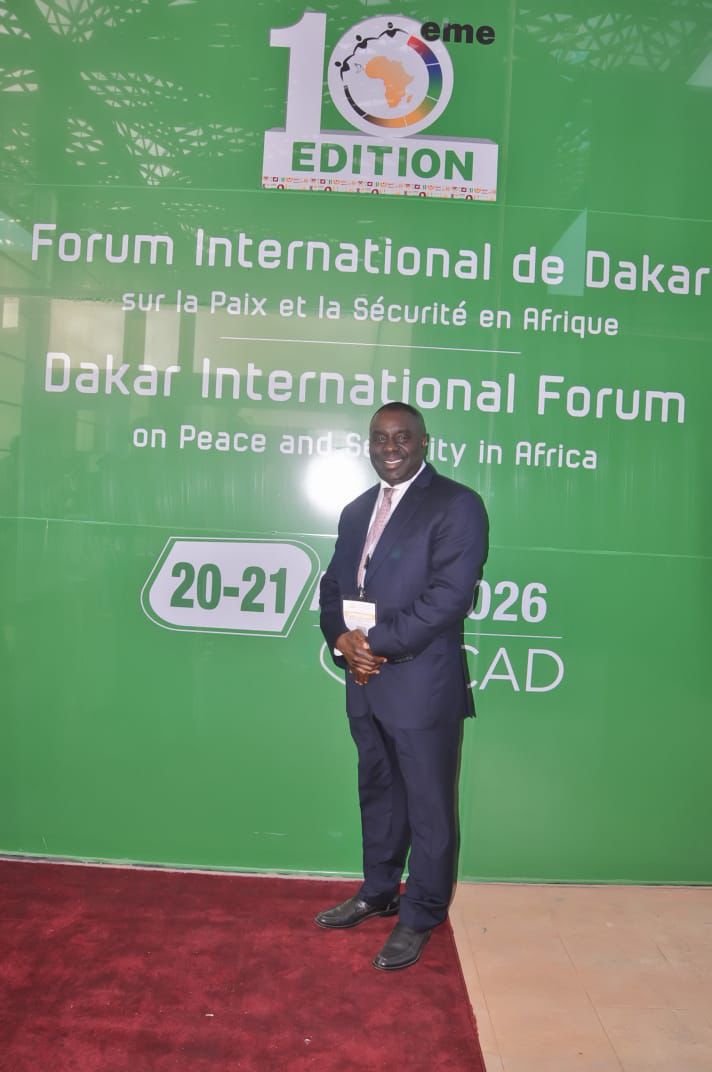

Dakar, Senegal — The Chief Executive Officer of the Centre for Intelligence and Security Analysis (CISA Ghana), Ambassador Rasheed Seidu Inusah, has called for stronger regional cooperation and more inclusive security strategies to address the evolving threat landscape in West Africa.
He made these remarks at the 10th Edition of the Dakar International Forum on Peace and Security in Africa, a platform dedicated to advancing African-led solutions to the continent’s security, stability, and development challenges.
Over the years, the Forum has convened policymakers, security experts, and civil society actors to propose innovative and sustainable responses to Africa’s complex security environment.
Speaking during high-level discussions, Ambassador Inusah emphasised that terrorism and instability across West Africa can no longer be addressed solely through state-led military responses. Instead, he advocated for a comprehensive, multi-level security architecture that integrates civil society and other non-state actors.
“Civil society and non-state actors are neither substitutes for state authority nor marginal participants in security governance,” he stated. “They represent a strategic layer within a broader, integrated security framework.”
Expanding Threat Landscape
Ambassador Inusah highlighted the continued southward expansion of terrorist activity from the Central Sahel toward coastal states, including Benin, Togo, Ghana, and Côte d’Ivoire.
He noted that extremist groups affiliated with Jama’at Nusrat al-Islam wal-Muslimin (JNIM) and Islamic State Sahel Province (ISSP) are exploiting porous borders and governance gaps, creating what he described as “an asymmetric but interconnected arc of instability.”
He pointed to key hotspots such as the Liptako-Gourma region and the Lake Chad Basin, warning of increasing spillover risks into coastal West Africa.
The situation, he noted, is further complicated by shifting geopolitical dynamics, including the emergence of the Alliance of Sahel States and evolving relations within the Economic Community of West African States (ECOWAS).
“This raises a central strategic question: how can African states strengthen security cooperation at a time when regional political fragmentation is increasing?” he asked.
Civil Society as a Strategic Asset
Against this backdrop, Ambassador Inusah underscored the critical role of civil society and non-state actors in strengthening resilience and supporting preventive security efforts.
“Terrorist expansion is rarely purely military,” he noted. “It thrives where security gaps intersect with governance deficits and social grievances.”
He explained that in many communities—particularly in border regions—actors such as traditional authorities, religious leaders, women’s groups, youth networks, and community organisations remain the most trusted institutions. These groups contribute to early warning systems, mediate local conflicts, and help counter radicalisation.
“In this sense, civil society acts as a frontline actor in preventive security,” he added.
He also highlighted the role of such actors in bridging trust deficits between communities and state institutions, warning that overreliance on military responses alone risks deepening public mistrust.
Toward a Broader Security Ecosystem
Ambassador Inusah stressed that civil society should be viewed as part of a wider ecosystem of non-state actors, including the private sector, humanitarian organisations, and research institutions.
“In many areas where state presence is limited, these actors are often the first responders to social tensions and the last guardians of community cohesion,” he said.
However, he cautioned that their growing role must be balanced with strong governance frameworks to ensure accountability, respect for human rights, and the preservation of state authority.
Regional Cooperation and Societal Integration
The CISA Ghana CEO also pointed to initiatives such as the Accra Initiative as examples of emerging approaches that combine security cooperation with community engagement.
He further noted that civil society networks often remain active across borders even when political relations between states are strained, describing this as an important form of “societal security integration.”
“If terrorism spreads across borders, societal resilience must also operate across borders,” he said.
A Call for Strategic Integration
Looking ahead, Ambassador Inusah called for:
- Institutionalising civil society participation in early warning and conflict prevention systems
- Strengthening collaboration between governments, regional bodies, and non-state actors
- Investing in vulnerable border communities
- Protecting civic space
- Embedding inclusive approaches within the African Union and ECOWAS security frameworks
He emphasised that while civil society plays a critical role, it cannot replace the central responsibility of states and regional institutions.
Conclusion
Ambassador Inusah concluded by reaffirming that sustainable peace and security in West Africa will depend on balanced, inclusive strategies that combine strong state institutions with community trust and long-term development.
“An effective response to contemporary security challenges must be comprehensive,” he said. “It should combine capable state institutions, strong regional cooperation, and inclusive approaches that reinforce trust between governments and the communities they serve.”
As the Dakar Forum marked its tenth anniversary, discussions reflected a broader shift in Africa’s security thinking—from purely military responses toward integrated strategies that prioritise both state capacity and societal resilience.
“Ultimately,” he concluded, “sustainable security will depend not only on military capability, but on trust between states and the societies they serve. And that trust is precisely where civil society plays its most strategic role.”
