

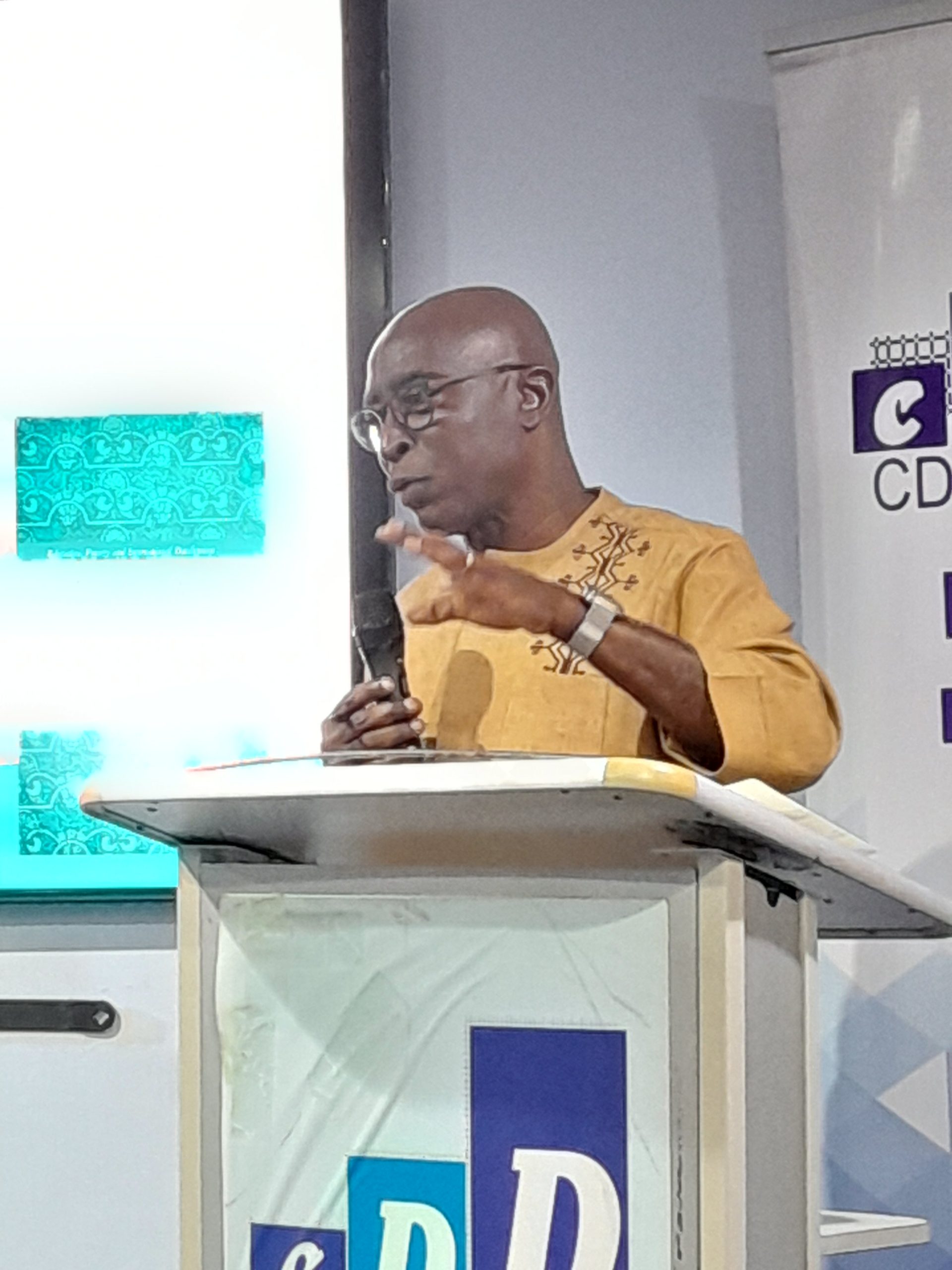
Accra, Ghana//-A Senior Fellow at Ghana Center for Democratic Development (CDD-Ghana), Professor Kwame Akyeampong has warned that to address the rising learning crisis, the country must pursue equity in education policy at the foundational level.
He gave the warning on Thursday, April 2026, in Accra at a public lecture titled “Reconceptualising the ‘Learning Crisis’ for Social Justice: The Case of Ghana” organised by the CDD-Ghana.
Prof Akyeampong noted: “Policies such as free secondary education are politically popular and have driven infrastructure expansion at the Senior High School (SHS) and tertiary levels.
As a result, only about one-quarter of government education spending reaches pre-primary and primary education, despite acknowledged learning challenges at these levels”
Access has expanded, but learning outcomes remain weak
The renowned education expert lamented that access has expanded, but learning outcomes in the country have remained weak.
Ghana, according to him, has achieved near-universal primary completion but still leaves many children behind.
By 2022, 97% of children aged 6–14 completed primary school, up from 61% in 2000. Yet approximately 450,000 children in this age group remain out of school, and large regional disparities persist, he added.
“Over-age enrollment masks deeper system inefficiencies: Kindergarten gross enrollment reached 122% by 2022/23, and Junior High School (JHS) enrollment shows wide gaps between gross and net rates, reflecting delayed entry and repetition. These patterns signal inefficiencies rather than true universal progression”.
Learning outcomes point to a severe foundational learning crisis: The 2024 National Standardised Test shows that 44% of Primary 4 learners are below basic proficiency in English and 38% in Mathematics.
Learning poverty estimates confirm that over 60% of children fail to achieve basic literacy and numeracy by the end of primary school, with particularly poor outcomes in Primary 4 and 6.
To this end, Akyeampong who is a Professor of International Education and Development issued a stark warning to policymakers and went on to declare that no child in Ghana should complete primary school without basic literacy and numeracy skills.
In his own words: “No child in Ghana should go to school and end up in Primary Six and cannot read and write. And it’s not a problem that takes 30 years to fix. We can fix it in a year”.
Furthermore, Prof Akyeampong added that school environments and teacher deployment exacerbate learning gaps. As many schools lack adequate water and sanitation, sufficient learning materials, and trained teachers—especially in rural and northern areas.
High teacher turnover and absenteeism further undermine instructional quality, he stated.
To reclaim the response to the ‘learning crisis’ in Ghana, Prof Akyampong said we must:
-Recognise and build on existing knowledge and strengths;
-Focus on holistic teaching & learning, grounded in Ubuntu;
-Value children’s resilience;
-Use local languages, especially in early grades;
-Engage communities as partners (tap into the power of mothers);
-Train, support and empower teachers as capable, innovative professionals; and
-Put teaching methods and classroom practices at the heart of reforms
Across Ghana and much of the Global South, concerns about a “learning crisis” have gained prominence, particularly in relation to foundational literacy and numeracy outcomes.
While these concerns are valid, they often risk narrowing the conversation to technical fixes and measurable outcomes, without sufficiently interrogating the broader social, structural, and equity dimensions of education.
So, the thought-provoking lecture sought to reframe the discourse by examining how issues of inequality, access, and systemic disadvantage shape learning outcomes and what a more socially just approach to education reform in Ghana might look like.
The Social Justice Issue
Touching on “The Social Justice Issue: Equity and Rights”, Prof Akyeampong noted: “Equity is about meeting rights”.
He was quick to explain that the weak version of rights emphasises opportunity, the strong version of rights emphasises justice.
Prof Akyampong insisted that every child deserves and should get the best possible education, irrespective of their gender, ethnicity, where they live, etc.
In his welcome address, the Executive Director of CDD-Ghana. Prof H. Kwasi Prempeh said social justice is a critical issue for the CDD-Ghana and the country at large.
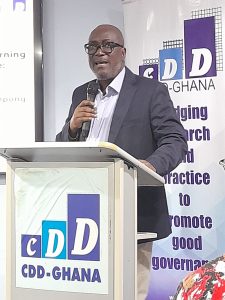
He added that inequality and its various forms in which it expresses itself are a critical issue for those who take education issues very seriously.
“You will find similar issues in health and almost all social policies. Our biggest concern today is to look at how the crisis in education and learning impacts social justice and how we will reframe or reform it and think around it to minimise social justice in Ghana”.
https://whatsapp.com/channel/0029Vb7WOj28aKvScvMNqw04
