


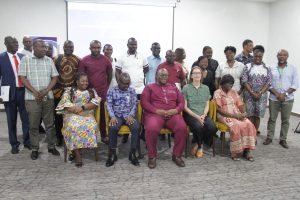
Accra, Ghana//-The Ghana Center for Democratic Development (CDD-Ghana), in collaboration with the London School of Economics’ Department of Geography and Environment, the University of Ghana—Legon, and the University of Manchester, today hosted a Research Dissemination Workshop focused on “Self-Build Housing and Urban Economic Growth.”
The event spotlighted groundbreaking findings on how self-constructed housing contributes to urbanisation and economic development across the continent.
The research examines the crucial role of self-built housing in Accra and Techiman, uncovering how this grassroots approach to housing not only drives urbanisation but also makes a substantial contribution to employment and economic development in Ghana.
Key findings
According to some key findings from the studies, women contribute to household income through the operation of home-based economic activities and housing-related businesses.
During the presentation, a lecturer from the University of Ghana (Legon), Professor George Owusu, noted that a majority of people are involved in building their own houses.
He mentioned that approximately 90 per cent of people in Ghana are engaged in self-constructing their homes.
“When we look at our policy, we don’t pay too much attention to this particular fact. So, the idea was to look at this and also to look at the fact that housing needs to generate a lot of economic activities, and also employment.
And so that was what motivated us to look at this particular research, the fact that over 90% of houses built in Ghana are self-built, and also to look at the kinds of economic activities and then jobs created through housing,” said Prof Owusu.
“And we also found out in this research that if you look at economic activities and the job created, the urban economy and even international, you know, those economic generate a lot of multiply effects and jobs that governments want to pay attention to, and that’s something that we emphasize in this research”.
Just take a look at the number of architects, surveyors, carpenters, masons, labourers, painters, talents, and what have you. Apart from that, they also buy what you call building materials. If you put all this together, there’s a lot, and it generates a lot of economic activities, and it generates a lot of employment. And so, we need to pay close attention to this”. He added
Ghana’s housing economy provides a valuable blueprint for understanding the complexities of self-built environments. The project aims to influence policy and practice by advocating for frameworks that empower self-builders and promote sustainable urban development.
The findings are intended to inform decision-makers, ensuring that the voices of those directly affected by housing policies are heard and valued.
