

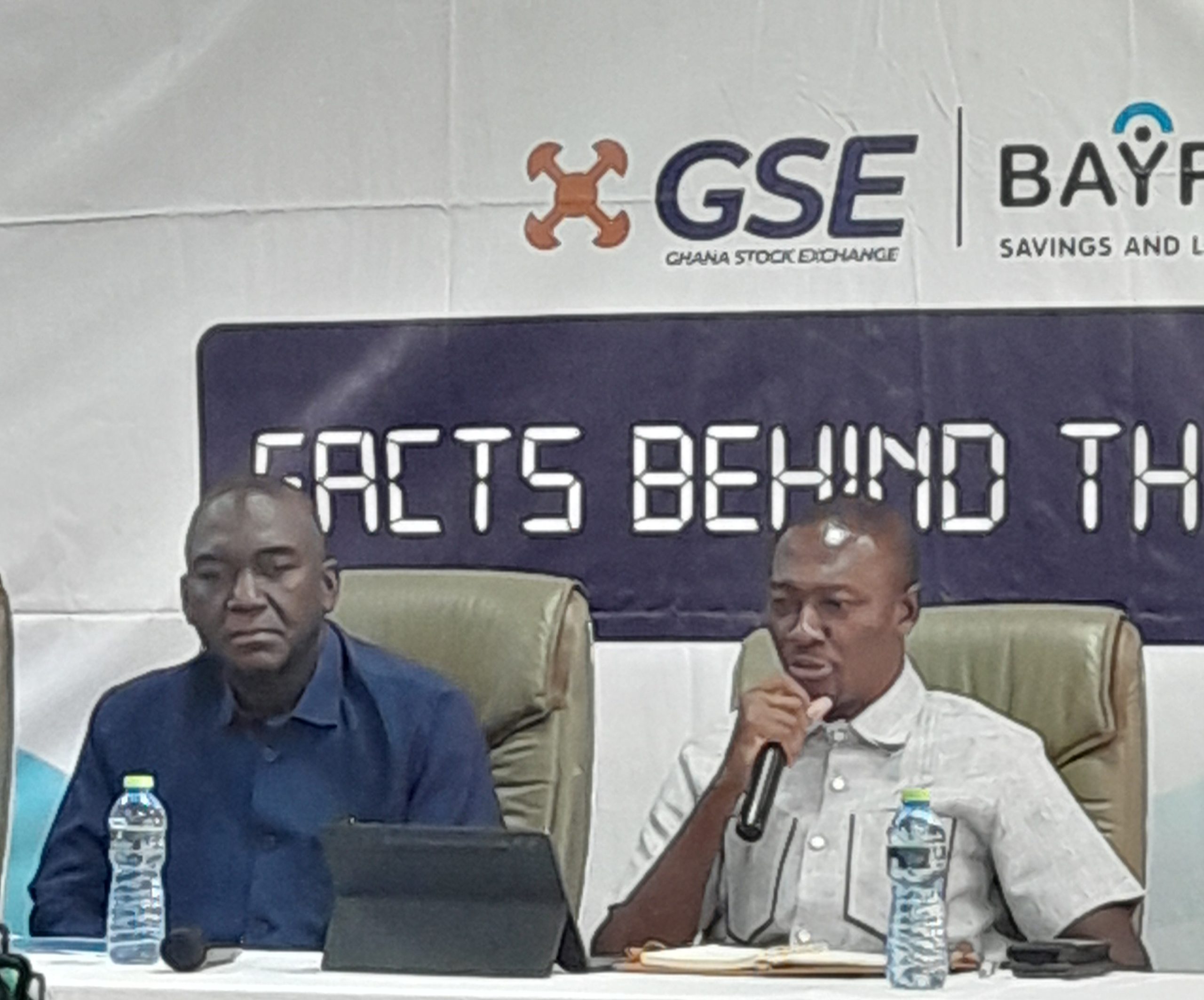

Accra, Ghana//-Bayport Savings and Loans PLC, a leading non-bank financial institution (NBFI), says it is continued to grow in the country’s difficult NBFI sector.
The company, whose total assets stood at GHC2.44 billion, attributed its strong performance in the first half of 2026, surpassing the full year of 2025, to key factors which drove the company’s growth.
The key factors, according to management of the company are- supporting the government sector workers, being very disciplined in cost and cost management, and getting a lot more funding through deposits and other funding sources.
The Managing Director of Bayport Savings and Loans PLC, Akwasi Aboagye, disclosed this when he took his turn at the Ghana Stock Exchange’s (GSE’s) Facts Behind the Figures in Accra, organised by the local bourse for listed companies in the country.
These factors he noted are what have powered the company’s growth for the first half year. The company has done that using technology, which is its digital transformation that it had embarked on about four or five years ago.
He said: “In terms of our strong performance in the first half of this year, we observed that our cost to income ratio continues to improve.
Most importantly, the government has also done well in managing the interest rates where we have seen the yields of the government treasury bills also dropped. That, has supported our business in deposit mobilisation”.
Mr Aboagye continued that the positive development in the treasury bills market has allowed institutions like them to continue to mobilise deposits. That has allowed our business to continue to grow, he stated.
The currency has also been friendly in the sense that the cedi stayed between Ghc10 and Ghc12 for the dollar range. For us because we are largely a digital business and a lot of our IT and technology is imported, that has further supported our cost moderation, the MD told the participants.
Bayport, which is the biggest lender to the government’s sector workers, depends on controller payments (government payments) and didn’t experience delayed payments in the first year.
“For instance, if you go through the government’s public sector payroll, if you see four customers, one of them will have a loan with Bayport”.
Mr Aboagye added that the company continues to lend to the government sector workers, including teachers, health professionals and those working in the various Ministries, Departments and Agencies (MDAs).
It is our DNA that we continue to lend and drive financial inclusion in the public sector space, he stated.
Throwing more light on the phenomenal performance of the company from 2025 to the half-year (H1) 2026, Mr Aboagye said: “We started a deposit mobilisation strategy in 2022; thankfully come the end of 2025, we managed to triple our deposit base. We moved from Ghc493 million to Ghc1.05 billion in total deposits.
We did that by building our capacity. So, today, all our branches, which we call business centres, only take deposits, and they don’t give loans. We also have partnerships and lots of engagements with fund managers who have believed in the business and have also supported this growth”.
According to him, two years ago, deposits formed just under 30% of the company’s funding pool. Today, it is at 80%. That is what is funding the company’s growth.
Mr Aboagye explained that because they are able to mobilise more deposits, they are now able to serve their customers better.
Instructively, Bayport Ghana was established in 2003 as a non-bank financial institution and registered with the Bank of Ghana under the PNDC Law 328. It is a market leader in payroll lending solutions to the formal sector and a deposit-taking institution.
Bayport Ghana is a subsidiary of Bayport Management Limited, which owns 99% of the business and is a leading provider of credit to primarily government employees in emerging markets. The remaining 1% is owned by Ghana’s Social Security and National Insurance Trust (SSNIT).
The Group’s other subsidiaries in Africa and South America are in Zambia, Uganda, Tanzania, South Africa, Botswana, Mozambique, Colombia, and Mexico.
