

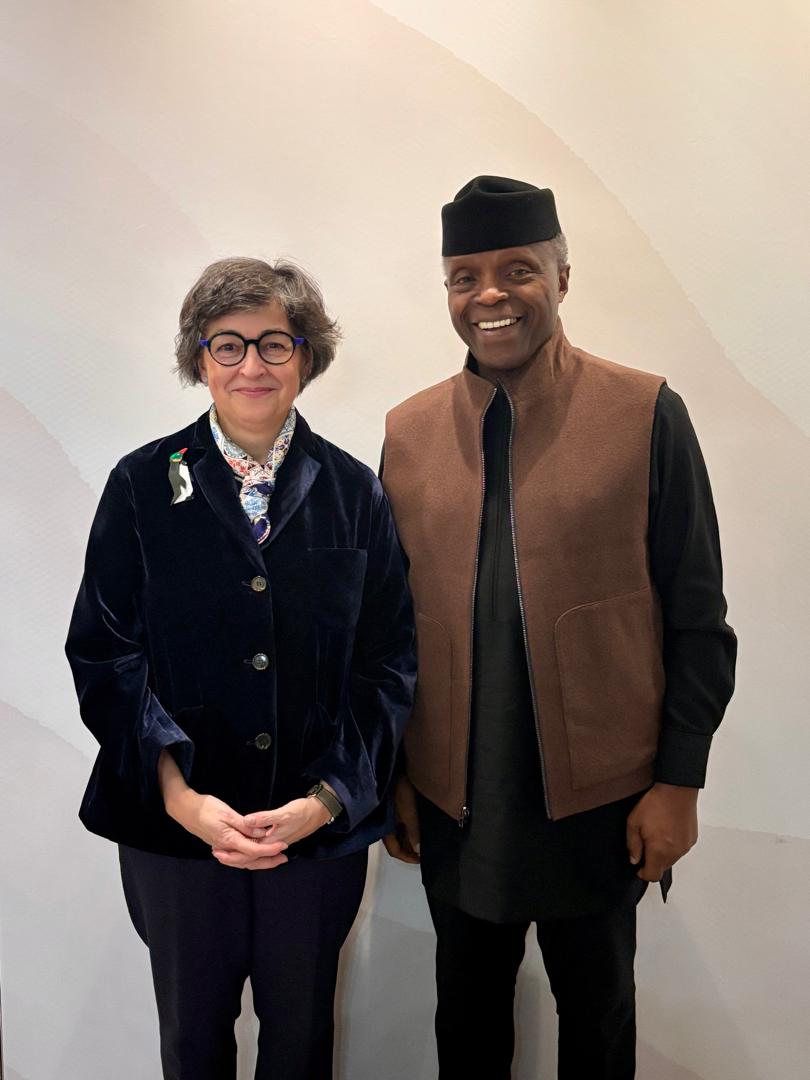

Davos, Switzerland// – Speaking on stage at the World Economic Forum in Davos today, former Spanish Foreign Minister Arancha González Laya announced her role as co-chair of the new Future of Development Cooperation Coalition, an independent initiative with a mandate to reimagine development cooperation at a moment of declining foreign aid budgets, an increasingly fractured multilateral system, and broad agreement that the existing system has reached its limits—but little unity of vision about what should come next.
Mr Yemi Osinbajo, former Vice President of Nigeria, will serve as co-chair of the Coalition alongside Ms González. Together, they bring deep experience from both advanced and emerging economies, and from leadership roles inside and outside the multilateral system.
Supported by a diverse group of Commissioners drawn from public, private, and civil society leadership, the Coalition will work over the next 12 months to build a bold, shared vision for the future of development cooperation. Rather than focusing on incremental reform, the Coalition will step back to ask what development cooperation is for in today’s world—and how it should work.
“2025 has been a year of contraction and hard choices. But 2026 has to be about something more ambitious: a credible vision for how development cooperation can work better across the public, private, and civil society sectors for countries navigating an increasingly uncertain world,” Ms González said.
“This effort starts from a simple question: is development cooperation working in a way that puts countries—their ambition and priorities—at the centre so that transformation happens at scale? If the answer is no—or not consistently—then we have a responsibility to rethink how the system works.”
As traditional models of development cooperation—including aid—come under strain, the Coalition is looking forward, not back. While 2025 was marked by the closure and tightening of aid budgets, 2026 must be a year for a new vision of development cooperation—one that is fit for the realities of the 21st century and focused on delivering meaningful results for people and countries.
Development cooperation today extends far beyond traditional aid. Official Development Assistance exceeds $200 billion annually yet represents less than 10 per cent of total financial flows to developing countries, as countries increasingly act as providers, recipients, investors, and innovators simultaneously.
This interconnected ecosystem—shaped by public policy, private capital, civil society action, and global public goods—demands new approaches to cooperation. The Coalition’s work will focus on how these elements can work together more effectively and efficiently to support sustainable development.
“For many countries, development cooperation isn’t a theoretical debate—it’s about daily realities,” said Coalition Co-Chair Yemi Osinbajo. “It determines whether economies can create jobs, children stay in school, and communities can rebuild after disasters. This moment demands cooperation that breaks free from a narrow assistance mindset and instead leverages the full range of partnerships needed for progress—across investment, trade, and economic transformation.”
Over the past six decades, international assistance and other forms of development cooperation have delivered extraordinary progress, lifting hundreds of millions of people out of extreme poverty and dramatically improving health, education, and well-being across much of the world. But today, those gains are increasingly under pressure. More than 50 countries face serious debt challenges, climate shocks are intensifying, fragility and conflict are on the rise, and geopolitical fragmentation is complicating cooperation just as collective action is needed most.
Over the coming year, the Coalition will engage governments, international institutions, private sector leaders, technology innovators, civil society organisations, and youth to assess current development cooperation flows and practices, identify areas of misalignment, and put forward actionable recommendations for reform. Initial engagements will begin in early 2026 across regions and sectors.
