

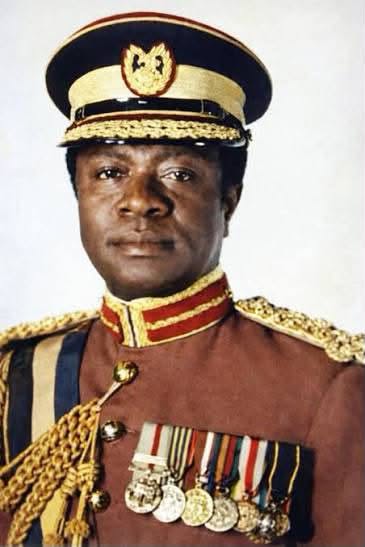
Accra, Ghana//-On Friday, 13, November 2026, at the Marriott Hotel in Accra, something important happened. Sir Sam Jonah, a leading Ghanaian business leader, stood up to deliver the Second General I.K. Acheampong Memorial Lecture, themed “Breaking the Silence: The Human and Political Complexities Behind the Leadership of General Kutu Acheampong.”
For almost 50 years, we have been told not to talk about this man. Sam Jonah called him an “orphan of Ghana’s politics” because he overthrew the Progress Party, the ancestor of the opposition New Patriotic Party (NPP), and he was executed by the Armed Forces Revolutionary Council (AFRC), the ancestor of the governing National Democratic Congress (NDC). So, neither side wanted to own him.
That silence has cost us. Because whether you loved him or hated him, Acheampong understood one thing that we have lost today: no nation can thrive without patriotism and discipline.
Like Nkrumah, he understood that patriotism is not singing and dancing. Patriotism is character. One of his most brilliant policies was the introduction of the National Pledge in 1973. All schools were to recite the pledge before classes, as a way of imbibing national values.
It was introduced by his National Redemption Council government as a daily affirmation of loyalty, to unify a country fractured by political divisions and successive coups.
“I promise on my honour to be faithful and loyal to Ghana my motherland…”
Every Ghanaian child of my generation grew up with those words on our lips. We did not just say them. We meant them. We were taught that Ghana had a good name, and it was our duty to uphold and defend it.
That is why I say today the pledge is lost on many Ghanaians. We still recite it in most schools, but we no longer live it.
There is indiscipline in our schools, in our places of work, and in our communities. We see it in the way we drive, the way we litter, the way we treat public property, and the way we treat each other.
Acheampong also understood the power of symbols. The national anthem we sing today, “God Bless Our Homeland Ghana,” with its call to “cherish fearless honesty” and to “resist oppressors’ rule,” came into use in the 1970s, in his era, after a national competition.
The words are credited to Michael Kwame Gbordzoe, then a student at Bishop Herman College, Kpando, while the music remained Philip Gbeho’s.
It was not a simple amendment in 1974 as is often repeated. It was a generational change, a new prayer for a new Ghana.
That prayer still speaks to us: “Fill our hearts with true humility, make us cherish fearless honesty.”
Fearless honesty. When was the last time we demanded that of ourselves? Those who speak honestly are kept out of the political class and not trusted because they will not condone sycophancy and corruption.
Patriotism is the foundation of the fight against corruption. That was Acheampong’s central message. He is reported to have said, in words that have been passed down in our political tradition: “If you love your country, you will not steal the country’s money.
If you love your country, you will not take goods meant for the people and smuggle them outside. If you love your country, you will not sell the country to outsiders.”
I cannot verify word for word that he said it in that exact form on a particular day, and I will not pretend otherwise. But I know this: it is true to his philosophy. It is the spirit of “Yentua”, we will not pay.
On 5th February 1972, his government said Ghana would not honour about US$90 million in suppliers’ credits it considered tainted by corruption, fraud or inflated contracts. Sam Jonah was right to call it negotiation, not recklessness.
He was prepared to absorb short-term pain for long-term dignity. It is the same spirit as Operation Feed Yourself, launched in 1972.
Sam Jonah reminded us that rice imports fell to zero in 1975 and again in 1976 because Ghanaians were mobilised to produce what they ate. “A nation that cannot feed itself will struggle to realise the full promise of independence,” Sam Jonah said.
He was right. And yet, look at us today. We import rice. We import chicken. We import tomatoes. We have the land, we have the rain, we have the water. What is wrong with us?
This is why any attempt to resuscitate patriotism must be applauded. That is why I welcome the NDC government’s policy requiring National Service personnel to undertake paramilitary training, a policy which was planned to start in 2017 had the NDC won the 2016 elections. I was part of a team sent by President Mahama, and led by the Hon. Chief of Staff, then Local Government Minister, to look at the model in Kenya and implement same in Ghana. It is a positive step.
The National Service Authority has now started screening for its Basic Military Training Programme.
Over 3,000 former service personnel applied for 2,000 places for a four-week programme starting in December 2026, to build discipline, resilience, teamwork and an understanding of national security. That is good. But it must be refined.
It must include all SHS leavers. For two reasons.
Firstly, SHS is free. Higher learning is not. If you narrow this training to only university graduates, what happens to the huge mass of students who drop out after SHS? They are the majority.
They are the ones who will drive our trotros, farm our lands, run our markets, and raise the next generation.
To leave them out is to say discipline is only for the privileged. That cannot be right.
Secondly, If you only train graduates, you create two Ghanas. One Ghana that has been taught discipline, first aid, emergency response, teamwork and love of country. And another Ghana, larger and poorer, left to learn indiscipline on the street. That is how we breed frustration, crime, and disrespect for authority. A nation cannot be disciplined in half.
The age to catch a young Ghanaian is 17, 18, 19, just after SHS, when character is still being formed. That is when the pledge must become practice. That is when a young man or woman must learn to wake early, to obey instructions, to serve others, to put Ghana first.
Let us be honest about Acheampong. He was not a saint. His government fell into Kalabule. His Union Government idea divided the country. He was overthrown in July 1978 and executed without trial on 16th June 1979, after being stripped of his rank by decree.
Sam Jonah did not ask us to glorify the coup. He asked us to judge the man whole, the vision and the blindness, the triumph and the disappointment.
That is what Sankofa means: “Se wo were fi na wosankofa a yenkyi. It is not wrong to go back for what you have forgotten.”
We have forgotten how to love Ghana enough to not steal from her. We have forgotten how to feed ourselves. We have forgotten how to recite a pledge and mean it.
Acheampong was ahead of his time because he tried to build a Ghanaian who would not sell his country for a pittance.
It is time to finish that work.
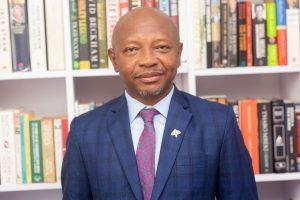
By Ras Mubarak, Pan-Africanist, Politician and Former Ghanaian Legislator
