

Declaring 2026 the “year of artificial intelligence,” Kazakhstan’s president is in the midst of an ambitious drive to transform the Central Asian nation into a “digital state,” with AI at the centre of the effort.
Two weeks after creating a Ministry of Artificial Intelligence in September 2025, President Kassym-Jomart Tokayev announced the next prong of his government’s agenda: setting up an AI research university, which would be granted “special status.”
That initiative is now in full swing. And the company tapped to spearhead the project was founded by Tokayev’s 23-year-old great-nephew before a state institution acquired shares in the venture, an investigation by Radio Azattyq has found.
Qazaq AI Research University, which opened its doors to students last month, is one of two universities that were founded by Nurassyl Medeu, the grandson of Tokayev’s sister, and now have significant state support, company filings and open-source records show.

An entrance to the Qazaq AI Research University campus in Astana.
The rapid rise of Medeu — and the allocation of state property and technology resources to his private ventures — raises questions about potential conflicts of interest and presidential favour in Kazakhstan, which Tokayev has governed since succeeding long-ruling strongman Nursultan Nazarbayev in 2019.
Medeu is the grandson of Tokayev’s younger sister, Karlyga Izbastina. She maintains a low public profile, but was named among the country’s 25 most influential women in 2024 by Forbes magazine, which cited her presidential ties and reported corporate holdings. Her daughter and Medeu’s mother, Dana Medeuova, recently secured a seat in parliament representing Adilet, the pro-Tokayev ruling party.
Founded by Medeu in April of this year, Qazaq AI Research University — which touts itself as “Central Asia’s first AI-enabled university” — quickly received an operating license from the Ministry of Science and Higher Education.
That same month, a state-owned company, QazExpoCongress, acquired a 5-per cent stake in the institution and relocated it to a striking, eight-story spherical building in the Kazakh capital, Astana, that was originally built as the centrepiece of the country’s EXPO 2017.
QazExpoCongress now operates the exhibition site and is transforming it into an AI hub called the “Exponential Cluster.”

A view of Astana.
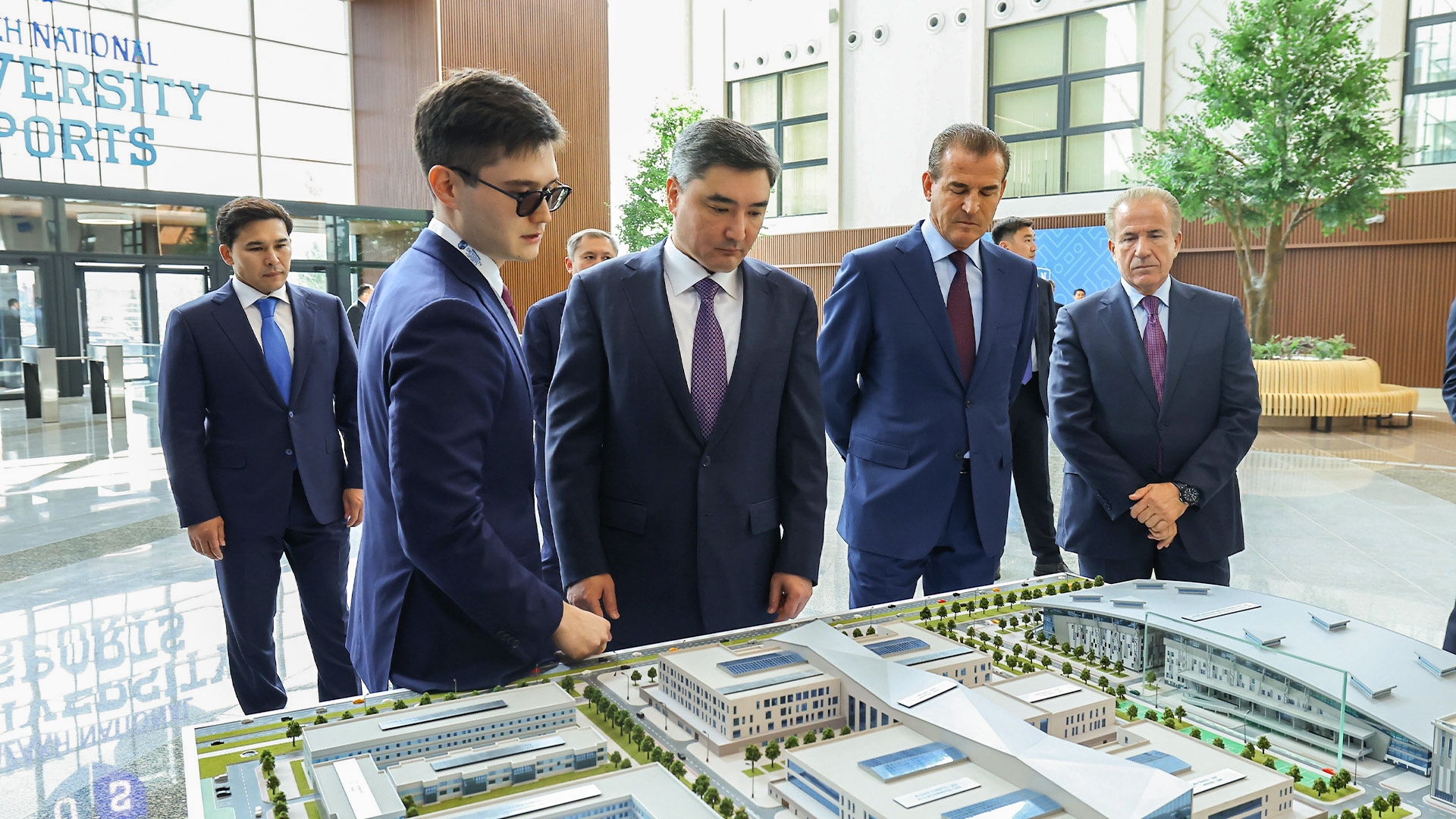
Meanwhile, a for-profit sports academy that Medeu founded when he was 18 years old was rebranded into a university this year, and moved into a $250-million state-owned facility. The government has also acquired a minority stake in the firm behind the sports school, reporters found.
Medeu did not respond to requests for comment, but he did give an interview to the state-run Qazsport television station this month to address questions about his family relationship with President Tokayev.
He said he wanted to quell rumours on social media that the connection had given him “special privileges.”
“I do not know where such assertions come from,” he said. “If you wish, you can also open a university and obtain a license. There is nothing extraordinary about it.”
The presidential administration referred questions on the universities to the Kazakh Ministry of Science and Higher Education.
The ministry told reporters that it bases its licensing decisions on educational criteria, not ownership structure. It did not respond directly to questions about the state’s stakes in Medeu’s companies or their operations on state premises.
A Sporting Chance
The new AI university wasn’t Medeu’s first foray into higher education — or his first business partnership with the Kazakh state.
In 2021 — while he was still an 18-year-old undergraduate at Boston University, according to his LinkedIn profile — Medeu founded the Academy of Physical Education and Mass Sports as a private company in Astana.

Nurassyl Medeu’s LinkedIn profile.
An archived version of the academy’s website shows it was intended to become “a leading national centre for training personnel for the sports sector.”
Company records show that Medeu was its sole owner for several years. Then, in August 2025, KazSportInvest — a state-owned entity established to develop the country’s sporting industry — took a 5-per cent stake in the academy, according to the Tourism and Sport Ministry.
At some point early this year, it was rebranded as the Kazakh National University of Sports. In April, it was relocated to a $250-million sports complex built by the Tourism and Sports Ministry, with 220,000 square meters of buildings and sports facilities spread across a 20.6-hectare site. It now describes itself as “one of the largest educational projects” in Central Asia.
According to local media outlet Orda.kz, which ceased operations last month after its editor-in-chief was given a jail sentence, construction began on the site in 2010 to use it for Olympic training. After a halt in the project in 2015, it was resumed three years later, this time as a national sports university, Orda.kz reported in August, although it noted that the website for the project’s developer listed its client as “private.”
Data from the government’s public procurement website shows that more than $250 million was allocated from the state budget for its construction.

The Kazakh National University of Sports in Astana, Kazakhstan.
In response to questions on the sports complex, the Tourism and Sport Ministry told reporters that Medeu’s university operates the facility under a “trust management agreement.”
Sports School Won Millions in Government Contracts
Medeu’s Kazakh National University of Sports has won government contracts worth over $4.2 million since it was set up in 2021, according to data from the Kazakh government’s official procurement portal.
Medeu did not respond to multiple requests for comment, but after receiving reporters’ questions, he did give a public interview about the university’s ownership structure, saying that he wanted to address “misconceptions” in the media.
“KNUS is a private university that I established in 2021,” he told the online news outlet EU Reporter. “However, the campus itself is not owned by KNUS or by its founders. The property is state-owned and is used by the university for educational purposes under a contractual agreement. The terms of that agreement explicitly prohibit privatisation, disposition, or any transfer of the property into private ownership.”
Speaking at the university’s inauguration in Astana in July, Medeu boasted that the project had “become a major centre where the pursuit of knowledge, talent, and hard work converge.”
“Today, we can proudly say that we have laid a solid foundation. I am confident that even greater achievements, international recognition, and new victories in science and sports lie ahead,” he said.

Nurassyl Medeu (second from left) at the inauguration of the Kazakh National University of Sports in Astana, Kazakhstan.
A ‘Special Role’ for AI University
Medeu’s second educational venture, Qazaq AI Research University, known as QAIRU, was established as a private company in April.
Eleven days later, the Kazakh state-owned company QazExpoCongress became a co-owner, corporate records show. Although the size of its stake is not clear from publicly available information, QazExpoCongress told reporters that it was 5 per cent.
The company said the AI university was a key part of the Exponential Centre, a new “integrated innovation and technology ecosystem” located inside the former EXPO site, and this was why it had been headquartered there.
“QAIRU’s location within the EXPO business complex is attributable to its direct integration into this ecosystem and its alignment with the strategic development priorities of the Exponential Cluster,” it said.
Tokayev soon made a personal visit to the “AI hub” inside the spherical building where Qazaq AI Research University was headquartered. He was given a tour of the space and viewed a presentation about the plans for the school.
Photographs of the event published on the presidential administration’s website show Medeu sitting next to Deputy Prime Minister Zhaslan Madiyev, who also serves as Kazakhstan’s minister of artificial intelligence and digital development.
In June, the school started accepting students for admission, inviting them to come “build the future together.” Last month, classes began for an inaugural group of 400 undergraduate and 100 master’s degree students, local media reported.
Meanwhile, the president has singled out the new university for public accolades at least twice — most recently on October 2, when he spoke about it at a technology conference in Astana.
“[W]e must establish a national scientific and engineering school capable of training educated, highly qualified, and innovation-minded professionals,” he said at the event. “In this regard, a special role is assigned to the recently opened Qazaq AI Research University.”
https://www.occrp.org/en/scoop/a-23-year-old-kazakh-owns-two-new-state-backed-universities-hes-the-presidents-great-nephew?utm_source=OCCRP&utm_campaign=3d754b5eb3-EMAIL_CAMPAIGN_2026_10_16_05_38&utm_medium=email&utm_term=0_bcc1d53473-3d754b5eb3-712171621
