

Accra, Ghana//-Senior officials of Doublethink Lab, Taiwan-based civil society organisation Doublethink Lab say China Index, the first research effort to measure and compare the People’s Republic of China (PRC) influence overseas could support media, civil society organisations (CSOs), researchers, students in Africa to know about the Asian country and its dealings with other countries.
The officials-Aihua Hsieh, Community Coordinator at Doublethink Lab, and Alda Elisa, Communication Officer at Doublethink Lab, said this during a Zoom meeting with some Ghanaian journalists.
They added that the latest China Index presented by Doublethink Lab and the China In The World (CITW) network could be a powerful tool for investigative journalists.
Taking the journalists through the index, Madam Hsieh said the index is published by the CITW network, an initiative of Doublethink Lab, and draws on research by hundreds of researchers and local experts worldwide.
She explained that the index’s rankings are determined by summing normalised responses to 99 Indicators, each corresponding to an observable phenomenon of PRC influence.
These Indicators, according to her, are devised by the Index Committee of experts in PRC influence tactics, and divided equally across nine Domains such as Media, Academia, Economy, Society, Military, Technology, Law Enforcement, Domestic Politics, and Foreign Policy.
Together, the indicators include the first and only research effort to compile PRC influence into a single set of observable phenomena.
The Country Profiles, Domains, and Indicators would be periodically updated to assist academia, civil society, media, and policymakers in analysing and understanding the evolving nature and impacts of the PRC‘s global influence.
“We would prioritise transparency, collaboration, and accuracy at each stage”. Mr Hsieh assured.
Speaking on how China Index fared in Ghana, Madam Elisa indicated that China has increased its presence in Ghana through military cooperation, digital infrastructure projects, and sustained diplomatic engagement.
According to her, the latest index ranked Ghana 18th out of 101 countries overall, and is the 5th highest-ranked country in the Sub-Saharan African region in the China Index.
The Military Domain is Ghana’s highest-scoring area of PRC influence, followed by Foreign Policy and Technology, Madam Elisa said.
“When looking through the data, we observed that China has increased its presence in Ghana through Military Co-operation, Digital Infrastructure programmes and projects and sustainable diplomatic engagements and more”, she further noted.
Still in the Military Domain, the index ranked Ghana 6th globally, demonstrating strong PRC-Ghana defence cooperation.
This includes participating in PRC-led security forums and hosting joint naval exercises, as well as donating military equipment, Madam Elisa explained.
These activities, she indicated, suggest a stable and well-established relationship and position Ghana as a major partner in Beijing’s military outreach on the continent.
In the Foreign Policy Domain, she noted that Ghana’s ranking fell from 16th to 34th, even though its score increased slightly.
This reflects Beijing’s intensified global outreach efforts more than changes in Ghana’s diplomatic alignment and cooperation with the PRC, which have remained steady, according to Madam Elisa.
Ghana’s Technology Domain score remained relatively stable, despite a drop in ranking from 16th to 21st. PRC-linked firms continue to play a major role in building Ghana’s digital infrastructure, supporting smart city projects, expanding rural internet access, and investing in local talent.
This long-term technological involvement points to a structural dependency on PRC actors for digital development.
Military, law enforcement, and foreign policy domains are a part of the Rule-making Cluster, where Ghana ranks 12 out of 101 countries.
This cluster measures the PRC’s influence over global norms, security cooperation, and diplomatic engagement.
Ghana’s high ranking in this cluster not only reflects participation in PRC-led security and diplomatic initiatives, but also its alignment on international diplomatic norms, including supporting the PRC’s “One China Principles,” and claiming that Taiwan is an inalienable part of China, and remaining silent on contentious issues like the South China Sea, Xinjiang, Tibet, and Hong Kong.
A point of concern is PRC’s influence on government norms in Ghana. For instance, one law enforcement indicator reads: “In my country, law enforcement and judicial-related training offered by PRC-connected individuals or entities have been accepted by national or subnational governments” to which the graded response is “Yes”, and the following supporting evidence state: “A significant number of Ghanaian law enforcement officers have been trained in China.”
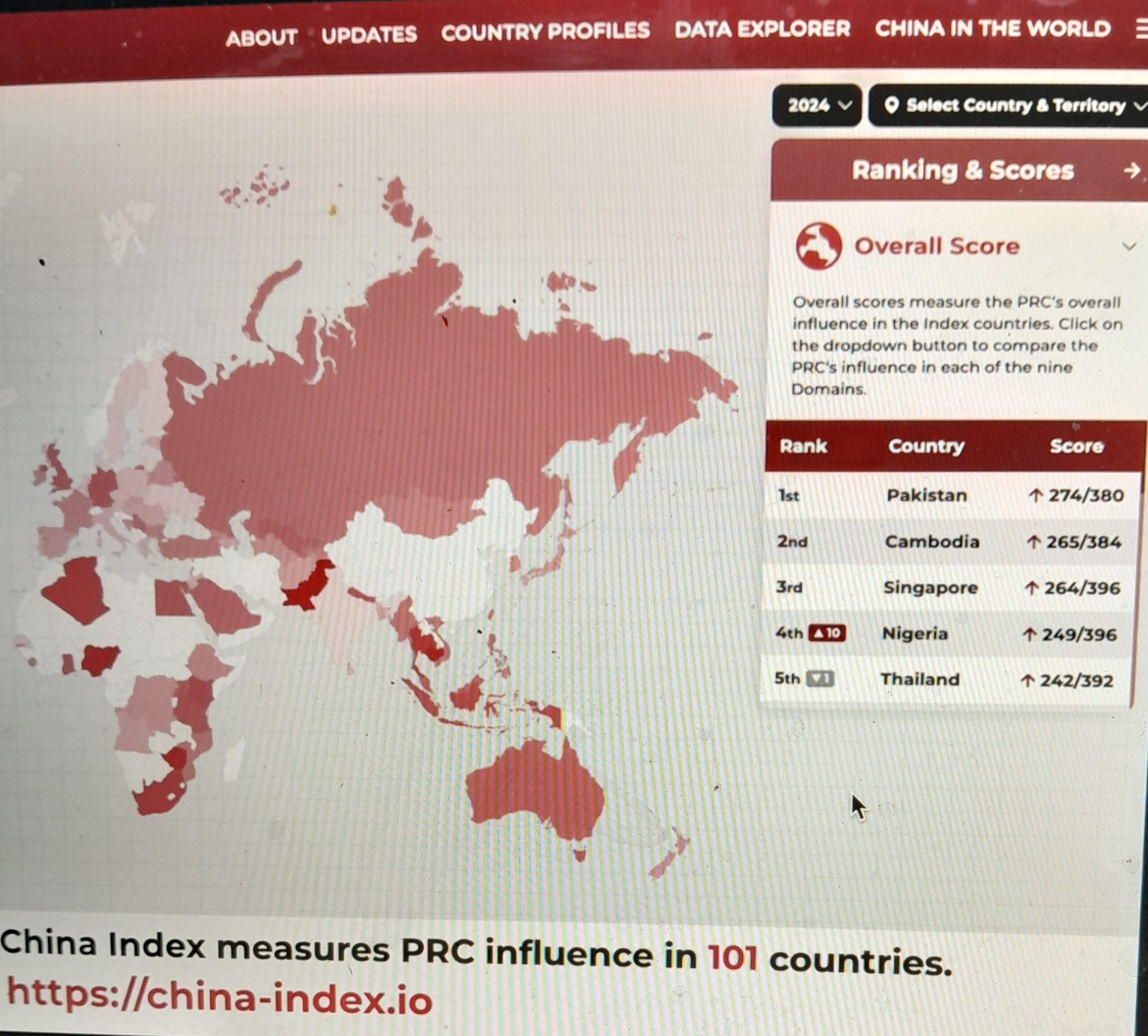
In the latest index, Pakistan, Cambodia, and Singapore are ranked as most exposed to PRC influence. North Macedonia, Albania, and Montenegro are ranked as least influenced.
Globally, PRC influence is assessed to be most prominent in the Domains of Foreign Policy, Technology, and Economy, and weakest in those of Military and Media.
