

The government’s repeal of the electronic transaction levy (e-levy) on Wednesday fulfils one of the strong preferences that Ghanaians expressed ahead of the December 2024 election.
In Afrobarometer’s survey last August, about four out of five citizens opposed maintaining the fee on mobile money transactions. During the election campaign, both major political parties called for its repeal.
Since its introduction in May 2022, many Ghanaians have decried the e-levy as an excessive tax burden and expressed scepticism about the government’s ability to use the revenues effectively for development projects.
On Wednesday, President John Dramani Mahama officially signed into law the repeal of the e-levy, along with repeals of an emissions tax and a betting tax, following their removal from the new administration’s 2025 budget.
In contrast, survey findings show that Ghanaians continue to back several other key government initiatives, including the free senior high school programme.
Key findings
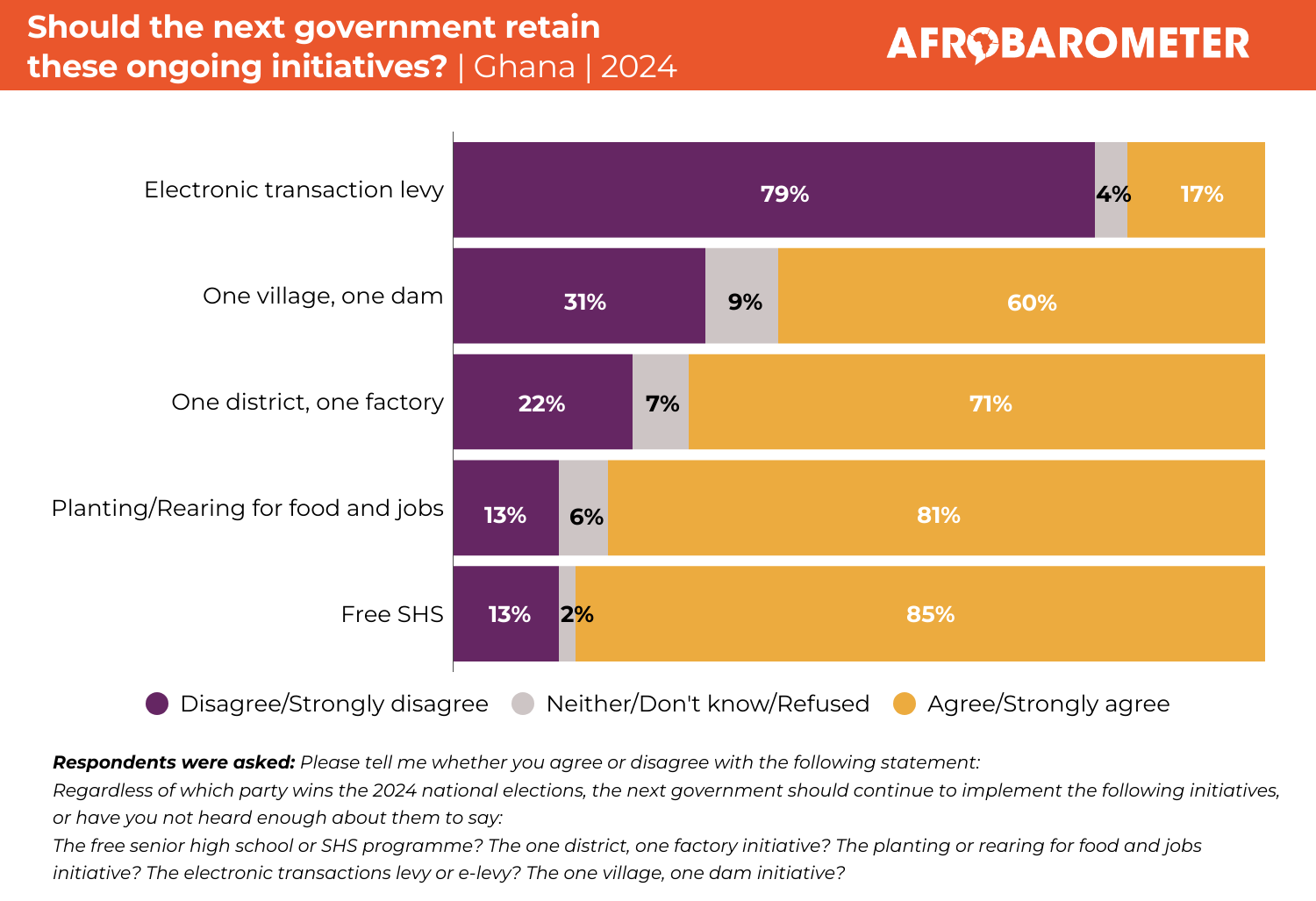
- More than three-fourths (79%) of Ghanaians favoured discontinuing the electronic transactions levy (e-levy) (Figure 1).
- In contrast, strong majorities expressed support for the new government to continue several other initiatives: free senior high school (85%); planting/rearing for food and jobs (81%); one district, one factory (71%); and one village, one dam (60%).
- Opposition to maintaining the e-levy was strong across key demographic groups, with particularly high resistance among men (83%), youth (83%), the poorest citizens (86%), and those with post-secondary education (87%) (Figure 2).
- In Afrobarometer’s 2022 survey, three-fourths (76%) of survey respondents said the e-levy was a bad idea because it would increase the tax burden on ordinary and poor citizens (Figure 3). Almost two-thirds (63%) “strongly agreed” with this view.
- A similar proportion were also “not very confident” (24%) or “not at all confident” (51%) that the government would fulfil its pledge to use the revenues generated by the e-levy to fund development programmes (Figure 4).
Afrobarometer surveys
Afrobarometer is a pan-African, non-partisan survey research network that provides reliable data on African experiences and evaluations of democracy, governance, and quality of life. Nine survey rounds in up to 42 countries have been completed since 1999. Round 10 was launched in January 2024. Afrobarometer’s national partners conduct face-to-face interviews in the language of the respondent’s choice.
The Afrobarometer team in Ghana, led by the Ghana Center for Democratic Development, interviewed a nationally representative sample of 2,400 adult Ghanaians in August 2024. A sample of this size yields country-level results with a margin of error of +/-2 percentage points at a 95% confidence level. Previous surveys were conducted in Ghana in 1999, 2002, 2005, 2008, 2012, 2014, 2017, 2019, and 2022.
