

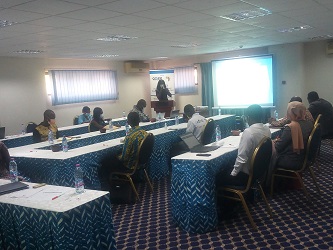
 The Ghana Anti-Corruption Coalition (GACC) today discussed Open Contracting and the use of Open Contracting Data Standard as well as its participation, efficiency, value for money, and competition in public contracting in Ghana.
The project titled-‘From Disclosure to Impact: Deepening and Broadening Open Contracting in Africa (Ghana),’ is being held and implemented in other three countries namely Nigeria, Malawi, and Uganda.
The forum was held in Accra in partnership with the Hewlelt Foundation and the African Freedom of Information Centre (AFIC).
What the partnership seeks to achieve is by helping these countries to be able to help in data disclosure.
The project analysis by the GACC was done on 21 public entities with a focus on the health and educational sectors, while the Communication Officer of GACC, Ms Faustina Djabatey, and Monitoring and Evaluation Officer, Michael Adisu did presentations.
She noted that there are so many gaps when it comes to disclosure of procurement with public institutions in the country.
“You will realize that there is a real information gap, so we only selected a few of them 21 institutions we are familiar with.
Because this project is mainly targeting the health and education sectors, we actually focused on the health and education entities,” she added.
Ms Djabatey stated that the existence of the Public Procurement Authority (PPA) and the Right To Information (RTI) Law should encourage the public to access information from the public institutions.
“The PPA and RTI should work hand in hand so that we can be able to get information easily. Because some of the information you need, it is about whom you know. Even we as Civil Society Organizations (CSOs), we face that challenge,” she closed.
“So the workshop is actually to promote a proactive disclosure of data on procurement.
We all can attest that there have been so many projects that have not actually reached a 10-year life-span to exist,” Ms Djabatey stressed.
The Communications Officer stated that there are some roads that are constructed and within a year or two they are seen in a bad state.
“We also see projects in some communities that do not have to be there, construction of gutters and you see some of those projects situated at wrong places.
This can also promote bad infrastructure because we don’t have a transparent process for procurement and you can’t know the contractors for those projects to even question them on the state of work,” she added.
By Isaac Dzidzoamenu
