


Journalist exile in Latin America has shifted from a temporary crisis to a structural problem. At SembraMedia, we address the need for holistic support architecture—including risk management and prevention—to ensure the sustainability of media in the diaspora.

What happens when exile stops being an exceptional event and becomes a structural problem?
In recent years, the number of journalists forced to leave their countries in Latin America has increased. Given this reality, SembraMedia aims to support the construction of solid infrastructure that provides media outlets and journalists with the tools to navigate these processes and continue reporting, if they so choose.
The global debate
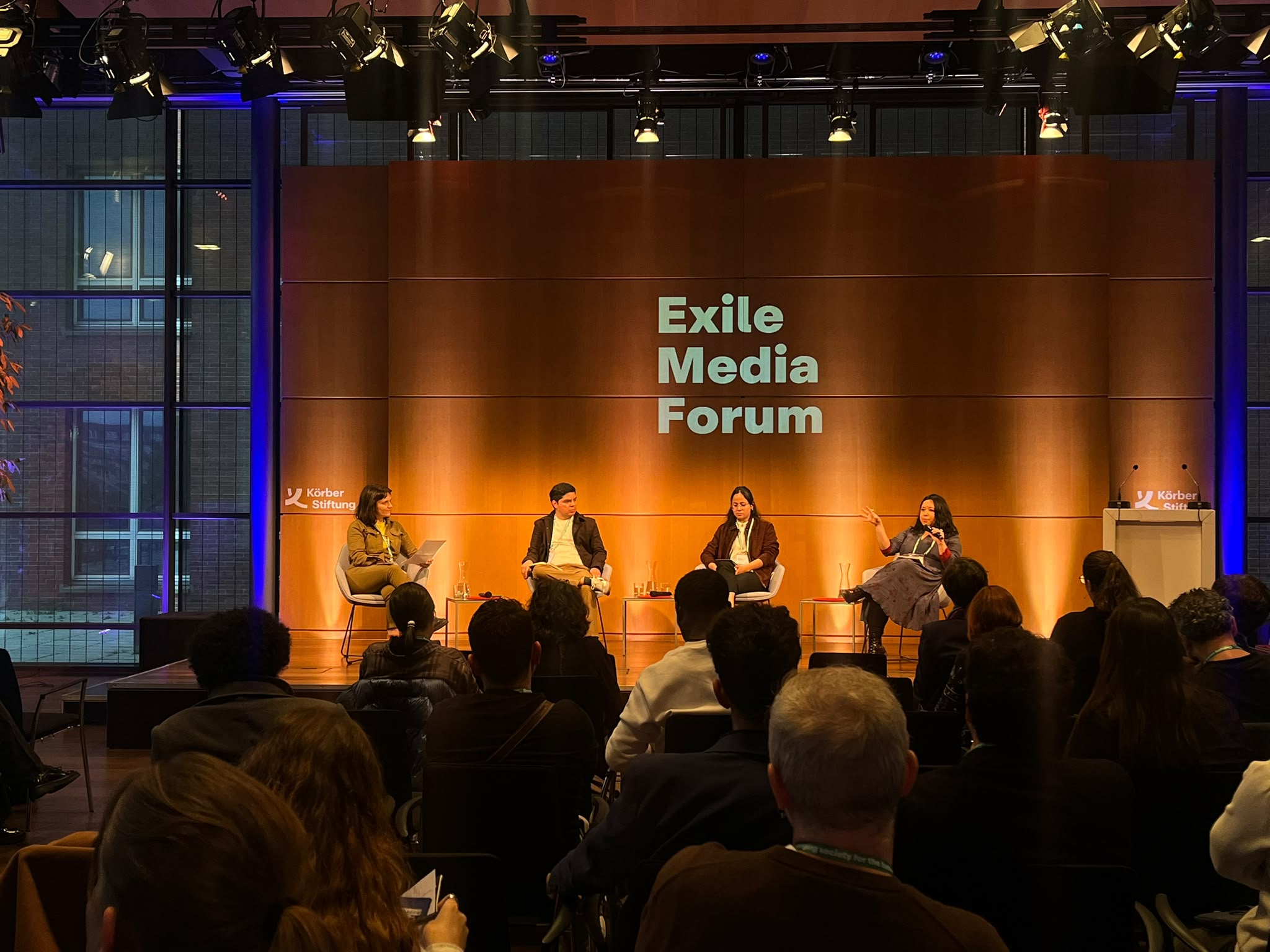
Last month, Sofía Álvarez, our Initiatives Director, attended the Exile Media Forum 2026 in Hamburg, Germany. She moderated the panel “When Exile Becomes Structural: Latin America and the Future of Press Freedom,” featuring Vania Pigeonutt (taz Panter Stiftung), Melisa Rabanales (freelance journalist), and Nelson Rauda Zablah (GFNE).
The goal of the gathering was to answer a pressing question: How can independent coverage survive in contexts where forced displacement is no longer a temporary crisis, but the norm?
During the discussion, speakers highlighted the importance of avoiding a single narrative when framing exile. Pigeonutt spoke about the need to address “exiles, in plural.” Shedding light on the nuances of these stories is essential—such as those forced into exile alone, or leaving countries officially considered “safe” or democratic.
There are as many types of exile as there are journalists and host countries. According to the report Voces desplazadas, Argentina, Chile, Colombia, Costa Rica, the United States, Spain, and Mexico are the primary host countries for displaced journalists. The case of Mexico illustrates this complexity: while the country serves as a refuge for exiled journalists from Central America, internal structural issues leave local journalists unprotected.
Complex situations also arise for professionals who traveled or emigrated for other reasons and later found it impossible to return safely due to political deterioration in their home countries.
During the panel, Rabanales addressed the uncertainty surrounding when and how a person can return to a home country—noting that the answer not only is non-definitive, but also grows more complex over time as people build lives in host countries.
For his part, Rauda Zablah highlighted an often invisible aspect of these cases: displacement also affects partners, children, and relatives who do not practice journalism, receive public recognition, or have access to sectoral support networks. They are left to rebuild their lives from scratch after losing their jobs and community ties.

Fragility before departure
Echoing the findings of Voces desplazadas, the vast majority of cross-border departures are triggered by direct acts of violence and occur abruptly, without basic security measures or advance planning.
This study and international discussions align with preliminary findings from an exploratory research project our team of digital media specialists at SembraMedia conducted in recent months. Through surveys and interviews with displaced Latin American journalists, we found that:
- The primary causes of exile among surveyed reporters were direct threats, surveillance or harassment, and detention or the risk of detention.
- Two out of three displaced journalists had no exit protocol agreed upon with their news outlets or organizations, and nearly half of the surveyed media outlets lack crisis management or prevention protocols.
- Only 13.5% of journalists received support from their media outlet to coordinate their departure, as organizational structures face the same precarious conditions and persecution as their reporters.
Holistic support for exiled journalists
Various organizations work tirelessly to support journalists in emergency situations. For example, the Inter American Press Association created the Network of Latin American Journalists in Exile (RELPEX, by its Spanish acronym), and organizations such as People in Need and the International Federation of Journalists offer assistance programs.
However, to sustain newsroom operations and journalists in the diaspora, SembraMedia reiterates the need to approach sustainability holistically. Cinthia Membreño, coordinator of the Network of Exiled Media Outlets (NEMO), notes: “Exile is not an isolated event; it is a reality that can extend for years, even decades. This condition affects every dimension of a media outlet’s operations—from legal and financial structures to talent retention, digital security, and team well-being.”
For NEMO, comprehensive support requires active, coordinated dialogue among media outlets, donors, media development organizations, and support networks. In this context, at SembraMedia, we propose focusing on two interconnected priorities: risk management and prevention, alongside safety and well-being.
Risk prevention and management
Safety cannot depend on the ability to improvise at the moment of highest vulnerability. Media outlets and organizations must build crisis management protocols before emergencies occur. This involves establishing clear workflows that range from preventive risk assessments for high-impact coverage, to actions that must be taken when a team member must leave the country—such as safe evacuation routes, decentralized backup of sensitive information, and delegating roles.
As we addressed in our previous article Prevailing at a distance: Keys to practicing journalism from exile (in Spanish), reporting from abroad requires developing new dynamics to access sources, verify information remotely, and protect local networks of contributors without halting coverage.
Shifting from reactive logic to a culture of prevention mitigates the institutional blow and protects the journalist’s life without entirely disrupting media operations.
We will soon offer a class in our Virtual School on designing care protocols. Subscribe to Sustainable Connections, our newsletter in English, to get notified as soon as it launches.
Well-being and safety
Exile is a traumatic process of personal and professional reconstruction where grief—both migratory and relating to professional identity—directly affects the capacity to continue reporting.
Historically, journalism culture has sidelined individual well-being in favor of the craft. However, in the context of forced displacement, emotional support and psychological care must be recognized as indispensable components of operational safety and sustainability.
The findings of our preliminary research highlight the weight of this dimension: 37% of journalists who say they needed psychological care received no support at all, facing the shock of exile and precarious conditions in host countries alone.
In our article Migrant journalists and mental health: How to cope with migratory grief and keep reporting (in Spanish), we dive into how migratory grief, isolation, and “survivor’s guilt” affect diaspora newsrooms.
A new support architecture
Faced with this moment in the region, SembraMedia aims to provide evidence so that decision-makers can offer responses aligned with journalists’ needs. From our position as a support organisation, we have identified a need for designing protocols and operational tools that allow journalists in the diaspora to work more safely.
Shedding light on the preliminary findings of our exploratory diagnosis is the first step toward driving the institutional infrastructure that independent journalism in Latin America needs in order to keep reporting.
