

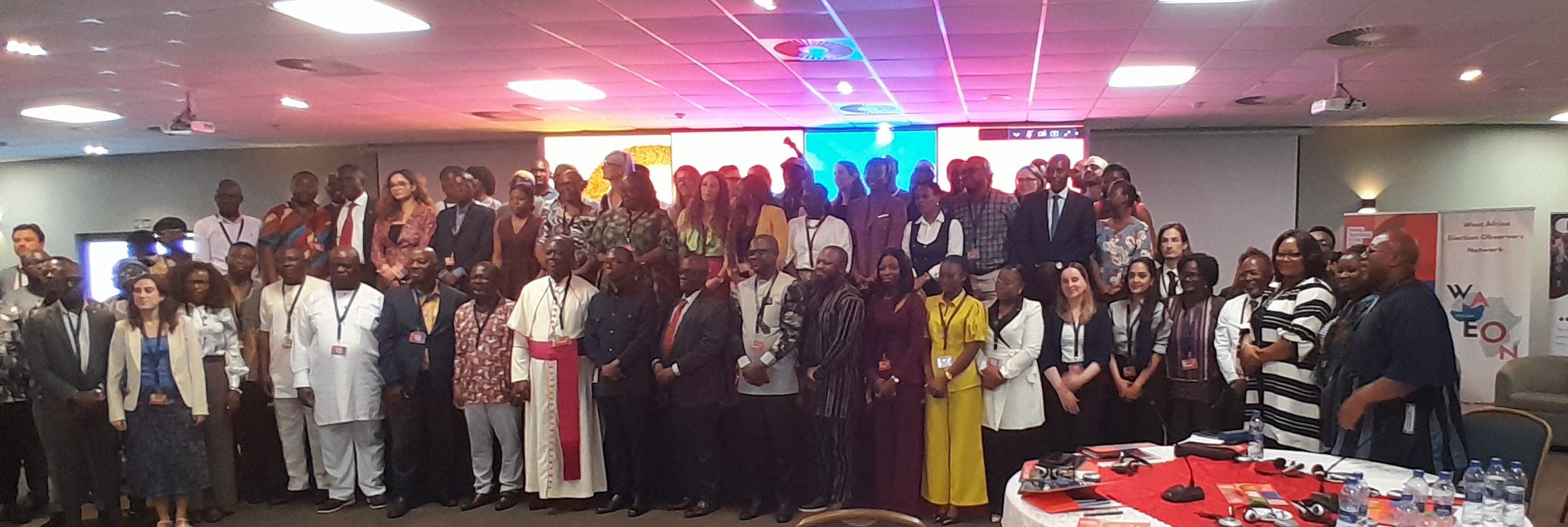
Accra, Ghana//-The third Electoral Integrity in Africa Summit today opened in Accra with a strong call on African governments to safeguard electoral integrity from financial and digital threats.
The two-day summit, themed ‘Money, Technology & Civic Rights: Defending Electoral Integrity in Africa’,was organised by the African Election Observers Network (AfEONet) together with the Center for Democratic Development Ghana (CDD-Ghana) and the West Africa Election Observers Network.
The summit brought together election observers, civil society, and democracy experts to explore how to limit the misuse of money and technology in elections and identify practical solutions to safeguard electoral integrity from financial and digital threats.
In a welcome Address, Executive Director of CDD-Ghana, Professor Henry Kwasi Prempeh, noted that citizen election observers across Africa continue to protect democracy as civic space comes under pressure.
However, their work is becoming more challenging as the forces shaping elections extend far beyond what happens at the ballot box.
Democracy he acknowledged, is also influenced by money and technology. When these forces are misused, elections become less about voters’ choices and more about who can afford to influence them.
Co-chair of Ghana’s Coalition of Domestic Observers (CODEO), Rev Fred Deegbe, in a speech, observed that the environment in which domestic observers operate is changing and their approaches to election observation must change with it.
He added that electoral processes are becoming increasingly technology-driven. “CODEO’s observation in 2024 voter registration exercise encountered challenges associated with the biometric equipment at some centres”.
For instance, Rev Deegbe noted that during their observation of the first seven days of the voter registration exercise, some registration centres experienced problems with their Biometric Voter Registration kits (BVR kits).
In some cases, people were forced to suspend the registration and come back and do it again.
As technology becomes more deeply embedded in voter registration, voter identification, results management and political communications, observers must develop the capacity not only to observe how electoral technology is deployed but also to assess its reliability, accessibility, transparency, and implications for public confidence and trust in the process.
Knowing very well that when there is a problem with technology, people are quick to identify who is manipulating it. Sometimes, it may be “African electronics” that is manipulating it, he emphasised.
“At the same time, the environment in which political communications take place is changing very fast. The growing financial involvement in politics raises questions that traditional election observation methodologies have not always been designed to answer.
If money increasingly shapes campaigns, candidate selection and voter mobilisation, how do domestic observers systematically document campaign expenditure, vote-buying, the use of state resources, and other forms of financial influence?”, Rev Deegbe asked.
More fundamentally, we must ask what these mean for the freedom of voters to make genuine choices and ultimately for the fairness and credibility of elections.
How do we generate credible evidence on these issues while within the mandate and maintaining the independence of citizen observers, he also asked?
