


When President John Dramani Mahama took the solemn oath of office, he promised the good people of Ghana a comprehensive “reset”. This was to be a systemic overhaul engineered to restore public confidence, accountability, and institutional competence across our public services.
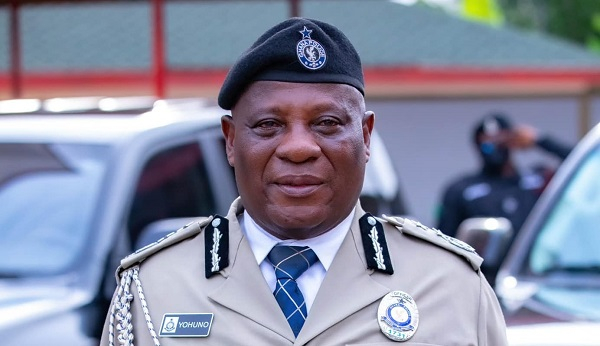
In no sector has this bold agenda been more profoundly felt than in our national security architecture. This success is spearheaded by the stellar, unassailable leadership of Commissioner of Police (COP) Christian Tetteh Yohuno.
Appointed on 13th March 2025 as Ghana’s 31st Inspector-General of Police (IGP), Yohuno’s tenure has been nothing short of an operational masterclass. He has breathed new life and structural discipline into a police service that was previously gasping for public trust.
To understand Yohuno’s brilliance is to appreciate the sheer depth of his preparation. He is not a deskbound theoretician or a political beneficiary of convenience.
Having enlisted as a raw recruit in 1985, his historic forty-year climb to the pinnacle of law enforcement is etched with the sweat of active, boots-on-the-ground policing. He has commanded critical divisions, operations, and intelligence units with legendary distinction.
Yet, this decorated operational commander also possesses a rare, formidable intellect. He holds both a Bachelor of Science in Administration and an Executive MBA in Project Management from the prestigious University of Ghana Business School.
It is this potent fusion of tactical grit and elite managerial acumen that has allowed him to modernise the Ghana Police Service with surgical, corporate precision. The dividends of this leadership have been evident throughout 2025 and 2026.
Under his watch, proactive policing has transitioned from a mere academic buzzword into a reality that ordinary Ghanaians can see and feel. Yohuno has fundamentally transformed our streets by drastically improving police visibility and expanding grassroots community-policing initiatives.
His approach to crisis management is swift, decisive, and remarkably empathetic. We saw this clearly in June 2026 following the tragic death of Innocentia Avinu, a Level 200 student at the University of Cape Coast.
Rather than hiding behind bureaucratic excuses, Yohuno instantly dispatched a high-powered, elite squad of seasoned investigators and intelligence operatives to Cape Coast. This is the hallmark of a commander who understands that in the theatre of security, time is the ultimate arbiter of peace.
Furthermore, Yohuno has courageously confronted the heavy, unresolved cold cases that have haunted our national psyche for years. From high-stakes bullion van robberies to unresolved murders, he has demanded results and accountability.
By introducing rigorous operational metrics and holding regional commands directly accountable, he is steadily rebuilding the fractured bridge of trust between the police and the citizenry.
As we look toward the horizon, a critical constitutional question looms. What happens when his current post-retirement contract expires on 27th December 2027?
Critics and cynics will undoubtedly cite Article 199(1) of the 1992 Constitution to argue for a mandatory exit. But they willfully ignore the genius of our Fourth Republican legal architecture.
Under Article 199(4), introduced via the constitutional amendment of Act 527 in 1996, a retired public officer may be engaged for sequential limited periods. Where the exigencies of the service require, these extensions can be granted for up to a cumulative limit of five years.
Having commenced his first two-year extension on 28th December 2025, Yohuno remains eligible for a subsequent extension of up to three more years. Legally, the path is entirely clear.
The President can seamlessly partition this remaining term into another sequential block. The precedent is already well-established in the security sector.
We saw former IGP James Oppong-Boanuh successfully granted consecutive extensions to navigate critical national transitions. Oppong-Boanuh’s tenure proved that continuity of command is vital during periods of deep reform.
The “exigencies of the service” are not mere academic abstractions; they are the urgent, everyday realities of a nation requiring absolute stability. Transitioning to an untested hand in 2027 would be an administrative gamble Ghana simply cannot afford.
Yohuno has demonstrated that he is the indispensable anchor of our domestic peace. If President Mahama is truly committed to a secure, reformed, and disciplined Ghana, he must lock in the Yohuno dividend beyond 2027. Let the steady hand remain at the wheel.
By Raymond Ablorh
