



Gold had already been on a strong run in 2025, when it repeatedly set new records and its price ultimately surged 64% over the year – its largest annual gain since 1979.
Momentum carried into early 2026, when gold climbed above $5,100, driven by safe-haven demand amid geopolitical tensions, expectations of looser U.S. monetary policy, strong central bank purchases (including China’s continued buying streak), and record inflows into exchange-traded funds.
Central banks were particularly active in 2025: several countries, including Poland, Kazakhstan, Brazil, and China, expanded their gold holdings as part of broader strategies to strengthen financial stability. While some nations increased reserves to hedge against geopolitical tensions and currency volatility, others, such as Singapore and Uzbekistan, reduced holdings to rebalance portfolios and manage liquidity. These movements highlight gold’s continuing role as a strategic and highly valued component of national reserves.
As of April 2026, gold has remained a focal point of global financial markets, even as prices have oscillated in response to shifts in monetary policy expectations and dollar strength. In view of this, the BestBrokers team undertook a comprehensive analysis of central bank demand for gold throughout 2025 and into the early months of 2026. Drawing on the latest World Gold Council data, we identified which countries expanded their official gold holdings most markedly and which reduced them, offering a detailed view of how sovereign reserve strategies have evolved alongside broader macroeconomic and market developments.
Countries That Expand Their Gold Reserves
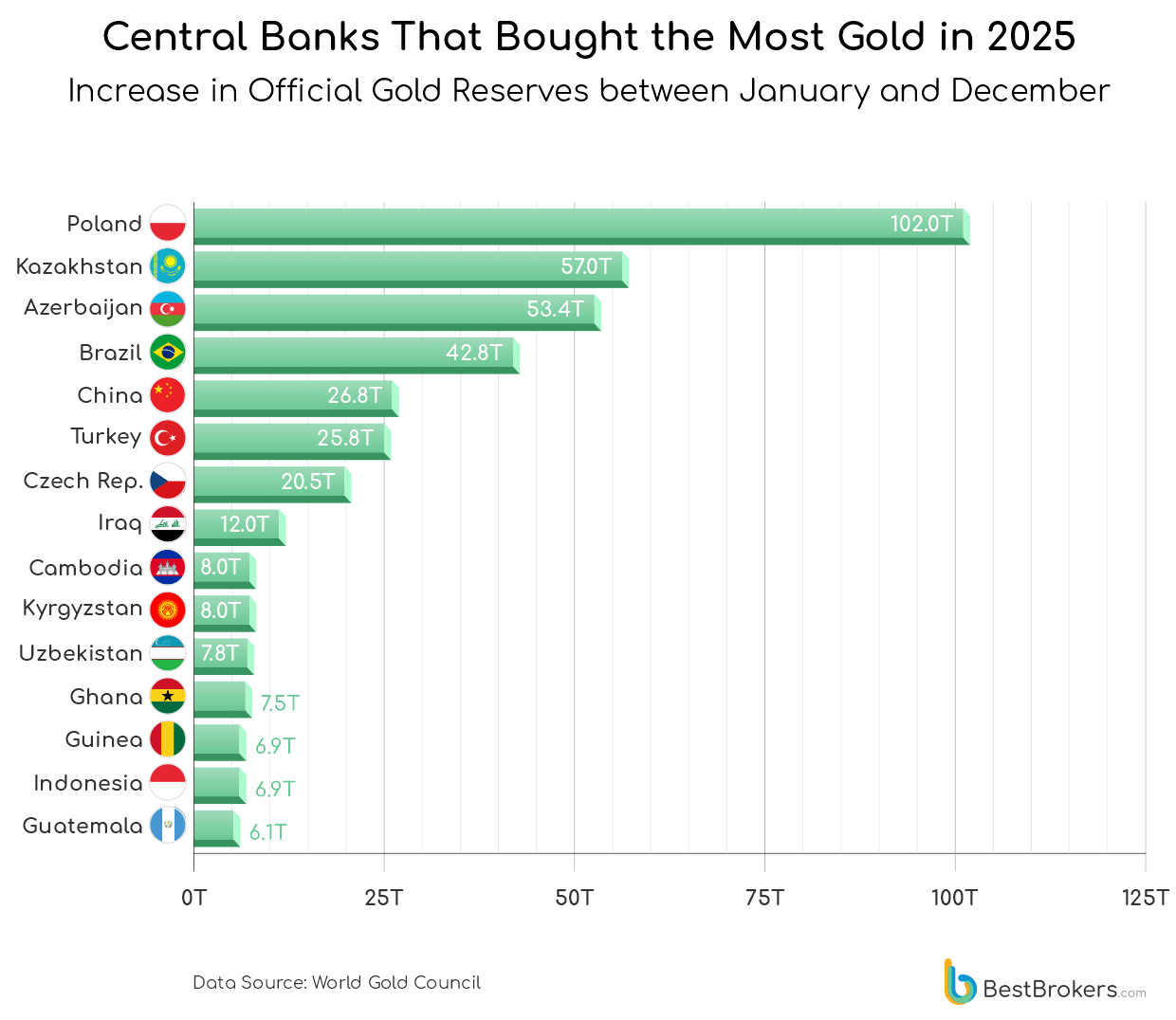
In 2025, several countries continued to bolster their gold reserves, with Poland at the forefront, adding 102 tonnes, a 14% increase over the 89.5 tonnes acquired the previous year. The National Bank of Poland’s approach remains guided by persistent geopolitical uncertainty, particularly the enduring fallout from Russia’s war in Ukraine, which has kept security considerations paramount. Record-high gold prices did little to temper accumulation, as evidenced by 34.9 tonnes purchased in the final quarter following a brief period of relative stagnation. As of April 2026, Poland’s holdings stand at 550.215 tonnes, accounting for roughly 30.1% of its total reserves and securing the country’s position as the 12th-largest official gold holder in the world.
Kazakhstan, Brazil, and China also expanded their gold reserves last year. Kazakhstan added 57 tonnes, a notable reversal after net sales of 10.2 tonnes in 2024, signalling a renewed strategic commitment to gold as a core reserve asset. Brazil remained largely inactive for most of the year, only to re-enter the market decisively with substantial acquisitions in September, October, and November, totalling 42.8 tonnes. Meanwhile, China continued its methodical accumulation, adding 26.8 tonnes on top of the 44.2 tonnes purchased in 2024, bringing its official holdings to over 2,307 tonnes and solidifying its position as the world’s sixth-largest gold holder.
After a substantial 77.4-tonne increase in 2024, Turkey continued to build its reserves, adding 25.8 tonnes. The pace, however, has moderated compared with its more aggressive accumulation in 2022 (147.6 tonnes) and follows a modest reduction in 2023 (-1.6 tonnes). Beyond the major players, other notable buyers in 2025 included the Czech Republic, Iraq, the Kyrgyz Republic, Cambodia, and Uzbekistan, each adding roughly 8 tonnes or more and securing a place among the year’s top ten gold purchasers.
Guinea, Indonesia, Guatemala, India, Serbia, Egypt, and several other countries also added to their gold reserves in 2025, with purchases ranging between 2.5 and 7 tonnes. Meanwhile, Bulgaria re-entered the market for the first time in several years, acquiring 2.05 tonnes ahead of its planned adoption of the euro in 2026. The purchase was linked to the country’s preparations for euro-area accession, which requires the Bulgarian National Bank to transfer part of its reserve assets, including gold and foreign currency, to the European Central Bank.
The State Oil Fund of the Republic of Azerbaijan (SOFAZ) boosted its gold holdings by 53.4 tonnes in 2025, making it the third-largest addition of the year after Poland and Kazakhstan. Unlike the central bank, which does not report any gold reserves and therefore is not included in official rankings of net buyers, SOFAZ manages the country’s oil and gas revenues and has treated gold as a strategic portfolio asset since 2012. Since then, the fund has steadily built its position, accumulating 185.1 tonnes.
What Has Been Driving Gold’s Rally?
Gold’s historic rally throughout 2025 and into early 2026 has been fuelled by a potent combination of investment demand, central bank buying, geopolitical risk, and macroeconomic dynamics. According to the World Gold Council, gold prices set more than 50 all‑time highs in 2025 as global sentiment shifted toward safe‑haven assets amid geopolitical and trade tensions, while investment demand alone surged by roughly 84% year‑on‑year, driven largely by record inflows into gold‑backed ETFs and elevated bar and coin purchases. ETF holdings climbed to their highest level on record, with global AUM doubling to historic peaks, underscoring how investor flows have amplified price momentum.
Official sector buying also remained substantial: central banks collectively purchased well above long‑term averages throughout 2025, adding signals of structural reserve diversification that helped absorb supply and lend underlying support to prices. Even as real yields and U.S. Treasury rates fluctuated, the weakening U.S. dollar, influenced by expectations of Federal Reserve rate cuts and shifting trade policy dynamics, lowered the opportunity cost of holding non‑yielding gold, broadening international demand.
As of early 2026, strong ETF inflows have continued, with some markets reporting record monthly inflows as investor appetite persists even at elevated price levels, and major banks have raised their forecasts for gold on expectations that macro risk factors, including inflation, fiscal deficits, and currency concerns, will remain supportive.
Countries Where Gold Reserves Dropped
In an unexpected trend, several central banks reduced their gold reserves in 2025, with Singapore at the forefront. Data indicates that multiple countries opted to sell portions of their holdings, likely in response to economic pressures, portfolio rebalancing, or to maintain liquidity in volatile markets. Another factor driving these sales was the historically strong gold rally: after prices surged sharply in 2025, some central banks took advantage of elevated valuations to realise gains, adjusting their reserve strategies while maintaining exposure to the precious metal.
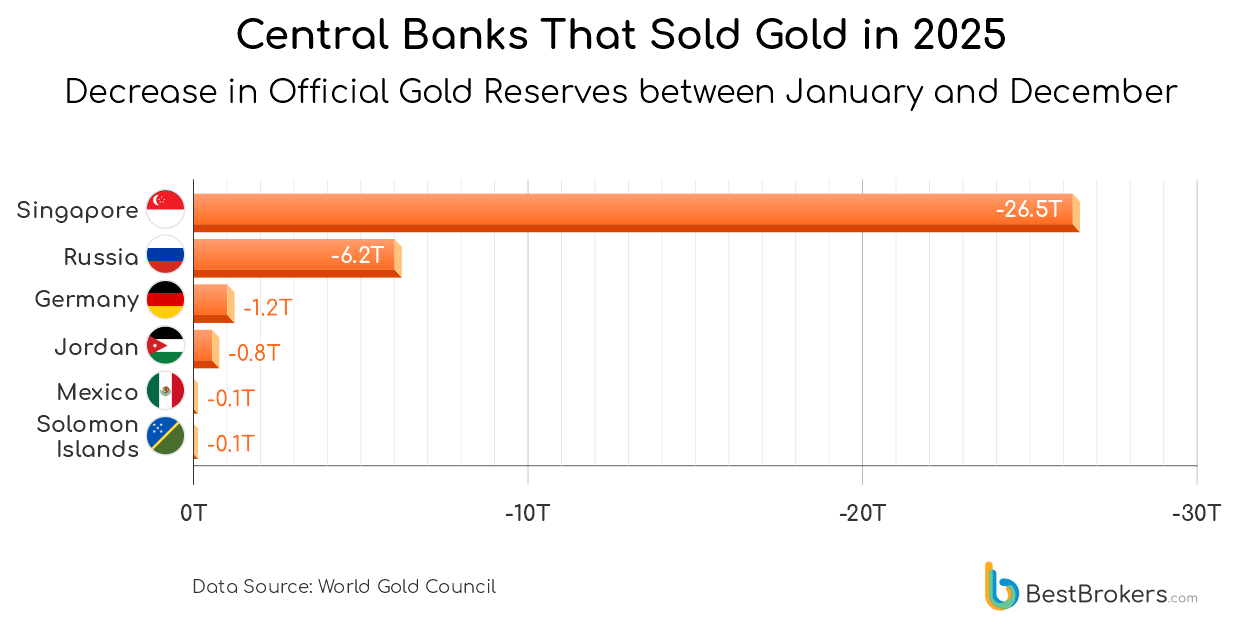
Singapore consistently pared back its gold reserves throughout 2025, beginning in March with a sale of 4.85 tonnes and bringing total disposals for the year to 26.5 tonnes. This marks a clear reversal from its earlier accumulation strategy: after decades of relative inactivity, the country acquired 26.3 tonnes in 2021 and 76.3 tonnes in 2023, before initiating modest sales of 10.1 tonnes in 2024. The 2025 reductions reflect a deliberate portfolio adjustment, likely aimed at capitalising on elevated gold prices while maintaining a balanced reserve composition.
Despite these official sales, the city-state has emerged as a major hub for private gold storage, attracting the ultra-wealthy seeking a safe jurisdiction amid global economic and geopolitical uncertainty. Facilities such as The Reserve have seen soaring demand, with orders to store physical gold and silver increasing sharply in early 2025, reflecting Singapore’s reputation as the ‘Geneva of the East’ and a preferred destination for investors seeking secure, non-bank storage.
Russia reduced its gold holdings by 6.22 tonnes in 2025, ending a long period of accumulation that had seen 17 consecutive years of purchases until 2023, followed by two years of stable reserves. The country’s official gold stock now stands at 2,317 tonnes, representing 47% of its total reserves and securing its position as the world’s fifth-largest official gold holder.
Germany holds one of the world’s largest gold reserves, second only to the United States. In 2025, it reduced this amount by 1.28 tonnes, bringing its total holdings to 3,350.25 tonnes. The country has been drawing from its gold reserves consistently for decades; WGC data show Germany has lowered its holdings every year since at least 2002 (the latest available data), often through regular exports to the UK. 2024’s sale of 1.1 tonnes was the smallest annual reduction on record.
Other countries that reduced their gold reserves in 2025 include Jordan, Mexico, and the Solomon Islands, although their net sales remained modest, each under a tonne. After four consecutive years of accumulation, Jordan pared back its holdings by 800 kilograms. Mexico sold 100 kilograms in April, while the Solomon Islands both bought and sold gold throughout the year, ultimately closing 2025 with a net reduction of 100 kilograms, as well.
Central Banks with the Largest Gold Reserves in 2026
As the value of various currencies fluctuates, the price of gold has remained strong this year, driving demand from both investors and central banks. The nation holding the largest official gold reserve remains the United States, with 8,133.46 tonnes, representing 84.2% of its total foreign reserves. Germany and Italy follow, with 3,350.25 tonnes and 2,451.84 tonnes, respectively. Other countries with substantial holdings include France (2,437 tonnes) and Russia (2,310.97 tonnes). China, Switzerland, India, Japan, and Turkey also maintain significant reserves, with China at 2,308.48 tonnes and Switzerland approaching 1,040 tonnes.
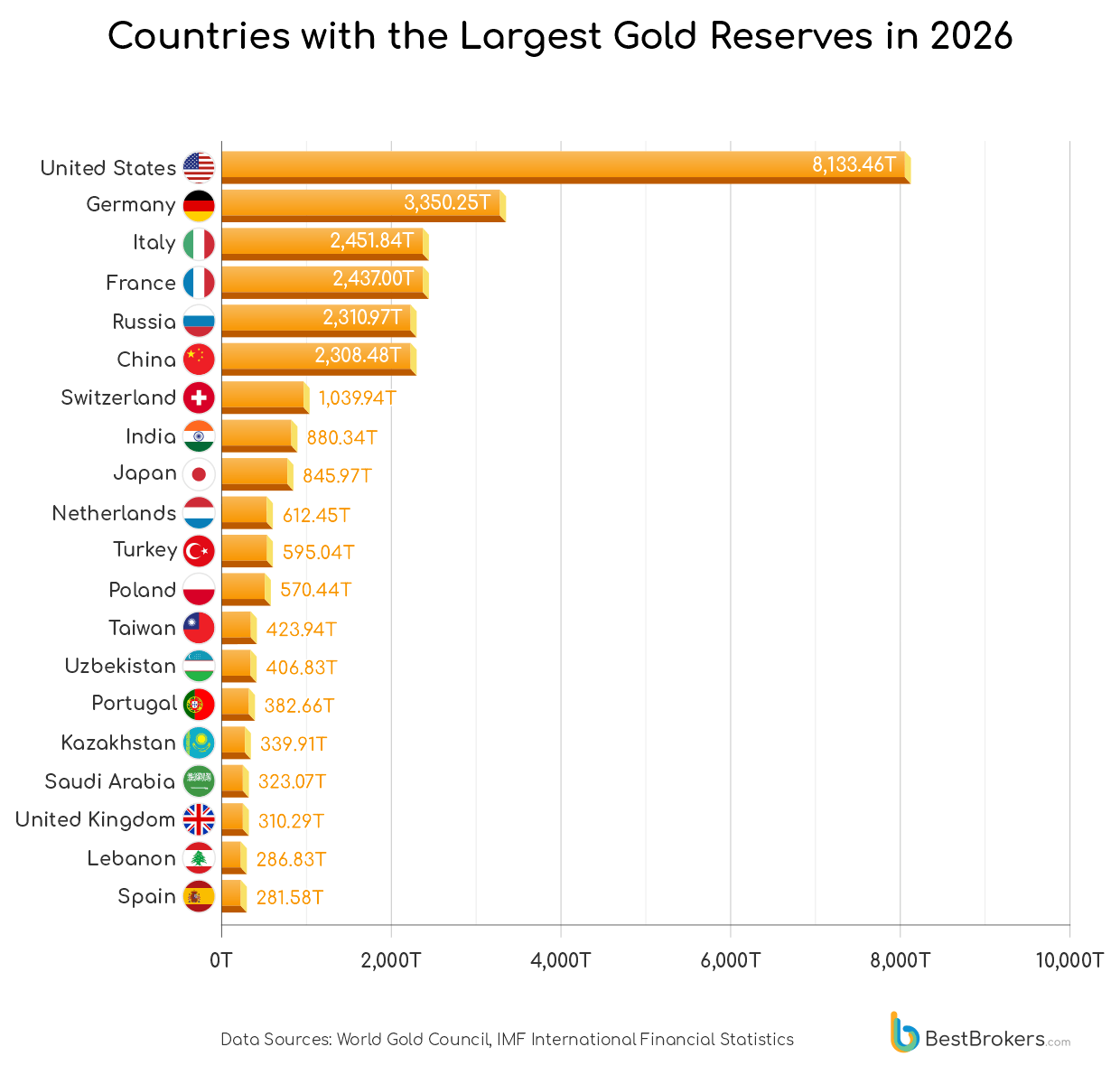
Although India, Japan, and the Netherlands each hold less than a thousand tonnes, together they account for roughly 6.4% of global official gold reserves. It should be noted that not all nations report their gold holdings to the IMF, so actual totals may vary. Collectively, the ten largest national reserves account for 74.2% of all gold held by official institutions, while the top five countries alone hold 56.9%.
Nations’ Gold Reserves Per Capita
Despite some countries holding substantial total reserves, per capita gold holdings provide a different perspective, offering insight into the relative ‘gold wealth’ of large and small economies.
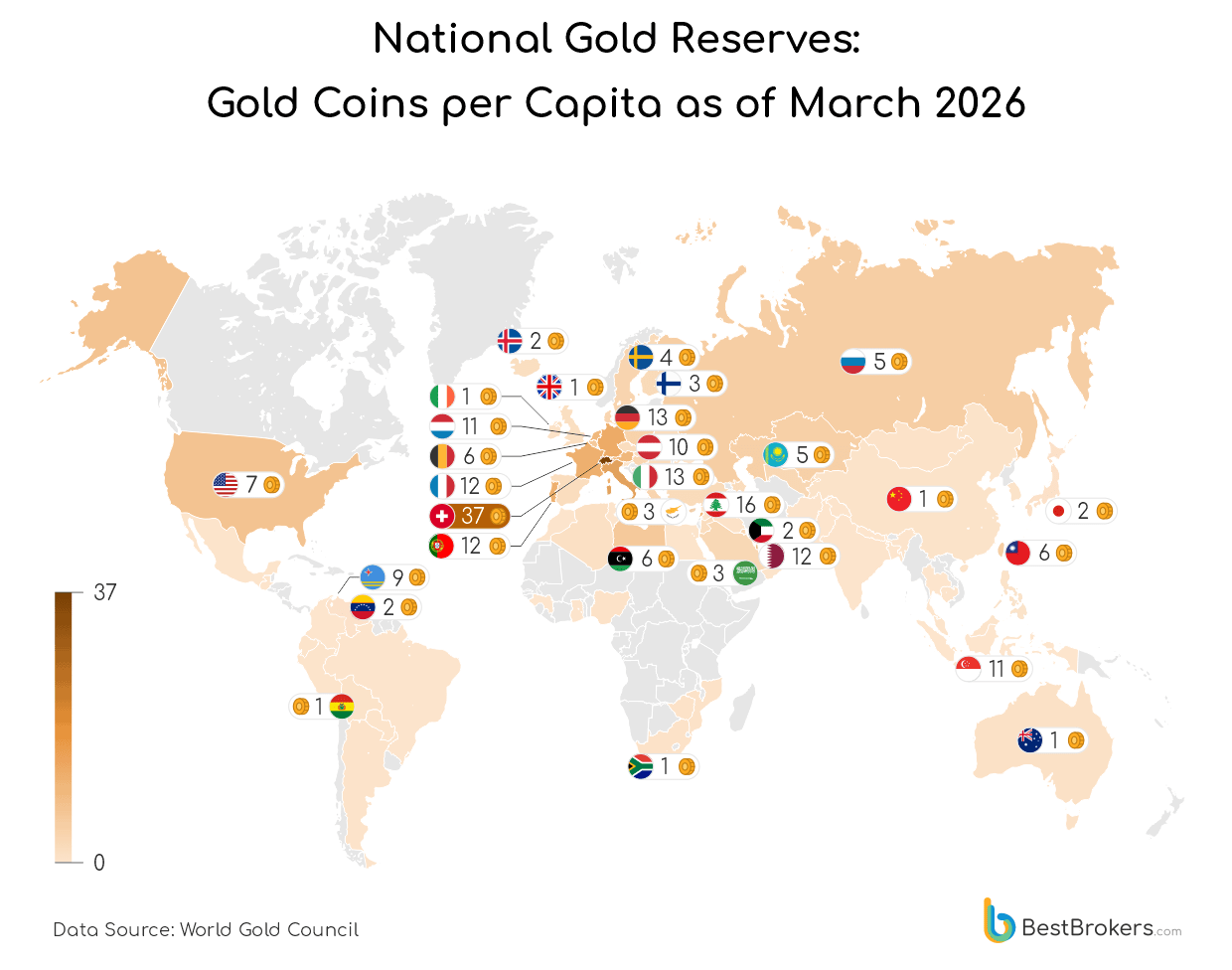
The United States, while maintaining the largest overall reserve, ranks only 12th in per capita terms, with 23.3 grams per citizen, equivalent to 0.75 troy ounces, or roughly seven small gold coins (each containing 0.1 troy ounces or 3.39 grams).
Switzerland, by contrast, holds the seventh-largest overall reserve, but its small population of approximately 9 million elevates it to first place in per capita holdings, with nearly 115 grams (3.7 troy ounces) per person, or the equivalent of 37 small gold coins, the highest per capita total worldwide.
Lebanon ranks second, with roughly 16 small gold coins per person, followed by Italy and Germany, each with about 13 coins per citizen, despite little change in their reserves over decades. Qatar also ranks highly, with 115.2 tonnes of gold, equivalent to around 12 coins per person, alongside Portugal (382.66 tonnes) and France (2,437 tonnes), which similarly translate to roughly 12 coins per citizen.
Other notable countries by per capita holdings include Singapore and the Netherlands, each with about 11 coins per person, while Austria follows with 10 coins. Ranking 11th is the Caribbean island of Aruba, whose 3.11 tonnes of gold for a population of just 108,000 surpasses the United States in per capita terms.
Trends in 2026: Activity Slows But Broadens
At the outset of 2026, central bank gold activity showed a broader but more measured pattern compared with the frenetic purchasing seen in 2025. Reported net purchases in the first two months of the year were well below the monthly average from last year, signalling that some sovereign buyers are pacing their accumulation amid record‑high bullion prices and seasonal volatility. Nonetheless, the breadth of buyers expanded, with a range of emerging and developing economies adding to their reserves, underscoring gold’s continued appeal as a strategic reserve asset.
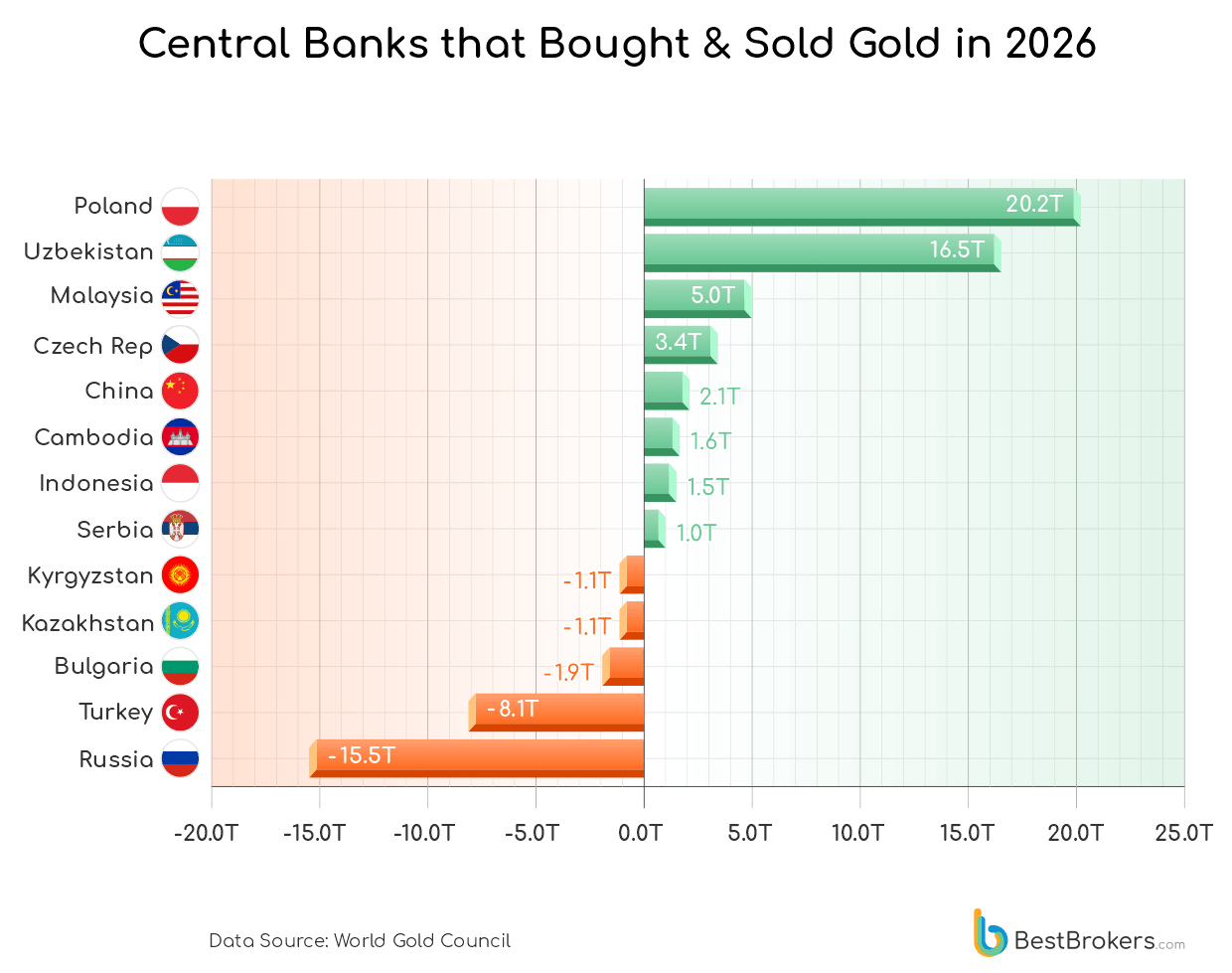
So far in 2026, Poland has led global central bank purchases, adding 20.2 tonnes in February alone and extending its rapid accumulation trend that has seen it build more than 340 tonnes over the past two years. Uzbekistan follows closely with 16.5 tonnes added in the first two months of the year, continuing a consistent multi-month buying pattern, while Malaysia has re-entered the market with 5 tonnes of combined purchases after an extended period of inactivity. The Czech Republic has also maintained steady accumulation, adding 3.4 tonnes in 2026 so far, alongside China, which has continued its gradual expansion with 2.1 tonnes added over the same period.
On the selling side, the Russian Federation has emerged as the largest net seller, reducing its holdings by 15.5 tonnes in the first two months of the year, followed by Turkey with an 8.1-tonne reduction. Smaller adjustments were also recorded in Bulgaria, Kazakhstan, and the Kyrgyz Republic, reflecting a more selective pattern of reserve rebalancing among a limited group of central banks. Overall, this split between broad-based accumulation and concentrated selling highlights a market still anchored in official-sector support, but increasingly shaped by tactical adjustments to price levels and domestic financial conditions.
Moreover, major financial institutions have raised gold price forecasts for 2026, citing sustained official demand and a broader push for diversification away from fiat reserves. Banks such as JPMorgan and UBS now anticipate further gains through the year, with long-term targets well above current levels even after recent volatility. Recent initiatives, such as Uganda’s launch of a domestic gold purchasing program, illustrate how newer reserve buyers are entering the market, reinforcing a wider base of central bank demand even as overall monthly buying has moderated from the outsized volumes of 2025.
Who Does Not Own Any Gold?
Despite being one of the world’s top gold-mining nations, Canada is among the very few countries that hold no gold in their official reserves. The Bank of Canada fully sold off its bullion holdings over the past two decades and today reports 0 tonnes of gold as part of its international reserves. This decision reflects a longstanding policy view that U.S. Treasury securities and other highly liquid assets are better suited for reserve management than gold, which former deputy governor Timothy Lane once described as not fitting Canada’s ‘asset-matching framework’.
Norway is another notable example. During World War II, its central bank evacuated about 50 tonnes of gold to the United Kingdom and the United States to support the government-in-exile. After the war, parts of the hoard were returned, but in 2004, Norges Bank announced the sale of nearly all of its remaining bullion, keeping only seven bars and some coins for historical and exhibition purposes. Today, Norway officially reports 0 tonnes of gold in its reserves.
These cases stand in sharp contrast to most other advanced economies, where gold continues to represent a significant share of central bank reserves. They highlight that not all major economies consider the precious metal essential to reserve strategy, even countries with large mining industries like Canada or with historical stockpiles like Norway.
| National Gold Reserves: Gold per Capita Held by Central Banks as of April 2026 | |||||||
|---|---|---|---|---|---|---|---|
| Country | Population 2026 | Gold Holdings | Share of Total Reserves | Holdings as of | Gold Holdings in Troy Ounces | Gold per Capita, gram per person | Gold per Capita, ounce per person |
| United States | 349,035,000 | 8,133.46 | 84.80% | Feb 2026 | 261,498,937 | 23.30 | 0.75 |
| Germany | 83,644,300 | 3,350.25 | 84.60% | Feb 2026 | 107,713,984 | 40.05 | 1.29 |
| Italy | 58,926,200 | 2,451.84 | 82.00% | Feb 2026 | 78,829,011 | 41.61 | 1.34 |
| France | 66,746,400 | 2,437.00 | 82.50% | Feb 2026 | 78,351,987 | 36.51 | 1.17 |
| Russian Federation | 143,394,000 | 2,310.97 | 48.10% | Feb 2026 | 74,299,996 | 16.12 | 0.52 |
| China, P.R.: Mainland | 1,412,910,000 | 2,308.48 | 10.00% | Feb 2026 | 74,220,005 | 1.63 | 0.05 |
| Switzerland | 9,007,800 | 1,039.94 | 15.60% | Jan 2026 | 33,435,014 | 115.45 | 3.71 |
| India | 1,476,630,000 | 880.34 | 19.80% | Feb 2026 | 28,303,811 | 0.60 | 0.02 |
| Japan | 122,428,000 | 845.97 | 10.10% | Feb 2026 | 27,198,878 | 6.91 | 0.22 |
| Netherlands | 18,448,800 | 612.45 | 74.50% | Feb 2026 | 19,691,009 | 33.20 | 1.07 |
| Turkey | 87,926,100 | 595.04 | 57.60% | Feb 2026 | 19,131,002 | 6.77 | 0.22 |
| Poland | 37,843,200 | 570.44 | 31.20% | Feb 2026 | 18,340,281 | 15.07 | 0.48 |
| Taiwan | 23,011,300 | 423.94 | 10.60% | Sep 2025 | 13,629,998 | 18.42 | 0.59 |
| Uzbekistan | 37,724,200 | 406.83 | 87.90% | Feb 2026 | 13,079,991 | 10.78 | 0.35 |
| Portugal | 10,395,400 | 382.66 | 80.10% | Feb 2026 | 12,302,998 | 36.81 | 1.18 |
| Kazakhstan | 21,083,600 | 339.91 | 77.80% | Jan 2026 | 10,928,286 | 16.12 | 0.52 |
| Saudi Arabia | 35,165,800 | 323.07 | 10.50% | Nov 2025 | 10,386,927 | 9.19 | 0.30 |
| United Kingdom | 69,931,500 | 310.29 | 23.00% | Feb 2026 | 9,976,037 | 4.44 | 0.14 |
| Lebanon | 5,897,470 | 286.83 | 83.10% | Mar 2025 | 9,222,000 | 48.64 | 1.56 |
| Spain | 47,850,800 | 281.58 | 34.80% | Feb 2026 | 9,053,014 | 5.88 | 0.19 |
| Austria | 9,107,270 | 280.02 | 76.40% | Feb 2026 | 9,002,987 | 30.75 | 0.99 |
| Thailand | 71,559,600 | 234.52 | 13.40% | Feb 2026 | 7,539,988 | 3.28 | 0.11 |
| Belgium | 11,774,600 | 227.40 | 61.10% | Feb 2026 | 7,311,009 | 19.31 | 0.62 |
| Azerbaijan | 10,454,900 | 200.00 | 38.20% | Dec 2025 | 6,430,200 | 19.13 | 0.62 |
| Singapore | 5,905,750 | 193.76 | 7.30% | Feb 2026 | 6,229,546 | 32.81 | 1.05 |
| Iraq | 48,007,400 | 174.61 | 28.10% | Nov 2025 | 5,614,015 | 3.64 | 0.12 |
| Algeria | 48,028,300 | 173.56 | 35.90% | Oct 2025 | 5,579,999 | 3.61 | 0.12 |
| Brazil | 213,563,000 | 172.45 | 7.80% | Feb 2026 | 5,544,279 | 0.81 | 0.03 |
| Venezuela | 28,633,700 | 161.22 | 93.30% | Jun 2018 | 5,183,384 | 5.63 | 0.18 |
| Libya | 7,539,850 | 146.65 | 22.60% | Nov 2025 | 4,715,008 | 19.45 | 0.63 |
| Philippines | 117,724,000 | 133.43 | 19.90% | Feb 2026 | 4,290,004 | 1.13 | 0.04 |
| Egypt | 120,101,000 | 129.42 | 43.20% | Feb 2026 | 4,161,111 | 1.08 | 0.03 |
| Sweden | 10,701,000 | 125.72 | 26.90% | Feb 2026 | 4,041,992 | 11.75 | 0.38 |
| South Africa | 65,453,100 | 125.50 | 25.90% | Feb 2026 | 4,035,015 | 1.92 | 0.06 |
| Mexico | 132,998,000 | 120.10 | 7.40% | Feb 2026 | 3,861,367 | 0.90 | 0.03 |
| Qatar | 3,173,560 | 115.22 | 34.00% | Jan 2026 | 3,704,535 | 36.31 | 1.17 |
| Greece | 9,897,120 | 114.71 | 71.00% | Feb 2026 | 3,688,009 | 11.59 | 0.37 |
| Hungary | 9,585,820 | 110.01 | 26.10% | Feb 2026 | 3,536,996 | 11.48 | 0.37 |
| Korea | 51,600,400 | 104.45 | 4.00% | Jan 2026 | 3,358,075 | 2.02 | 0.07 |
| Romania | 18,800,600 | 103.63 | 18.50% | Feb 2026 | 3,331,712 | 5.51 | 0.18 |
| Indonesia | 287,887,000 | 87.04 | 9.60% | Feb 2026 | 2,798,487 | 0.30 | 0.01 |
| Australia | 27,227,100 | 79.87 | 18.40% | Feb 2026 | 2,567,997 | 2.93 | 0.09 |
| Kuwait | 5,102,770 | 78.98 | 24.70% | Jan 2026 | 2,539,157 | 15.48 | 0.50 |
| United Arab Emirates | 11,574,700 | 74.96 | 6.90% | Feb 2026 | 2,410,168 | 6.48 | 0.21 |
| Czech Rep. | 10,527,800 | 74.51 | 4.30% | Dec 2025 | 2,395,700 | 7.08 | 0.23 |
| Jordan | 11,589,500 | 70.83 | 42.60% | Nov 2025 | 2,277,095 | 6.11 | 0.20 |
| Denmark | 6,023,520 | 66.55 | 8.60% | Jan 2026 | 2,139,585 | 11.05 | 0.36 |
| Pakistan | 259,300,000 | 64.77 | 38.40% | Jan 2026 | 2,082,517 | 0.25 | 0.01 |
| Argentina | 46,003,700 | 61.74 | 22.80% | Feb 2026 | 1,984,971 | 1.34 | 0.04 |
| Cambodia | 18,051,200 | 56.12 | 32.20% | Feb 2026 | 1,804,346 | 3.11 | 0.10 |
| Belarus | 8,937,020 | 53.87 | 56.20% | Jan 2026 | 1,732,103 | 6.03 | 0.19 |
| Serbia | 6,641,960 | 53.50 | 28.80% | Feb 2026 | 1,720,014 | 8.05 | 0.26 |
| Kyrgyz Rep. | 7,400,460 | 44.80 | 76.40% | Jan 2026 | 1,440,493 | 6.05 | 0.19 |
| Finland | 5,621,740 | 43.86 | 5.70% | Feb 2026 | 1,410,014 | 7.80 | 0.25 |
| Malaysia | 36,385,100 | 43.76 | 31.20% | Feb 2026 | 1,406,992 | 1.20 | 0.04 |
| Bulgaria | 6,667,660 | 41.04 | 69.20% | Feb 2026 | 1,319,509 | 6.16 | 0.20 |
| Peru | 34,922,100 | 34.67 | 6.10% | Jan 2026 | 1,114,675 | 0.99 | 0.03 |
| Slovak Rep. | 5,451,340 | 31.69 | 27.80% | Feb 2026 | 1,018,994 | 5.81 | 0.19 |
| Ukraine | 39,535,800 | 27.37 | 8.40% | Feb 2026 | 880,005 | 0.69 | 0.02 |
| Ecuador | 18,444,500 | 26.28 | 38.20% | Jan 2026 | 844,960 | 1.42 | 0.05 |
| Syrian Arab Republic | 26,472,500 | 25.80 | 20.60% | Jun 2011 | 829,496 | 0.97 | 0.03 |
| Bolivia | 12,749,300 | 22.50 | 86.70% | Apr 2025 | 723,398 | 1.76 | 0.06 |
| Morocco | 38,762,400 | 22.12 | 7.40% | Jan 2026 | 711,084 | 0.57 | 0.02 |
| Afghanistan | 45,047,100 | 21.87 | 30.80% | May 2021 | 703,014 | 0.49 | 0.02 |
| Nigeria | 242,432,000 | 21.44 | 7.30% | January 2026 | 689,317 | 0.09 | 0.00 |
| Ghana | 35,697,600 | 19.20 | 47.70% | Feb 2026 | 617,299 | 0.54 | 0.02 |
| Bangladesh | 177,818,000 | 14.28 | 8.40% | Jan 2026 | 459,148 | 0.08 | 0.00 |
| Cyprus | 1,382,330 | 13.87 | 69.80% | Feb 2026 | 445,999 | 10.04 | 0.32 |
| Guinea | 15,442,000 | 13.16 | 58.40% | Sep 2025 | 423,171 | 0.85 | 0.03 |
| Guatemala | 18,968,000 | 13.02 | 6.60% | Feb 2026 | 418,606 | 0.69 | 0.02 |
| Mauritius | 1,265,060 | 12.42 | 20.00% | Feb 2026 | 399,187 | 9.81 | 0.32 |
| Ireland | 5,356,950 | 12.04 | 14.60% | Feb 2026 | 387,002 | 2.25 | 0.07 |
| Paraguay | 7,095,280 | 8.19 | 13.30% | Nov 2025 | 263,413 | 1.15 | 0.04 |
| Nepal | 29,629,400 | 7.99 | 6.30% | Dec 2025 | 256,822 | 0.27 | 0.01 |
| Mongolia | 3,556,800 | 7.88 | 19.60% | Jan 2026 | 253,350 | 2.22 | 0.07 |
| Tajikistan | 10,978,600 | 7.42 | 24.60% | Feb 2023 | 238,400 | 0.68 | 0.02 |
| Georgia | 3,804,640 | 7.14 | 18.90% | Dec 2025 | 229,494 | 1.88 | 0.06 |
| North Macedonia | 1,804,060 | 6.89 | 17.60% | Feb 2026 | 221,617 | 3.82 | 0.12 |
| Tunisia | 12,415,100 | 6.84 | 11.90% | Oct 2025 | 220,009 | 0.55 | 0.02 |
| Oman | 5,671,460 | 6.73 | 5.80% | Mar 2025 | 216,312 | 1.19 | 0.04 |
| Latvia | 1,835,940 | 6.66 | 17.50% | Feb 2026 | 213,997 | 3.63 | 0.12 |
| Lithuania | 2,797,340 | 5.82 | 12.90% | Feb 2026 | 186,990 | 2.08 | 0.07 |
| Colombia | 53,936,200 | 4.68 | 1.20% | Jan 2026 | 150,306 | 0.09 | 0.00 |
| Bahrain | 1,675,570 | 4.67 | 13.50% | Oct 2025 | 149,984 | 2.78 | 0.09 |
| Slovenia | 2,114,570 | 4.23 | 19.40% | Feb 2026 | 135,999 | 2.00 | 0.06 |
| Zimbabwe | 17,273,600 | 4.08 | 52.80% | Dec 2025 | 131,305 | 0.24 | 0.01 |
| Mozambique | 36,639,900 | 3.94 | 15.20% | Jul 2025 | 126,578 | 0.11 | 0.00 |
| Bosnia and Herzegovina | 3,114,240 | 3.48 | 6.10% | Mar 2025 | 112,014 | 1.12 | 0.04 |
| Albania | 2,751,020 | 3.42 | 6.90% | Oct 2025 | 109,989 | 1.24 | 0.04 |
| Aruba, Kingdom of the Netherlands | 108,164 | 3.11 | 22.50% | Dec 2025 | 99,990 | 28.75 | 0.92 |
| Luxembourg | 687,448 | 2.24 | 12.00% | Feb 2026 | 71,986 | 3.26 | 0.10 |
| El Salvador | 6,391,250 | 2.10 | 7.20% | Feb 2026 | 67,388 | 0.33 | 0.01 |
| Hong Kong | 7,378,600 | 2.08 | 0.10% | Jan 2026 | 67,003 | 0.28 | 0.01 |
| Iceland | 402,329 | 1.98 | 4.20% | Feb 2026 | 63,788 | 4.93 | 0.16 |
| Papua New Guinea | 10,947,800 | 1.96 | 8.50% | Nov 2025 | 63,016 | 0.18 | 0.01 |
| Trinidad and Tobago | 1,513,270 | 1.96 | 6.70% | Aug 2025 | 62,984 | 1.29 | 0.04 |
*Figures rounded
Data Source:
- World Gold Council
- London Bullion Market (LBMA), New York Stock Exchange (NYSE)
- World Population Review:
- U.S. Mint: American Eagle Coins
- International Monetary Fund
Methodology
To prepare this report, the team at BestBrokers used the most current data about official central banks’ gold reserves published by the World Gold Council.
This is an international trade association for the gold industry, which collects gold holdings data from the International Monetary Fund, the Bank for International Settlements, central banks, and other sources. It should be noted, however, that certain countries are excluded from the database as they are known to have gold reserves but do not report them officially.
Another territory not to make it to our calculations is Curacao and Sint Maarten, which have 9.2 tonnes of gold as of March 2025. The WGC has combined data for the two Caribbean nations, but they are separate constituent countries of the Kingdom of the Netherlands, which is why we did not list them jointly.
For the per-capita gold reserve ranking, we used publicly available population estimates for 2026. We had to convert the tonnes of gold to troy ounces, so all calculations were based on a conversion rate of 32,150.70 ounces for 1 tonne. For the gold coins, we looked for a small coin and used the American Eagle Gold Proof Coin, 1/10 ounce as an example. It is a one-tenth-ounce coin with a $5 face value, which is 0.650 inches (16.50 mm) in diameter. The coin contains 0.1000 gold troy ounces and weighs 0.1091 troy ounces (3.393 g). It is minted in the United States but many other countries have similar coins.
Here are a few measurements and rates we used for the calculations:
- 1 tonne of gold = 32,150.70 gold troy ounces
- 1 tonne = 1,000,000 grams
- 1 gold troy ounce = 10 coins (1/10 ounce gold coin)
Gold’s Rally: Mapping Central Banks’ Demand For The Precious Metal In 2026
