

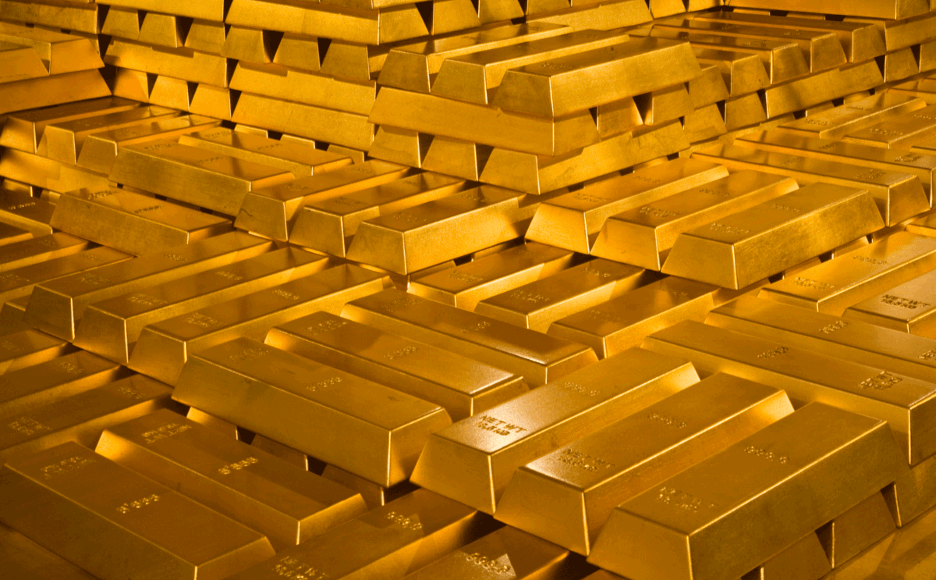
In 2025, gold delivered a historic rally, repeatedly setting new records as safe-haven demand, Fed rate-cut expectations, and steady central-bank buying pushed prices beyond $4,400, with futures briefly topping $4,430 this week.
In this context, I am sharing insights from our report, which presents an overview of 2025 global gold demand, highlighting the countries leading in gold purchases and sales, as well as those with largest reserves.
Gold prices began climbing sharply in 2024 as central banks and investors alike turned to the precious metal as a safe haven amid mounting geopolitical tensions and global economic uncertainty.
While some countries accelerated their gold purchases to strengthen reserves, others seized the opportunity to cash in on elevated prices by selling significant volumes. The team at BestBrokers analysed the World Gold Council’s December release, covering all of the available data for 2025, to identify the world’s largest buyers and sellers of gold during this period. The complete dataset behind the report can be accessed on Google Drive via the following link.
The value of global gold reserves has climbed to an estimated $4.67 trillion, underpinned by a succession of record gold prices that have propelled the balance sheets of the world’s largest reserve holders to unprecedented levels.
The United States continues to dominate in absolute terms, with its gold holdings now valued at approximately $1.16 trillion, while Germany ranks second with reserves worth $477.29 billion. Italy and France likewise remain central pillars of the global gold landscape, holding reserves valued at roughly $477.29 billion and $349.30 billion, respectively.
Countries that bought the most gold in 2025:
- Poland: +82.67 tonnes, reserves now valued at $75.63 billion
- Kazakhstan: +40.97 tonnes, reserves now valued at $46.30 billion
- Brazil: +31.48 tonnes, reserves now valued at $22.95 billion
- Turkey: +26.68 tonnes, reserves now valued at $91.79 billion
- China: +24.88 tonnes, reserves now valued at $328.30 billion
- Czech Republic: +18.04 tonnes, reserves now valued at $9.86 billion
- Iraq: +8.21 tonnes, reserves now valued at $24.34 billion
- Cambodia: +7.96 tonnes, reserves now valued at $7.75 billion
- Ghana: +7.51 tonnes, reserves now valued at $5.42 billion
- Guatemala: +6.12 tonnes, reserves now valued at $1.85 billion
Countries with the largest gold reserves as of December 2025:
- United States: 8,133.46 tonnes, now valued at $1.16 trillion
- Germany: 3,350.25 tonnes, now valued at $477.29 billion
- Italy: 2,451.84 tonnes, now valued at $349.30 billion
- France: 2,437.00 tonnes, now valued at $347.18 billion
- Russian Federation: 2,326.52 tonnes, now valued at $331.44 billion
- China: 2,304.44 tonnes, now valued at $328.30 billion
- Switzerland: 1,039.94 tonnes, now valued at $148.15 billion
- India: 880.18 tonnes, now valued at $125.40 billion
- Japan: 845.97 tonnes, now valued at $120.52 billion
- Turkey: 644.28 tonnes, now valued at $91.79 billion
Other highlights from the report:
- At a current price of $4,431.10 per ounce, the total value of central banks’ gold reserves stands at approximately $4.65 trillion, elevating the world’s largest reserve holders to record valuations. The United States remains the largest owner with 8,133.46 tonnes of gold, followed by Germany at 3,350.25 tonnes. Italy and France round out the top four, with reserves totaling 2,451.84 tonnes and 2,437 tonnes, respectively.
- In 2025, the market value of U.S. gold reserves rose above the $1 trillion mark for the first time, highlighting the country’s unmatched status as the world’s largest official holder of gold. Although the United States has kept its gold stockpile steady at 8,133 tonnes for decades, the metal’s historic price rally has lifted the value of those reserves to roughly $1.16 trillion. As a result, the U.S. stands alone as the only nation with gold reserves exceeding one trillion dollars in value, comfortably outpacing the other major holders.
- Poland remains the world’s most aggressive central-bank gold buyer in 2025, adding 82.67 tonnes despite record prices. It expanded its reserves to 530.9 tonnes, equivalent to 25.6% of its total reserve assets and valued at $75.63 billion, a strategy shaped by heightened geopolitical risks. Kazakhstan and Turkey are likewise maintaining strong accumulation trends, pointing to a broader regional shift toward hard-asset security, with Kazakhstan reversing last year’s net selling to add 40.97 tonnes and Turkey increasing its holdings by 26.68 tonnes, extending a multi-year pattern of heavy purchases.
- Singapore emerged as the world’s largest net gold seller in 2025, overtaking Uzbekistan after its central bank sold 15.24 tonnes, compared with Uzbekistan’s 11.82 tonnes, which continued to reflect liquidity management rather than a strategic shift. Among buyers, Serbia, India, Indonesia, and Qatar each added around 4-5 tonnes, followed by Bulgaria with a smaller increase of 2.05 tonnes ahead of its planned euro adoption in 2026. On the selling side, Mexico, Cyprus, and Portugal trimmed their reserves by less than one tonne each, highlighting a broader pattern of fine-tuning rather than large-scale reallocation.
- Switzerland stands out not only as the world’s seventh-largest holder of gold reserves, with 1,039.94 tonnes now valued at $148.15 billion, but also as the global leader on a per capita basis, holding $16,521.23 worth of gold per citizen, equivalent to roughly 37 gold coins per person.
– comments Alan Goldberg, lead data analyst at BestBrokers.
More information about countries’ demand for gold is available in the full report. It includes more details about the latest changes in the official national gold reserves reported to the International Monetary Fund, as well as the complete methodology behind our findings. The complete dataset is also available on Google Drive via the following link. Feel free to use any data or graphics for publication by providing a link to the original report.
By Paul Hoffman, BestBrokers.com
