

The Ghanaian voter was, for far too long, a jilted lover, standing at the despondent altar of democracy with a bouquet of withered promises and a heart heavy with betrayal.
The air in our markets, our offices, and our shrines was thick with the suffocating mantra of “duka daya, the cynical, soul-crushing conclusion that every politician, regardless of the colour of their party cloth, was carved from the same rotten wood.
By the twilight of 2024, the “last hope” once invested in the previous administration had not merely failed; it had evaporated into a mist of disillusionment. We saw a nation where the youth were ready to burn the entire establishment to the ground, convinced that the ballot box was a deceptive trap and that the political elite were merely two sides of the same debased coin.
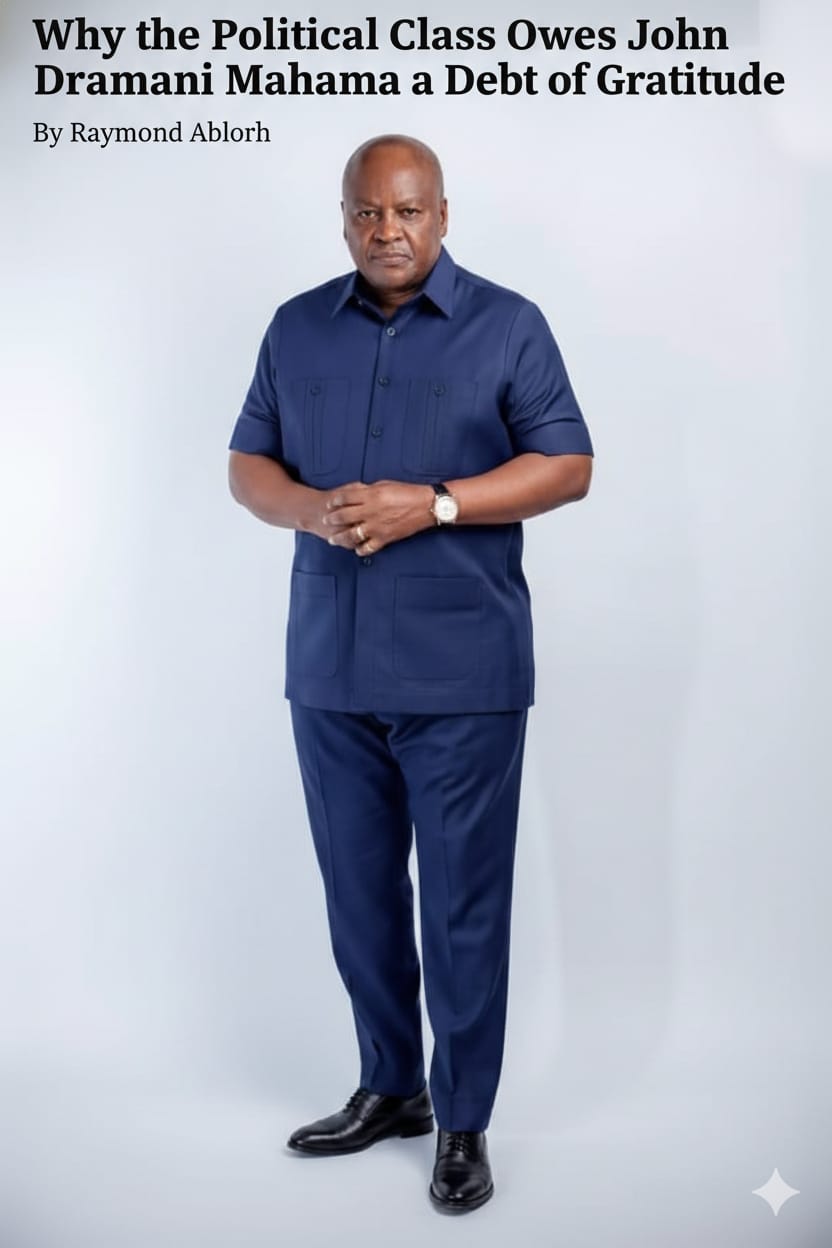
Yet, in this vacuum of despair, a remarkable phenomenon occurred. John Dramani Mahama did not merely win an election; he staged a rescue mission for the entire political class. Those who sit in the ivory towers of the NPP, and indeed all who wear the badge of “politician,” owe him a debt of gratitude that transcends partisan lines. He has saved the profession from permanent exile.
Had the 2024 transition failed to offer a credible, sobering alternative, the rising tide of public anger would have birthed a “Third Force” rooted not in policy, but in pure, systemic rejection. By stepping back into the fray with the “Reset” agenda, Mahama provided the essential safety valve for a nation on the brink of explosion. He gave the people a reason to vote instead of a reason to revolt.
He understood that hope is not a fleeting feeling but an economic reality anchored in the courage to fix what is broken. Under his stewardship, we are witnessing the resurrection of value. Through a disciplined fiscal regime that prioritises the pocket of the common man over the appetites of the state, he has rescued the Cedi from its deathbed.
The stabilisation of our currency and the remarkable drive that brought inflation down to a staggering 5.4 per cent is not just a statistical triumph. For the market woman in Makola and the consumer in Kumasi, it is the difference between survival and starvation. It is the restoration of the dignity of the Ghanaian purse and the credibility of the Ghanaian state.
Mahama has also proven that true leadership is found in the continuity of the state rather than the vanity of the individual. He silenced the propagandists by not only maintaining the Free SHS policy but by radically improving its delivery. By eliminating the dreaded “Double Track” and restoring quality to our classrooms, he has turned a chaotic experiment into a sustainable legacy for the Ghanaian child.
In a rare display of political maturity, he has refused to let the “Agenda 111” hospitals rot in the name of partisan spite. Instead, he has integrated them into his broader “Big Push” infrastructure agenda, proving that a leader’s ego should never stand in the way of a citizen’s health. He has shown that the state is a relay race, not a solo sprint.
The industrial pulse of the nation is beating again. By breathing life back into the Tema Oil Refinery (TOR), he has signalled that Ghana will no longer be a mere spectator in its own energy sector. Our refineries are working, our tourism space is being transformed into a global destination of choice, and the Ghanaian identity is once again a brand of international pride.
Perhaps his most profound gift to the state is the rehabilitation of the presidency itself. For years, the Ghanaian citizen felt ignored, lectured, or dismissed by an arrogant executive. Mahama has introduced a tolerant, listening leadership, one that respects the dissent of Civil Society Organisations, the wisdom of traditional leaders, and the grievances of the ordinary worker.
He is resetting our institutions not by the force of a decree, but by a return to constitutional clarity and administrative respect. He has reminded us that authority is a loan, not a gift. By enforcing a lean, disciplined government and demanding transparency, he has made opulence in office a relic of the past.
The NPP should be grateful because, in his success, the stability of the two-party system is preserved. Civil society should be grateful because its voices now carry the weight of law. The business community is grateful because the “Cedi-killer” has finally been tamed.
We danced to the music of change in 2024 because we wanted to believe one last time. If John Mahama had arrived with the same old arrogance, the Fourth Republic would today be a memory. Instead, he brought a sobriety that has become infectious. He has not just redeemed his name; he has rescued the very soul of Ghanaian democracy.
By Raymond Ablorh
