

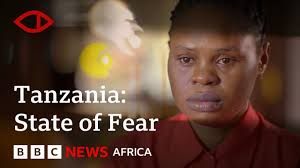
Amidst an apparent wave of enforced disappearances targeting government critics in Tanzania, BBC Africa Eye presents powerful testimonies from survivors of abduction and torture.
State of Fear: Inside Tanzania’s Enforced Disappearances uses vivid reconstructions and first-hand accounts of a sustained campaign of intimidation faced by those who speak out against the government in Tanzania.
Activist Maria Sarungi Tsehai says abductions in Tanzania are not new, and identifying those responsible is extremely hard to prove. She told the BBC World Service: “It’s not only just human rights activists, journalists or opposition, but now we’re seeing many other people being abducted out of nowhere, just because somehow, they ended up on the wrong side of the government. It’s rapid, it’s brutal, it’s really well-organised, it’s cold-blooded completely.”
On 18 May 2025, a group of prominent East African human rights activists travelled to Tanzania to attend the trial of opposition figure Tundu Lissu. Several members of the group were deported by Tanzanian authorities upon arrival at the airport, but Kenyan activist and politician Boniface Mwangi and Ugandan activist Agather Atuhaire were amongst those who were allowed to enter the country.
Not long after arriving, Mwangi and Atuhaire say they were detained. They recount being blindfolded and subjected to a terrifying and violent ordeal, including rape and severe physical and psychological abuse.
While held at a police station in Dar es Salaam, Atuhaire described threats made to her by a senior police officer: “The officer asked three times, ‘Do you have children?’ I said I had two. He then asked, ‘Do you want a third one? If you want a third one, Tanzania is happy to do that.’ In my mind, I had already registered that as a rape threat. So now I started to get scared.”
Mwangi said that during the torture, his body went into shock. He added, “It was so much pain, I had no tears. It was a bloody sad affair. Everything that happened was just ugly.”
Hilda Newton, a member of the country’s main opposition party, also attended Lissu’s trial on the first day of his court proceedings in April 2025. She was arrested and says she was tricked into signing a bail form. “They made me fill that bail form so that, even if I was made to vanish for good, it would indicate that I disappeared on the streets, not in their hands. I prayed to God and told him to help me get out, to go and see my baby.”
Sativa, a Tanzanian human rights activist, says he was abducted after being tricked into attending what he thought was an appointment with his estate agent in June 2024. He described being driven hundreds of kilometres across the country, tortured, and dumped in Katavi National Park near the Congolese border, where he was shot by his captors. He survived after being found by passers-by on a main road.
Survivors in State of Fear: Inside Tanzania’s Enforced Disappearances reflect on the long‑term impact of their abductions and their hopes for what lies ahead.
The Tanzanian government told the BBC it has never involved itself in abductions and has never looked for anyone who is a critic of the government. The Immigration Department denies all allegations of wrongdoing. The Tanzania Police Force did not respond to the allegations made in this report.
Where to watch?
State of Fear: Inside Tanzania’s Enforced Disappearances will be available from Monday, 2 February
- International: The documentary will be available on the following YouTube channels – BBC News Africa (in English), BBC News Swahili, BBC News Afrique & BBC News Hausa.
- UK audiences: Watch on BBC iPlayer
